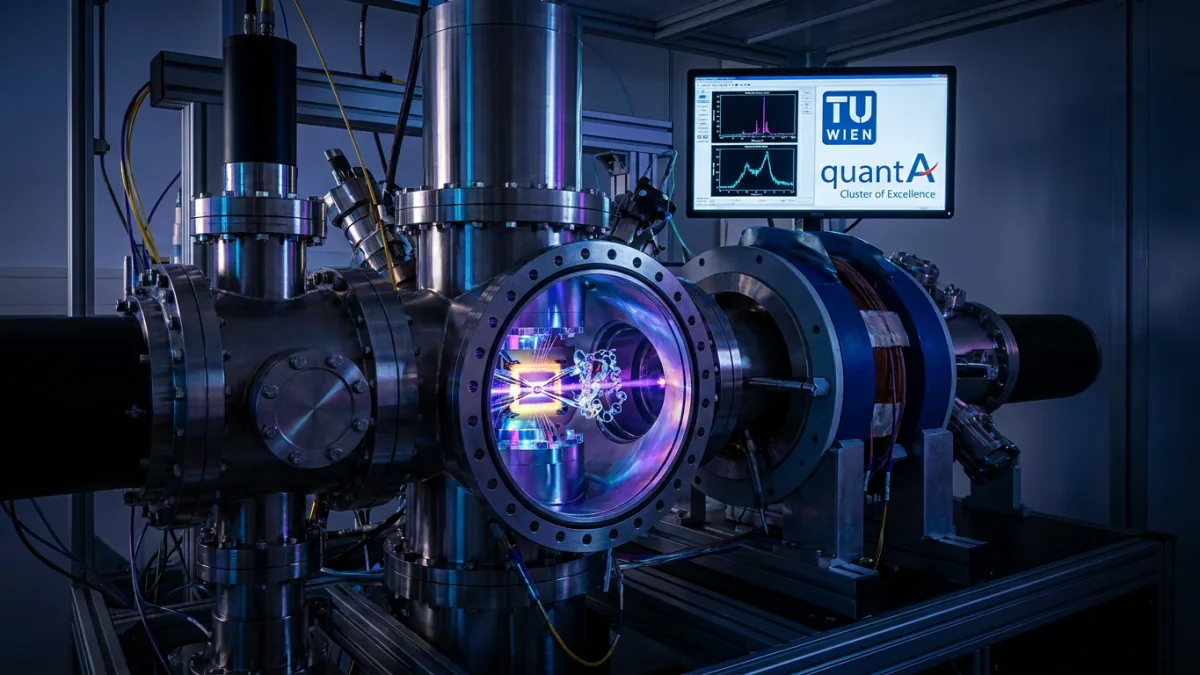
Researchers in Austria have designed a quantum electron microscope that integrates a small quantum computer directly into the imaging beam path. By using trapped ions to capture quantum information from passing electrons, the system allows scientists to image fragile biological samples, such as individual proteins, without destroying them with high electron doses.
For decades, structural biologists have faced a fundamental tradeoff in electron microscopy. Producing a high-resolution image requires sending a massive number of electrons through a specimen, but this intense radiation dose often damages or obliterates the exact delicate structures researchers are trying to observe. The new approach, developed by a consortium of Austrian universities, bypasses this limitation by preserving the quantum information that conventional microscopes discard.
Instead of simply counting electrons as they hit a detector, the proposed system forces the electrons to interact with a built-in quantum computer before they finish their journey. This allows the system to accumulate data across multiple electrons, strengthening the final signal without increasing the physical radiation dose on the sample.
How Trapped Ions Preserve Data
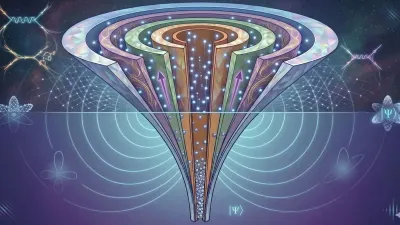
The core innovation relies on placing trapped ions along the path of the electron beam. As an electron travels through the microscope and interacts with the sample, it also interacts with these ions, creating a state of quantum entanglement. The electron and the ion then share a joint quantum state.
Because the ion remains trapped in the microscope, it retains the quantum information associated with that specific electron even after the particle has passed. When the next electron arrives, it interacts with the same quantum computer, allowing information from successive electrons to be mathematically accumulated rather than treated as isolated, noisy measurements.
Quantum physics allows us to overcome the statistical limits that constrain conventional electron microscopes.
- Elias Pescoller, Institute for Theoretical Physics, TU Wien
This accumulation process is critical for imaging biological samples where only a tiny number of electrons can safely be used. "What would previously have been indistinguishable from random noise can thus become a clear signal," Iva Březinová from the Institute for Theoretical Physics at TU Wien explained. By processing this hidden quantum layer, researchers can retrieve structural data that standard electron counting completely misses.
The Experimental Roadmap
While the advantages of this quantum-enhanced imaging have been proven mathematically, the consortium is now moving to build a physical prototype. The project brings together teams from TU Wien, the University of Vienna, JKU Linz, and the University of Innsbruck under the quantA Cluster of Excellence.
At TU Wien's University Service Centre for Transmission Electron Microscopy (USTEM), researchers will integrate an ion-based quantum computer developed at the University of Innsbruck directly into a working electron microscope. The theoretical framework and quantum algorithms driving the system were published in a recent peer-reviewed paper (DOI: 2601.11446), with major funding provided by the Austrian Science Fund (FWF) and the Gordon and Betty Moore Foundation.
The Metrology Shift Nobody Is Talking About
The broader tech industry views quantum computing almost exclusively as a data-crunching tool for cryptography or complex simulations, but this Austrian project signals a massive shift toward quantum metrology. By using a quantum computer as an active, inline physical sensor rather than a passive calculator, researchers are fundamentally changing how we measure the microscopic world.
If this experimental prototype succeeds, it could disrupt the field of structural biology, which currently relies heavily on Cryogenic electron microscopy (Cryo-EM). While Cryo-EM flash-freezes samples to protect them from electron damage, a quantum-enhanced microscope could achieve similar or better resolutions at room temperature or with vastly lower doses. This would accelerate drug discovery by allowing pharmaceutical researchers to observe proteins in their natural, undamaged states, turning quantum entanglement into a practical tool for modern medicine.