Finance teams spending hours rebuilding the same financial models and copying data into spreadsheets just got a major reprieve. Microsoft has rolled out a significant update to Copilot in Excel, introducing reusable workflows, live data connectors, and strict traceability features designed specifically for financial analysis.
The update directly targets the repetitive nature of corporate finance work. By allowing users to save custom instructions and pull real-time market data directly into their workbooks, Microsoft is positioning Copilot as a mandatory tool for enterprise accounting and investment teams.
Today we're bringing skills to Copilot for Excel, giving teams a new way to scale their expertise across every workbook.
- Satya Nadella, Microsoft
Automating Workflows with Copilot Skills
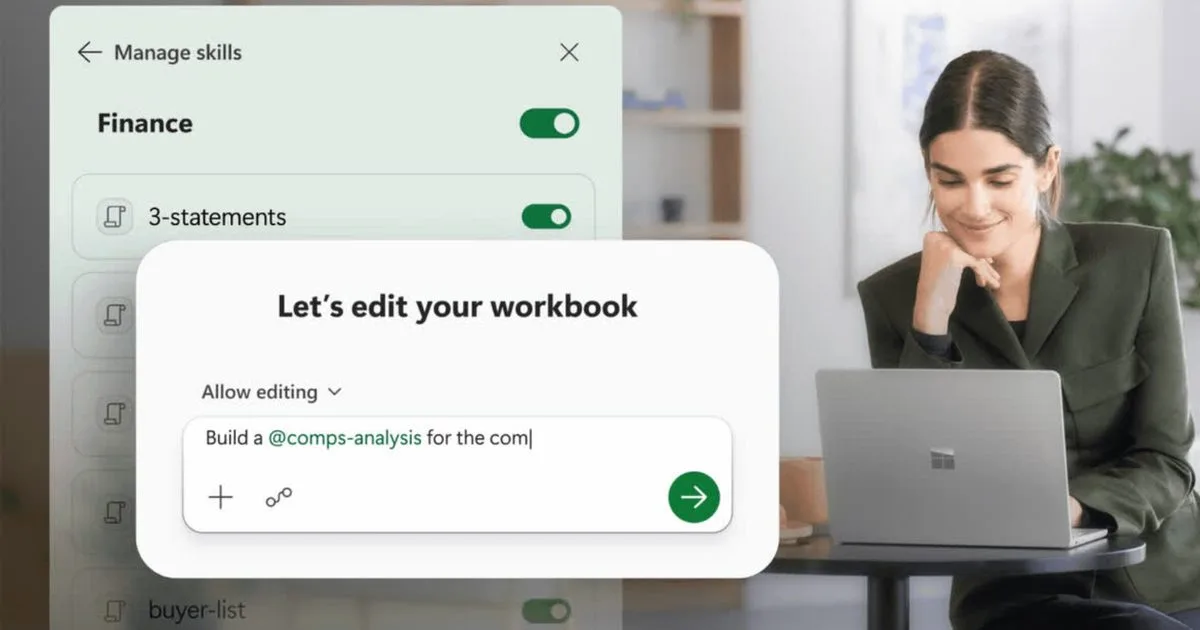
The standout addition to Copilot in Excel is a feature called Skills, which eliminates the need to type out lengthy, detailed AI prompts for routine tasks. Users can now instruct the AI exactly how to handle repeatable processes, such as building a Discounted Cash Flow (DCF) model, closing the books, or generating a variance analysis.
To automate these workflows, users simply save a configuration file named SKILL.md in their OneDrive. From that point forward, Copilot will automatically follow the exact steps, formatting rules, and structural preferences outlined in that file. Teams can utilize Microsoft's prebuilt finance skills or engineer their own from scratch.
This ecosystem is set to expand rapidly later this year. Microsoft confirmed that enterprise partners, including LSEG, Ramp, Rogo, and Vena, will begin selling their own proprietary skills directly through the Microsoft Marketplace.
Live Data Connectors for Real-Time Analysis
To reduce the friction of copy-pasting numbers from external reports, Copilot can now pull live financial data directly into a workbook. Microsoft has integrated several high-profile data connectors into the platform, though some will require their own separate subscriptions to access.
The newly supported data providers include:
- CB Insights
- Daloopa
- FactSet
- Morningstar
- PitchBook
- S&P Global
- LSEG (added in May)
- Moody's (added in May)
Strict Traceability and Plan Mode
Because AI hallucinations are a critical risk in financial modeling, Microsoft has introduced a Plan with Copilot mode. This feature explicitly maps out exactly which ranges, formulas, and assumptions the AI intends to modify before any actual changes are executed.
Once edits are approved, they remain fully traceable. The Show Changes pane now clearly tags and differentiates modifications made by Copilot from those made by a human teammate. These updates build upon Excel's existing Agent Mode and follow Microsoft's recent acquisition of the finance AI startup Fintool.
The new features are currently live for Microsoft 365 Copilot customers using Excel on the Web, Windows, and Mac. The custom Skills functionality will continue rolling out to all eligible users over the next month.
The Enterprise App Store Inside Your Spreadsheet
The introduction of monetized Skills and premium data connectors signals a massive strategic shift for Microsoft. By allowing third-party companies like PitchBook and Vena to sell their workflows directly inside the Microsoft Marketplace, the company is effectively turning Excel into an enterprise app store. This isn't just about saving time on variance analysis; it is about locking finance teams so deeply into the Microsoft 365 ecosystem that churning to a competitor becomes impossible.
Furthermore, the combination of live data feeds and the Fintool acquisition suggests Microsoft is quietly positioning Copilot in Excel as a lightweight alternative to the Bloomberg Terminal. If an analyst can pull live S&P Global data, apply a proprietary LSEG analysis skill, and generate a fully formatted DCF model without ever leaving their spreadsheet, the traditional boundaries between data providers and software platforms will completely collapse.