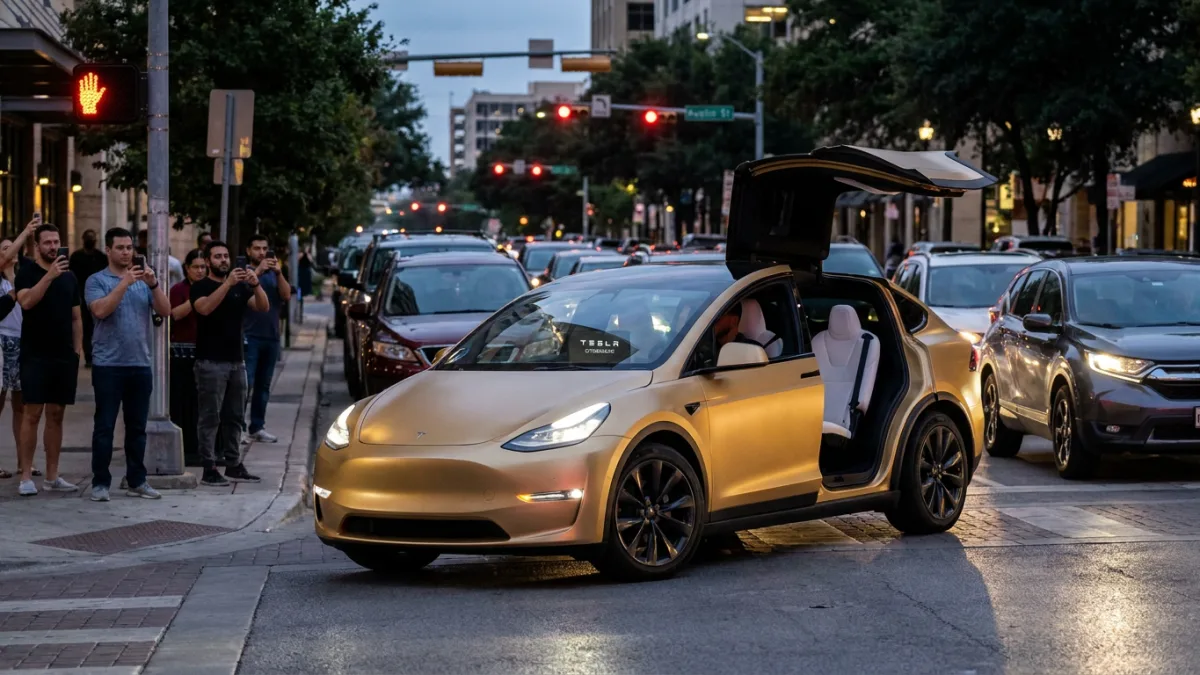
Sitting in the driver's seat of the gold-painted Tesla Cybercab as it navigates a chaotic Austin parking lot is an exercise in surrender. There is no steering wheel, no dashboard, no gas pedal, and no brake. When a frustrated human driver in the car ahead pounds her steering wheel and leans on the horn, there is no way to communicate that the person in the driver's seat has absolutely zero control over the vehicle.
Suddenly, the car jerks into reverse. Lacking a rear window - replaced instead by a solid black panel - and missing side mirrors, the vehicle relies entirely on its internal systems to back up safely. It swings halfway into a parking space to let the traffic clear, repeating the maneuver flawlessly a few yards later. It is a complex, tight situation that other autonomous vehicles might have failed to navigate, yet the Cybercab handles it with surprising precision.
The $30,000 Golden Robotaxi
The shimmering gold robotaxi, which strongly evokes the aesthetic of the Need for Speed video games, is Elon Musk's weapon to take on market leaders Uber and Lyft. When it eventually goes on sale, the vehicle is targeted to cost just $30,000. Tesla aims to achieve operating costs of $0.20 to $0.40 per mile, undercutting competitors like Alphabet's Waymo and Amazon's Zoox by a wide margin.
Visually, the model is sleeker than the oversized Cybertruck, though its wheels are completely covered by clunky gold panels. It earns design points for its doors, which swing automatically upward as a passenger approaches - a maneuver typically reserved for Italian luxury brands like Ferrari or Lamborghini. Inside, the cabin is minimalist, featuring matte beige and black finishes alongside a massive screen where passengers can log into Spotify, YouTube, or Netflix.
Unlike its competitors, the Cybercab operates without the bulky exterior cameras that adorn other robotaxis. This month, these steering-wheel-free vehicles finally became available to book in downtown Austin, turning heads and prompting pedestrians to pull out their phones to film the extravagant design.
Assertive Navigation vs. Crippling Wait Times
On city streets, the Tesla Cybercab scores high marks for its driving style. The car navigates rush-hour traffic assertively and briskly. At one point during the test ride, it merged back into the right lane just ahead of a construction site, cutting in front of another car - a logical move that prevented the unnecessary slowdowns an overly cautious human driver might have caused.
However, the current booking experience is severely user-unfriendly. While the fare is comparable to an Uber, the service is highly unreliable. An initial wait time of 40 to 50 minutes stretched into an hour and a half, still showing 30 to 40 minutes remaining, before suddenly dropping to a 12-minute arrival time. By contrast, a ride in a Tesla Model Y robotaxi - which still has a steering wheel and pedals - is available in cities like Austin or Dallas with wait times of just a few minutes.
Drop-offs also lack precision. Because the Cybercab cannot park just anywhere, the ride ended a three-minute walk away from the actual destination. For passengers with heavy luggage or limited mobility, this inability to reach an exact address is a significant drawback.
The Highway Limitation and Safety Concerns
If Tesla intends to truly compete with Uber and Lyft, it must fix its biggest weakness: the self-driving cars do not venture onto highways. In cities like Dallas, which rely heavily on highway infrastructure, this limitation is crippling. A route that Google Maps estimates at 12 minutes took a whopping 34 minutes in a Model Y robotaxi simply because the system actively avoided the highway.
Currently, the robotaxi network is strictly limited to downtown cores, making routine trips like airport runs impossible. Furthermore, the lack of manual controls has raised safety questions. Matthew McElearney, an Austin fire captain, has called for higher standards, questioning how emergency responders are supposed to move the vehicle if the central screen shatters in a fire or the electronics fail entirely.
The broader impact on the labor market remains a distant concern. According to the U.S. Department of Labor, there are roughly 450,000 taxi, shuttle, and chauffeur drivers, alongside an estimated 1.7 million Uber and Lyft drivers. With Waymo operating roughly 4,000 fully driverless robotaxis, autonomous vehicles currently hold less than a 0.2 percent market share.
The Highway Hurdle Tesla Must Clear
Tesla's market value currently stands at roughly $1.1 trillion, driven largely by the promise of autonomous driving. Wall Street analyst Dan Ives of Wedbush Securities predicts the company could capture around 80 percent of the robotaxi business. However, rival Waymo already has a substantial head start, projecting 14 million rides in 2025 alone.
While the Cybercab navigates 30 mph city traffic safely using vast amounts of collected data, its true trial by fire will be performing at highway speeds above 70 mph on multi-lane roads. Until it can seamlessly transition from downtown streets to high-speed interstates, it remains a localized novelty rather than a universal transport solution.
For now, human drivers remain essential. Sylvain, a driver who immigrated from the Central African Republic nearly 20 years ago, provided the ride back to the hotel after the Cybercab's long wait times proved impractical. Noting the influx of robotaxis on Austin's streets, he admitted the technology is both fascinating and unsettling. "Who knows what will happen in the future," Sylvain said, stepping on the gas.