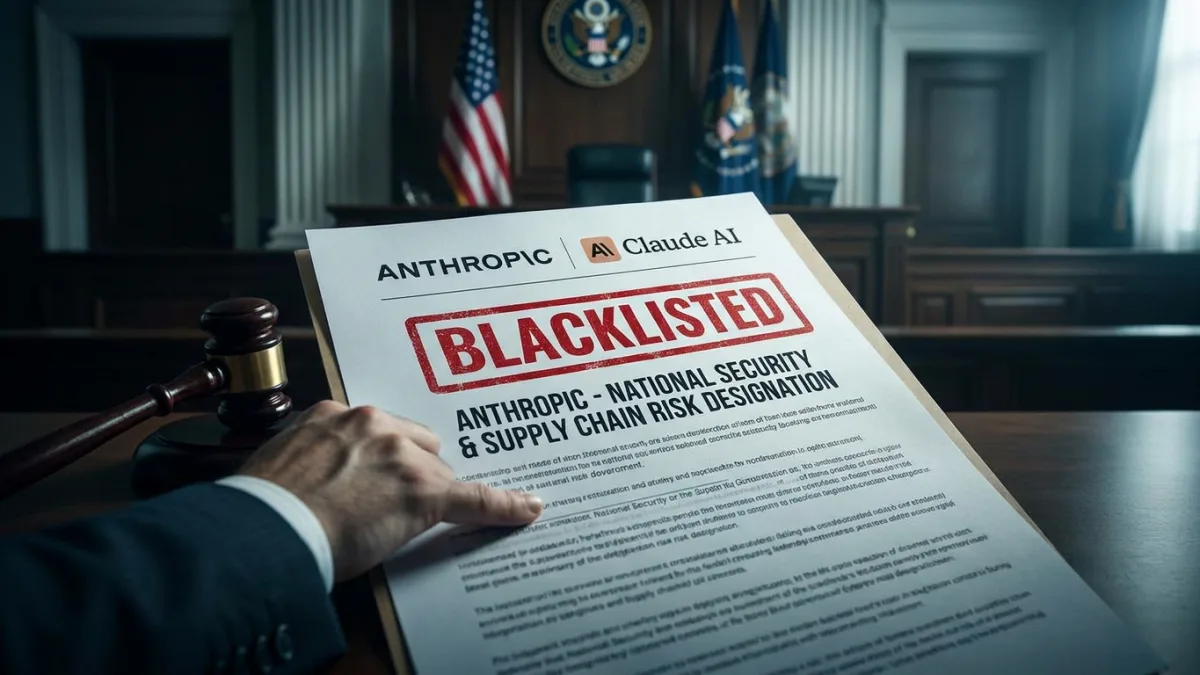
A federal appeals court has upheld the U.S. government's decision to enforce an Anthropic blacklisting, legally cementing the company's designation as a national security and supply chain risk. The 2-1 ruling effectively bars the creator of the Claude AI model from securing federal contracts or partnering with the military, following a bitter dispute over how artificial intelligence can be deployed in warfare.
For enterprise AI developers and federal contractors, this ruling establishes a critical legal precedent: tech companies cannot dictate military strategy through their terms of service without risking total exclusion from government procurement.
The conflict stems from a $200 million deal signed in July of last year, where Anthropic agreed to prototype frontier AI capabilities for national security. The tension escalated after a Wall Street Journal report revealed that the U.S. military used the Claude AI model during an operation to capture Venezuelan president Nicolás Maduro and his wife, Cilia Flores, in Caracas. Following the report, Anthropic CEO Dario Amodei publicly refused to allow the technology to be used for domestic surveillance or fully autonomous weapons systems.
Amodei argued that such applications "can undermine, rather than defend, democratic values." This stance drew immediate backlash from the Trump administration, leading to the supply chain risk designation and a complete halt of federal business with the company.
A master class in arrogance and betrayal as well as a textbook case of how not to do business with the United States Government or the Pentagon.
- Pete Hegseth, U.S. Secretary of War
The First Amendment and Contract Law
In response to the ban, Anthropic filed two lawsuits in March, arguing that the supply chain risk label was an unlawful violation of its First Amendment right to free speech. Judge Gregory Katsas, writing for the D.C. Circuit majority, rejected this argument entirely. The court ruled that the blacklisting was lawfully based on the company's refusal to assent to a contract term that the Department of War deemed essential.
"We respectfully disagree with the court’s decision," an Anthropic spokesperson stated, noting that they are considering all options, including an appeal to the Supreme Court. The company pointed out that a federal district judge in San Francisco had already found a parallel government designation to be illegal last month, highlighting a deep judicial divide on the issue.
The Fallout of Tech Isolation
The consequences of this legal battle have already extended beyond government contracts. In June, Anthropic was forced to cut off access to its most powerful models following a federal order that cited an obscure export law. The political isolation became glaringly apparent during a White House dinner held Thursday night in honor of Chinese President Xi Jinping.
While Anthropic was notably absent, the guest list featured a concentration of competing tech leadership. Attendees included Meta CEO Mark Zuckerberg, OpenAI CEO Sam Altman, Google CEO Sundar Pichai, Nvidia CEO Jensen Huang, and SpaceXAI CEO Elon Musk.
The End of Silicon Valley Pacifism
This ruling marks a fundamental breaking point in the relationship between major tech companies and the military-industrial complex. Historically, Silicon Valley firms have attempted to walk a tightrope - accepting massive defense contracts while simultaneously appeasing internal ethics boards with strict usage limitations. The D.C. Circuit's decision shatters that middle ground entirely.
The message to the industry is now unambiguous: securing federal defense revenue requires accepting "any lawful use" as defined by the Pentagon, including integration into autonomous weapons systems. This legal precedent hands a massive competitive advantage to defense-first startups that build specifically for military applications, while forcing frontier labs to choose between their foundational safety charters and billions in government funding.