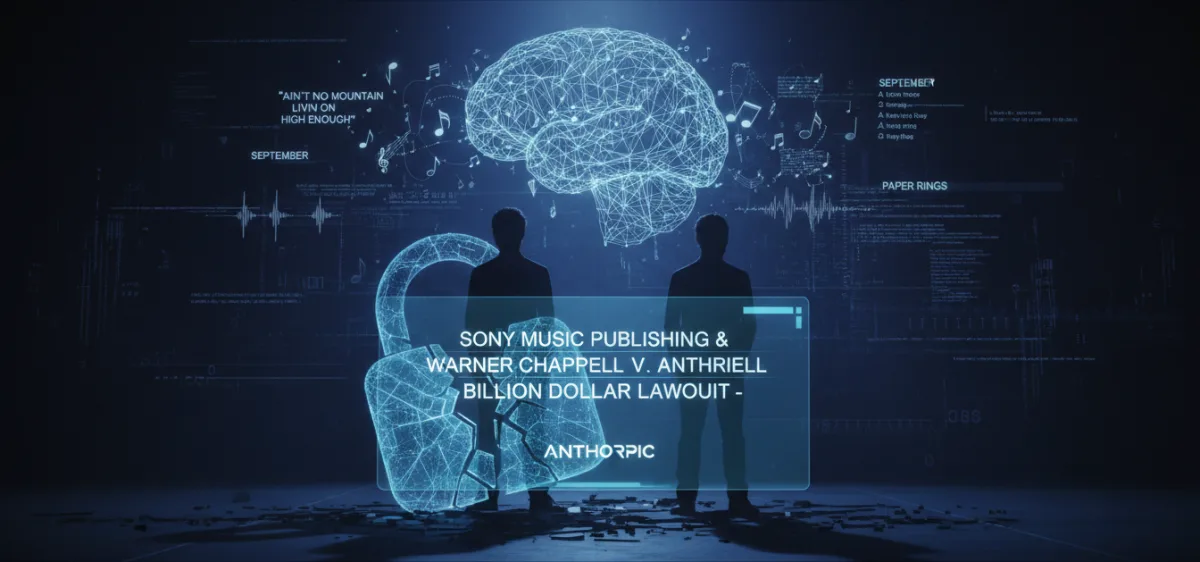
Anthropic is facing a fresh copyright lawsuit that could cost it several billion dollars - and this time the company's own founders are in the dock. Sony Music Publishing and Warner Chappell filed the complaint in the US District Court for the Northern District of California, seeking damages over what they describe as the mass theft of copyrighted songs used to train the Claude AI models.
The stakes are enormous for anyone tracking the AI industry's legal reckoning - developers, investors, and music rights holders alike - because the outcome will shape how AI companies license training data and how much they pay for it. The publishers are demanding up to $150,000 per infringed work across "tens of thousands" of songs, plus up to $25,000 for each instance where identifiable copyright data was stripped. If a court sides with Sony and Warner and awards the maximum on every count, the total climbs into the billions.
Plaintiff Music Publishers, a group of the world's leading music publishers, bring this action to hold accountable the culprits behind one of the largest and most blatant ongoing thefts of intellectual property in history.
- Lawsuit filing, Sony Music Publishing and Warner Chappell v. Anthropic
The complaint doesn't stop at the corporate entity. It names co-founders Dario Amodei and Benjamin Mann as individual defendants, accusing them of conducting "a brazen campaign of illegally torrenting, scraping, and downloading copyrighted works on a massive scale" to develop, operate, and profit from the Claude models.
The allegations against Mann are unusually blunt. The filing claims he used BitTorrent to download more than five million pirated books, and that Anthropic employees downloaded at least two million more from Pirate Library Mirror.
On the music side, the publishers say Anthropic scraped lyrics from sites like MusixMatch and LyricFind - platforms that paid to license that content from the labels. In effect, Anthropic allegedly took for free what other companies were paying for.
The complaint also gets specific about what supposedly ended up in Claude's training data, naming songs that span more than five decades of pop history:
- "Ain't No Mountain High Enough" - Marvin Gaye and Tammi Terrell
- "Livin' On a Prayer" - Bon Jovi
- "September" - Earth, Wind & Fire
- "Hallelujah" - Leonard Cohen
- "Paper Rings" - Taylor Swift
Anthropic did not immediately respond to a request for comment. One clarification worth noting: the suit was filed by Sony Music Publishing - the publishing arm - specifically, not Sony Music Entertainment.
The Copyright Lawsuit Pile-On Anthropic Can't Shake
This is hardly an isolated case. Anthropic recently settled a suit brought by the publishing industry for $1.5 billion, and it has faced multiple lawsuits from Universal Music Group, Concord, and ABKCO, plus separate suits from BMG and Round Hill Music.
That $1.5 billion settlement matters far beyond its headline number. It proved that litigation over AI training data ends in ten-figure payouts, which effectively invites every rights holder with a valuable catalog to line up behind it.
Naming the Founders Is the Real Pressure Play
The damages math is deliberately aggressive. The figures - $150,000 per work and $25,000 per stripped copyright notice - track the statutory maximums under US copyright law, the tier reserved for willful infringement. The publishers aren't just asking for money; they're framing Anthropic's conduct as intentional, which undercuts any "we didn't know better" defense before it's even raised.
Naming Amodei and Mann individually is the sharper tactical move. Companies can absorb settlements with investor cash, but founders staring at personal liability have a far stronger incentive to settle quickly and quietly - and the BitTorrent allegation against Mann hands the publishers leverage that a corporate-only complaint never could.
The most likely endgame isn't a courtroom verdict; it's a licensing deal. Music publishers watched the publishing industry walk away with $1.5 billion, and this suit reads like an opening bid for a similar arrangement - one where catalog access becomes a paid input for AI training instead of a free-for-all. For developers and AI startups, the message is blunt: training-data provenance is now a due-diligence item, not an afterthought.
This article was written by AI from reporting by theverge.com.