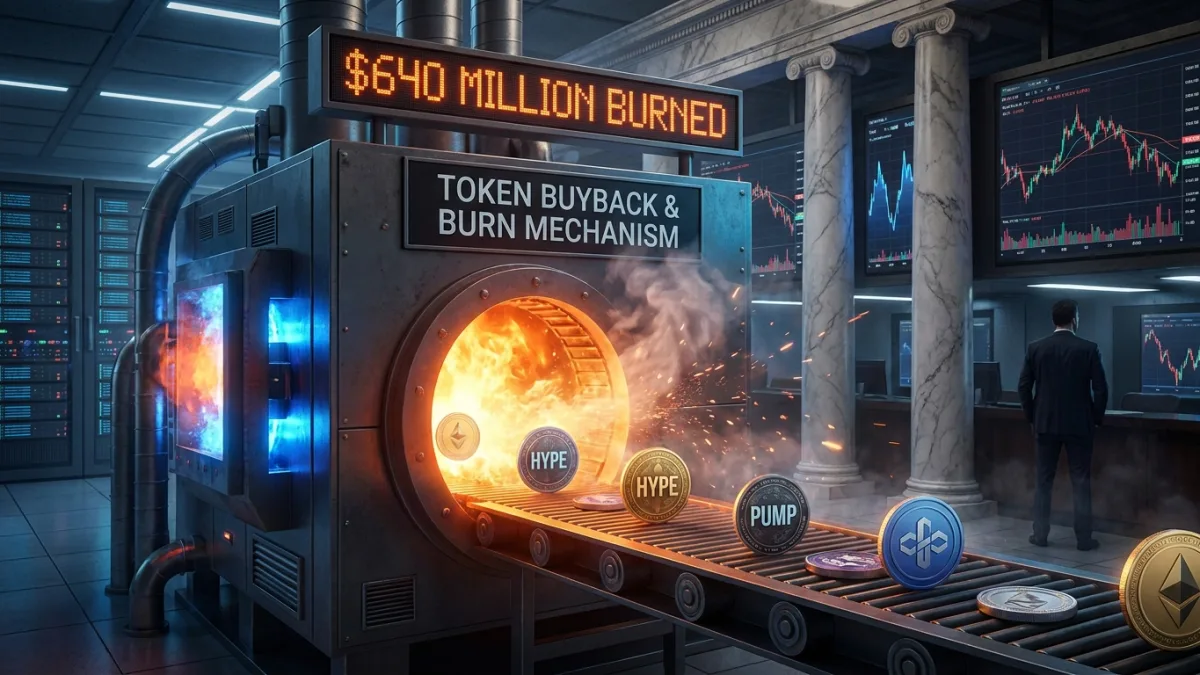
Crypto projects are aggressively adopting Wall Street tactics, pouring $640 million into token buybacks in 2026 alone. While this strategy aims to artificially reduce supply and boost prices, investors are left wondering if these massive expenditures actually build sustainable ecosystems or just mask underlying flaws.
The practice has exploded compared to the mere $366,000 spent in 2024, representing a 17% year-over-year increase from 2025. Two major players, Hyperliquid and Pump.fun, currently account for almost 90% of this massive capital outflow. By using protocol revenue to purchase their own tokens, these projects are attempting to create a direct link between platform usage and token value.
Not all buyback strategies are identical across the industry. Hyperliquid commits a staggering 99% of its revenue to buy back and burn its HYPE token. Meanwhile, Pump.fun allocates 50% of its revenue to the same practice, having already removed $446.65 million worth of PUMP from circulation.
"Buybacks and burns remain an effective way to accrue value to tokenholders," Max Shannon, senior research associate at Bitwise Europe, explained. He noted that they create a continuous bid in the open market, directly tethering token success to platform adoption.
Conversely, decentralized finance infrastructure protocol Spark takes a retention approach rather than destroying its assets. The project has acquired over 143 million SPK through open-market buybacks funded by protocol surplus. Instead of burning them, Spark holds these tokens in its treasury to reward long-term ecosystem participants.
Tokenholders should participate in the long-term economic success of the protocol, rather than simply receive a distribution every time it generates revenue.
- Sam MacPherson, Co-founder and CEO, Spark
Despite the massive capital injection, buybacks do not guarantee price appreciation. Pump.fun has been aggressively buying and burning PUMP since July 2025, yet the token remains hovering 50% below its September 2025 all-time high. Similarly, UNI has surrendered about half of the gains it achieved following Uniswap's UNIfication proposal in November 2025.
As these mechanisms increasingly resemble traditional dividend and stock buyback programs, regulatory scrutiny is intensifying. The draft Digital Asset Market Clarity (CLARITY) Act of 2025 highlights the ongoing debate over whether these tokens should be classified as commodities or securities.
Orest Gavryliak, chief legal officer at 1inch, warned that if a token's value relies heavily on the team providing returns to holders, it risks being classified as a security. "In the end, don’t put the clothes of a stock on the token and expect it to be a commodity," Gavryliak said.
The Illusion of Financial Engineering
The current obsession with token buybacks feels like a dangerous misallocation of capital for early-stage protocols. When a startup like Hyperliquid burns 99% of its revenue, it starves its own research and development pipeline in favor of short-term price manipulation. This mirrors the worst habits of legacy corporate finance, where executives prioritize stock pumps over long-term innovation.
Furthermore, the glaring disconnect between Pump.fun's $446.65 million burn and its stagnant token price proves that artificial scarcity cannot replace genuine utility. If a protocol relies entirely on buybacks to maintain its market cap, it is fundamentally fragile. Investors should view aggressive burn rates not as a sign of strength, but as a potential red flag that the project has run out of ideas for organic growth.
This article was written by AI from reporting by cointelegraph.com.