For years, ChatGPT's ability to retain personal details across conversations has been a frustrating mix of forgotten context and stubbornly outdated facts. Now, OpenAI is rolling out a massive overhaul to its AI memory system, dubbed "dreaming," designed to automatically synthesize and update your personal information in the background without requiring explicit prompts. This marks the most significant architectural change to the chatbot's memory capabilities since the feature originally launched in 2024.
Previously, the AI explains that it relied heavily on "strong cues" to save information, meaning users had to explicitly command the bot to remember specific details. This manual approach allowed crucial context to slip through the cracks and left temporary preferences permanently etched into the system. The new dreaming system rectifies this by working silently in the background, analyzing your chat history to build a cohesive, evolving profile.
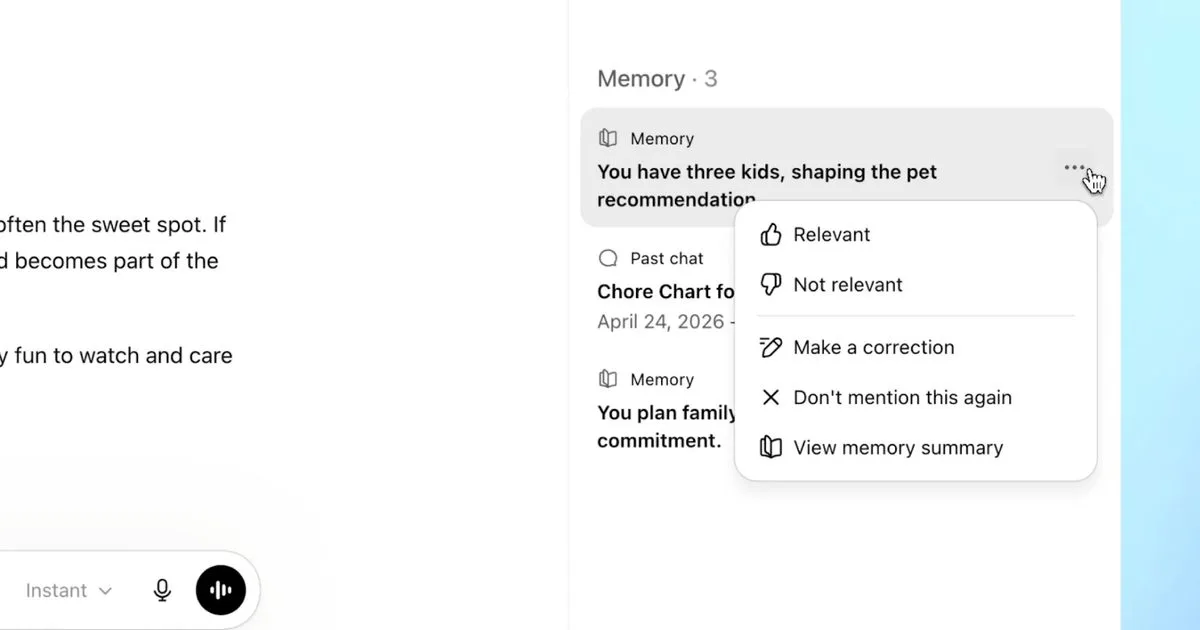
Crucially, the updated system now understands the passage of time. If you mentioned traveling to Singapore last month, the AI will dynamically update its context to recognize that the trip has concluded, rather than assuming you are still there. To ensure users maintain agency over this automated profiling, OpenAI has introduced a dedicated Memory Summary page where users can review, correct, or manually add details to their profile.
With the new memory system, you can review and steer what ChatGPT remembers through a memory summary, with more visibility and control over how context is used.
- OpenAI
How the Rollout Impacts Free and Pro Tiers
The dreaming update is currently rolling out to ChatGPT Plus and Pro users in the US, with availability expanding to additional countries in the coming weeks. Notably, the feature will also be deployed to the Free and Go tiers shortly after. This broad release strategy is powered by recent backend efficiency improvements; OpenAI states they have reduced the compute required to serve the memory feature by roughly 5x.
These efficiency gains have also allowed the company to double the total memory capacity for Plus and Pro subscribers. This expansion directly addresses long-standing user frustrations. The community has frequently voiced complaints about inconsistent recall and reported bugs where new memories not saving disrupted their workflow.
The Ultimate Ecosystem Lock-In Strategy
While the "dreaming" system is framed as a quality-of-life improvement, it represents a profound strategic moat for OpenAI. By shifting from manual memory triggers to passive, background synthesis, ChatGPT is transitioning from a stateless tool into a deeply personalized digital twin. The 5x reduction in compute costs isn't just a technical win; it is the economic key that allows OpenAI to offer this hyper-personalization to free-tier users.
This creates a massive switching cost for consumers. If a user spends six months passively training ChatGPT on their dietary restrictions, coding preferences, and family dynamics, the friction of moving to a competitor like Google's Gemini or Anthropic's Claude becomes incredibly high. However, this convenience comes with a steep privacy tax. A system that constantly "dreams" about your data requires users to be far more vigilant about the casual information they drop into chat windows, making the new Memory Summary page less of a neat feature and more of a mandatory privacy dashboard.
This article was written by AI from reporting by digitaltrends.com.