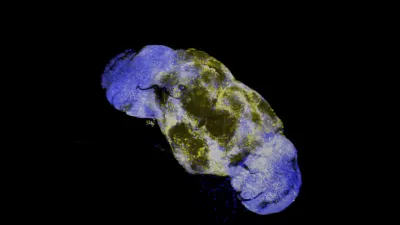
Brain scans of individuals under the influence of psilocybin reveal a distinct neurological signature where the boundary between the self and the external world physically dissolves. A new study published in Nature demonstrates that the psychedelic compound, found in magic mushrooms, fundamentally reorganizes how the brain processes internal thoughts and external surroundings. For patients and researchers exploring psychedelic-assisted therapy, this provides concrete biological evidence of why the experience often feels profoundly meaningful and deeply connected to the immediate environment.
The research team examined 62 healthy adults with no prior psychedelic experience. Each participant received a moderate dose of 19 milligrams of psilocybin, mirroring the amounts typically used in clinical trials. Researchers recorded electrical brain activity using magnetic resonance imaging (MRI) and electroencephalograph (EEG) scans twice - once as a baseline and once under the influence of the compound. During both sessions, participants rested, meditated, listened to ambient music, and watched a silent video of moving clouds.
Melding with the MRI machine, floor, walls and air... losing all sense of self.
- Study Participant, Nature Research
The findings have been released openly as the PsiConnect dataset, which now stands as the world’s largest single-site psychedelic brain-imaging database. Under ordinary consciousness, closing our eyes drastically reduces external visual input. However, co-author Leonardo Novelli’s analysis revealed that psilocybin severely disrupts this standard neurological separation.
The scans highlighted several dramatic shifts in brain activity:
- The gap between eyes-open and eyes-closed activity shrank by a massive 85% in the visual network.
- This same gap decreased by more than 66% across all combined brain networks.
- In the EEG recordings, the difference in major brain rhythms between open and closed-eye states dropped by 48%.
Regions of the brain responsible for integrating information and maintaining the "sense of self" became highly connected with the rest of the brain, while standard sensory regions became less connected. Because traditional studies often average brain activity over time - which can hide moment-to-moment changes - co-author Moein Khajehnejad applied a machine learning (Machine Learning) method to map these complex fluctuations dynamically.
This dynamic mapping revealed a state researchers call "embeddedness." When participants reported feeling a positive, continuous connection with their surroundings and the music, this specific neurological signature was at its strongest. Conversely, it was absent in participants who reported confusion or anxiety. Notably, participants rated listening to music as substantially more emotionally resonant under psilocybin, and the embeddedness signature was strongly linked to reports of positive psychological changes the following day.
The Biological Proof for "Set and Setting"
For decades, psychedelic advocates and underground therapists have preached the absolute necessity of "set and setting" - the idea that a patient's mindset and their physical environment dictate the outcome of a psychedelic experience. This study finally provides the hard biological data to back up that philosophy. By proving that psilocybin physically lowers the neurological barrier between internal processing and external stimuli, the research shows that the environment is not just a backdrop; it becomes an active ingredient in the therapy.
This fundamentally shifts how clinical treatments must be designed. If a patient's brain is actively fusing with its surroundings, the clinical room's lighting, the specific ambient music played, and the demeanor of the guiding therapist are just as critical to the medical outcome as the 19-milligram dose itself. Moving forward, this "embeddedness" signature could serve as a measurable biomarker, allowing clinicians to predict which patients will benefit most from treatment and precisely tailor the therapeutic environment to guarantee a positive psychological reset.
This article was written by AI from reporting by theconversation.com.