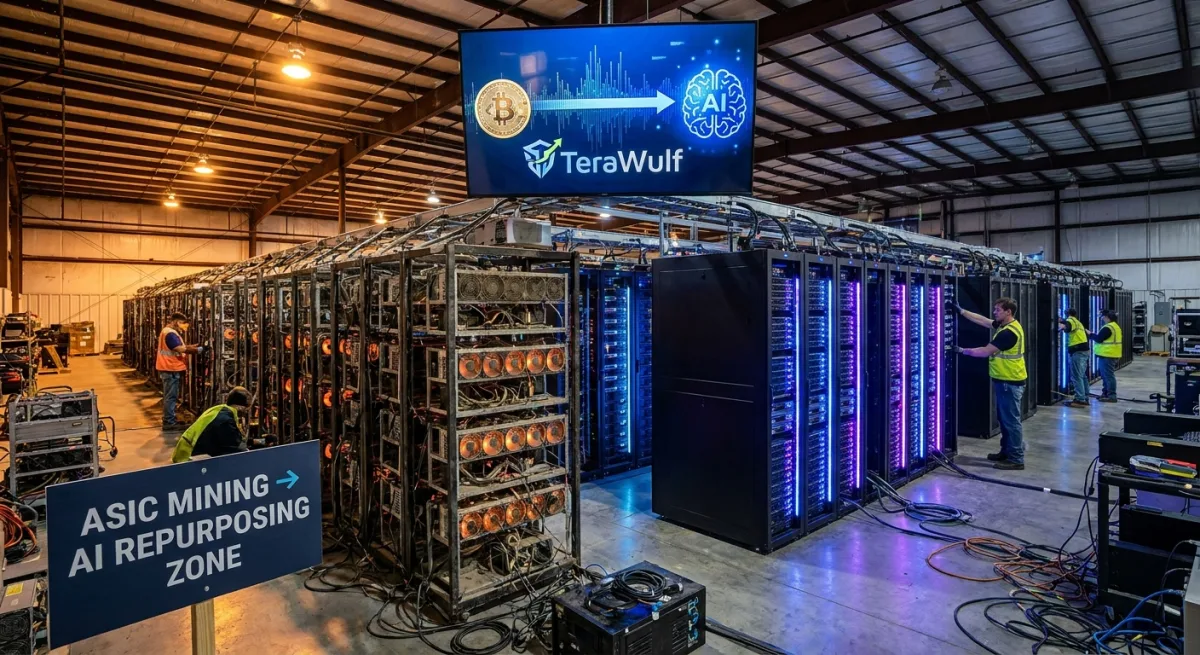
For years, Bitcoin mining operations functioned primarily as leveraged bets on cryptocurrency prices, but tightening margins are forcing a massive industry shift. As demand for artificial intelligence computing accelerates, major mining firms are discovering that their access to massive power grids and data center infrastructure is becoming more lucrative than generating hash rate. This Bitcoin miners AI pivot is rapidly transforming the digital asset landscape.
This transition gained significant validation as Nvidia reportedly prepares a $20 billion bond sale to finance its next phase of AI expansion. The chipmaker's multi-part bond offering, aimed at funding AI-related investments and refinancing debt, highlights a sustained multi-year investment cycle. Facing pressure from recent mining economics, companies like HIVE Digital, Hut 8, CleanSpark, and TeraWulf are actively repurposing their energy-intensive facilities to position themselves as high-performance computing and AI hosting providers.
Tokenized RWAs Surpass $43 Billion
While the broader cryptocurrency market faces a downturn, the tokenized real-world asset (RWA) sector continues to expand rapidly. The total value of on-chain financial assets has surpassed $43 billion, marking a 37% increase over the past six months. According to data from Token Terminal, tokenized funds dominate this space, accounting for nearly 80% of all on-chain financial assets, with commodities and tokenized stocks also gaining traction.
Major financial institutions are projecting massive long-term growth for this sector. Standard Chartered estimates that tokenization could drive decentralized finance to a $2.7 trillion market capitalization by 2030. Meanwhile, Citigroup forecasts that tokenized RWAs could reach $5.5 trillion in the same timeframe, signaling a permanent shift in how traditional assets are managed.
Ripple’s $3.3 Billion Flutterwave Move
In the payments sector, Ripple has invested an undisclosed amount in Flutterwave, one of Africa’s fastest-growing remittance companies. This strategic deal values the fintech startup at $3.3 billion and integrates Ripple’s RLUSD stablecoin, the Ripple Payments platform, and XRP Ledger infrastructure into a network operating across 35 countries. The partnership was officially highlighted by Flutterwave as a major milestone for cross-border transactions.
This investment accelerates Ripple’s push to dominate the African payments network, where demand for faster, low-cost cross-border transfers is surging. It follows the company's October partnership with South Africa’s Absa Bank to provide institutional digital asset custody solutions, further cementing its footprint on the continent.
SBF Loses Appeal Amid Fraud Conviction
On the legal front, former FTX CEO Sam Bankman-Fried has failed to overturn his fraud conviction. A three-judge appeals panel in Manhattan upheld the verdict, confirming he received a fair trial. Bankman-Fried, who was sentenced to 25 years in prison in 2024 for fraud and conspiracy tied to the collapse of FTX, has now formally applied for a presidential pardon from US President Donald Trump.
While he was publicly reassuring customers, investors and regulators that FTX customer funds were safe, he was simultaneously using FTX as his own personal piggy bank, spending customer funds on real estate, political contributions, and investments.
- Circuit Judge Barrington Parker
The Infrastructure Arbitrage Play
The pivot of Bitcoin miners toward AI hosting is not just a temporary survival tactic; it represents a fundamental repricing of digital infrastructure. Mining companies are realizing that their most valuable assets are not their ASIC rigs, but their secured energy contracts and industrial-scale cooling systems. As Nvidia injects another $20 billion into the AI hardware ecosystem, the bottleneck for AI development is shifting from chip availability to raw power generation.
Miners who successfully transition a portion of their capacity to high-performance computing will likely see their valuations decouple from Bitcoin's price volatility, transforming them into diversified utility providers for the AI economy. Meanwhile, Ripple's integration into Flutterwave proves that while Western markets remain bogged down in regulatory battles, blockchain-based remittances are quietly becoming the standard financial plumbing in emerging markets.