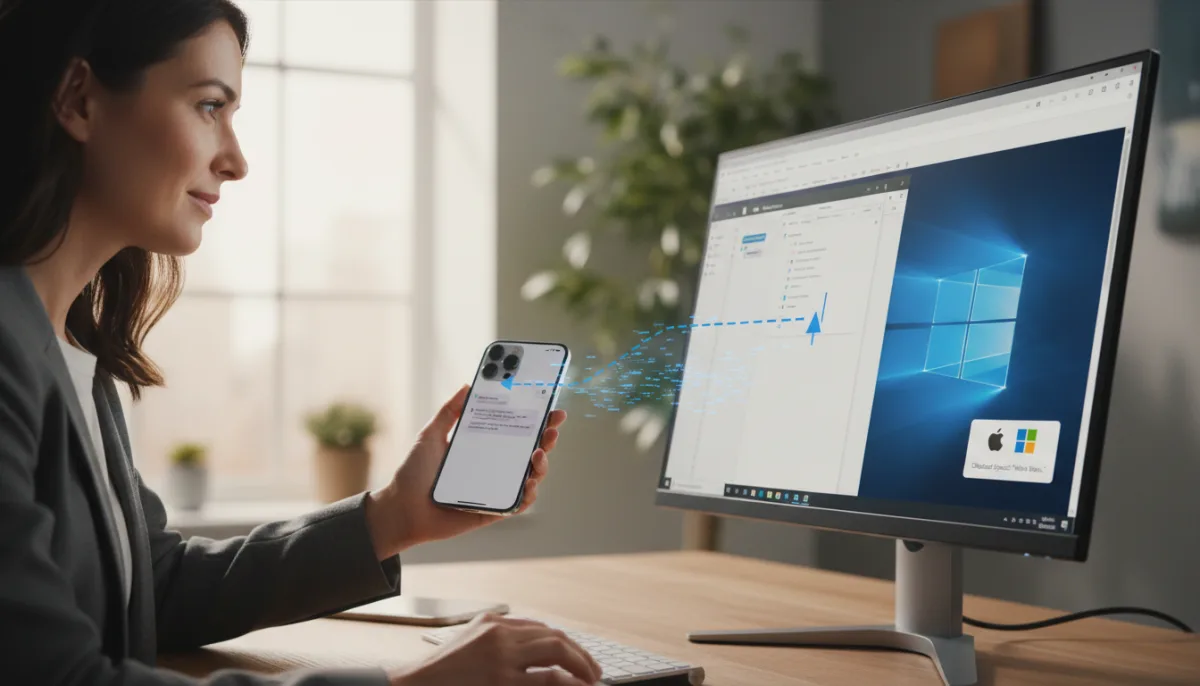
Apple is officially developing an iPhone to Windows copy and paste feature, bridging a long-standing ecosystem gap for PC users. Driven by a formal interoperability request from Microsoft under the European Union’s Digital Markets Act (DMA), the upcoming update will finally allow seamless background clipboard synchronization between iOS and Windows devices. Apple began evaluating the request in March and formally proposed a project plan on June 26.
This development is a massive win for professionals and everyday users who rely on an iPhone alongside a Windows PC. Currently, users are forced to rely on clunky third-party workarounds, messaging apps, or emailing links to themselves just to move text between devices. By integrating this at the system level, Apple is removing one of the most frustrating friction points in cross-platform productivity.
In its request, Microsoft outlined specific requirements to ensure the feature functions as a lightweight, continuous capability rather than a manual, app-driven operation. Microsoft detailed that users must be able to:
- Copy text or other supported content on their iPhone and paste it directly on their Windows PC, and vice versa.
- Perform common productivity workflows without needing to foreground an app or take explicit repeated actions to initiate a transfer.
- Experience clipboard synchronization as a continuous background process, bypassing current iOS restrictions.
Currently, iOS strictly limits clipboard access. An app can only read an iPhone's clipboard if it is actively running in the foreground and the user explicitly grants access for each individual action. While Apple offers a seamless Universal Clipboard feature for its own hardware, Microsoft argued that these restrictions unfairly prevent continuous synchronization to a PC.
To solve this, Apple proposed a framework that allows an iPhone to share and import items from the pasteboard to a paired accessory, such as a Windows PC. The system will utilize a method similar to the Accessory Notifications option introduced for third-party wearables in the EU in iOS 26.5.
To adopt this solution, you will need to adopt AccessorySetupKit in order for the user to consent to the necessary permissions allowing the pasteboard to be shared with your accessory. This solution will require the user to perform a one-time consent to sharing the pasteboard with each paired accessory that will receive this functionality.
- Apple
How the iOS to Windows Clipboard Will Work
Because Apple considers this a significant engineering effort, the implementation will require specific steps from both developers and users to maintain security while enabling background sync.
- Initial Pairing: Users will connect their iPhone to their Windows PC using a compatible app built with Apple's AccessorySetupKit.
- One-Time Consent: The user must grant explicit, one-time permission allowing the PC to access the iPhone's pasteboard data.
- Background Sync: Once authorized, text and supported content copied on either device will sync silently in the background, eliminating the need to open a specific app to trigger the transfer.
Despite the project plan being approved, users will have to wait. Apple expects the engineering work to be completed by fall 2027, with the feature shipping first in a developer beta. A public release is not expected until early 2028. Furthermore, it is highly likely this feature will be geofenced to the European Union, though Apple has previously rolled out some DMA-mandated features, like eSIM transfers, globally.
The End of the Walled Garden's Highest Fence
The fact that Apple is delaying this feature until 2028 is incredibly telling. The Universal Clipboard has long been one of the most powerful "magic" features keeping iPhone users locked into buying MacBooks. By opening this exact functionality to Windows PCs, Apple is losing a critical hardware up-sell advantage. The extended timeline suggests Apple is dragging its feet to maximize Mac sales for as long as legally possible under the DMA.
For Microsoft, this is a strategic masterstroke. As the company pushes its Copilot AI and deeper mobile integration into Windows, removing the clipboard barrier makes the PC a much more attractive daily driver for the hundreds of millions of iPhone users. If Apple ultimately restricts this to the EU, it will create a bizarre fractured ecosystem where European users enjoy seamless cross-platform productivity, while the rest of the world remains trapped behind an artificial software wall.