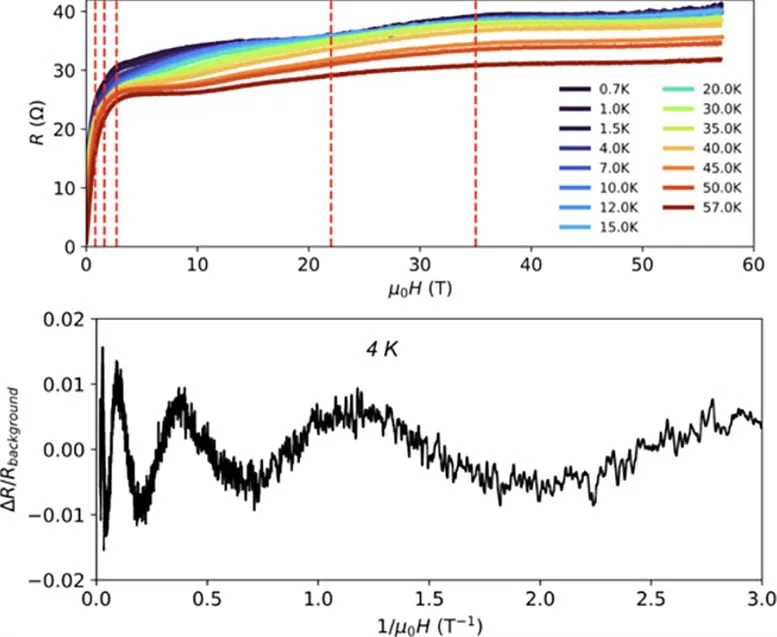
Under extreme magnetic fields, electrons inside the exotic material zirconium pentatelluride (ZrTe₅) are defying conventional quantum limits. Instead of settling into their lowest available energy states and ceasing to oscillate as traditional physics dictates, the material's electrical resistance continues to fluctuate. This anomaly, observed at temperatures near absolute zero, points directly to the material's unique topological structure rather than complex interactions between multiple particles.
The findings, published in Nature Communications, expand the current understanding of topological insulators - materials that block electrical current through their interiors while allowing it to flow freely across their surfaces. Because ZrTe₅ sits precisely at the boundary separating different topological phases, even microscopic shifts in temperature or magnetic fields can radically alter how its electrons behave. This makes it an ideal test bed for observing relativistic quasiparticles in solid matter.
This work expands our understanding of electron transport in exotic phases of matter and suggests that topological insulators support the transport of not only electric charge, but also another fundamental degree of freedom: electron spin.
- Julio Larrea Jiménez, Laboratory for Quantum Matter under Extreme Conditions
Breaking the Rules of Quantum Oscillations
Ordinarily, applying a strong magnetic field forces electrons into discrete energy states known as Landau levels. In pure metals, as these levels cross the Fermi level, electrical resistance rises and falls in a predictable, periodic pattern known as Shubnikov - de Haas oscillations. However, ZrTe₅ breaks this expected pattern. Its magnetoresistance oscillations continue far beyond the quantum limit where conventional oscillations should vanish.
According to Cauê Kaufmann Ribeiro, the paper's first author, the interaction between spin and the magnetic field profoundly alters the energy levels of the electrons when strong magnetic fields are applied. This interaction causes Landau levels to "bend back" and cross the relevant energy threshold again, a phenomenon the researchers call reentrant Landau levels.
Topology Over Particle Interaction
A central question for the research team was whether these unusual oscillations stemmed from collective interactions among many electrons or the intrinsic topology of the material. Theoretical modeling confirmed that complex many-body interactions are not required to explain the phenomenon. Instead, a single-particle model based on a three-dimensional Dirac Hamiltonian with strong spin-orbit coupling successfully reproduced the experimental data.
This conclusion resolves a long-running scientific debate over why different ZrTe₅ samples exhibit varying quantum behaviors. The new analysis suggests that conventional periodic oscillations and anomalous logarithmic signals both emerge from the same underlying Dirac electronic structure. The variations between samples are primarily dictated by carrier density and the size of the Fermi surface.
Extreme Testing Conditions
Unlocking these topological secrets required pushing the material to its absolute limits. The experiments were conducted at the National High Magnetic Field Laboratory in Los Alamos, utilizing pulsed magnetic fields reaching 60 tesla while maintaining temperatures of roughly 0.7 kelvin (-272.45 °C). Measurements indicated an extremely low carrier density of around 10¹⁶ per cubic centimeter, confirming the material sits very close to a topological transition.
During these tests, researchers also discovered that the oscillation amplitude did not simply weaken as temperature increased, but rather exhibited a local minimum due to interference between spin-separated electronic states. The full methodology and theoretical models are detailed in the Nature Communications study.
The Blueprint for Next-Generation Quantum Materials
Proving that the anomalous behavior in zirconium pentatelluride is rooted in single-particle topology rather than messy many-body interactions is a massive leap for materials science. By confirming that these reentrant Landau levels can be modeled predictably using a Dirac Hamiltonian, researchers now have a reliable mathematical blueprint. This predictability is exactly what engineers need to harness topological insulators for future technologies, such as fault-tolerant quantum computing and advanced spintronics.
Furthermore, the ability to manipulate electron spin as a fundamental degree of freedom opens the door to highly efficient, low-power electronic devices. If scientists can carefully tune crystal symmetries and carrier densities as suggested by this study, ZrTe₅ could soon transition from a theoretical test bed into a foundational component for next-generation quantum architecture.
This article was written by AI from reporting by scitechdaily.com.