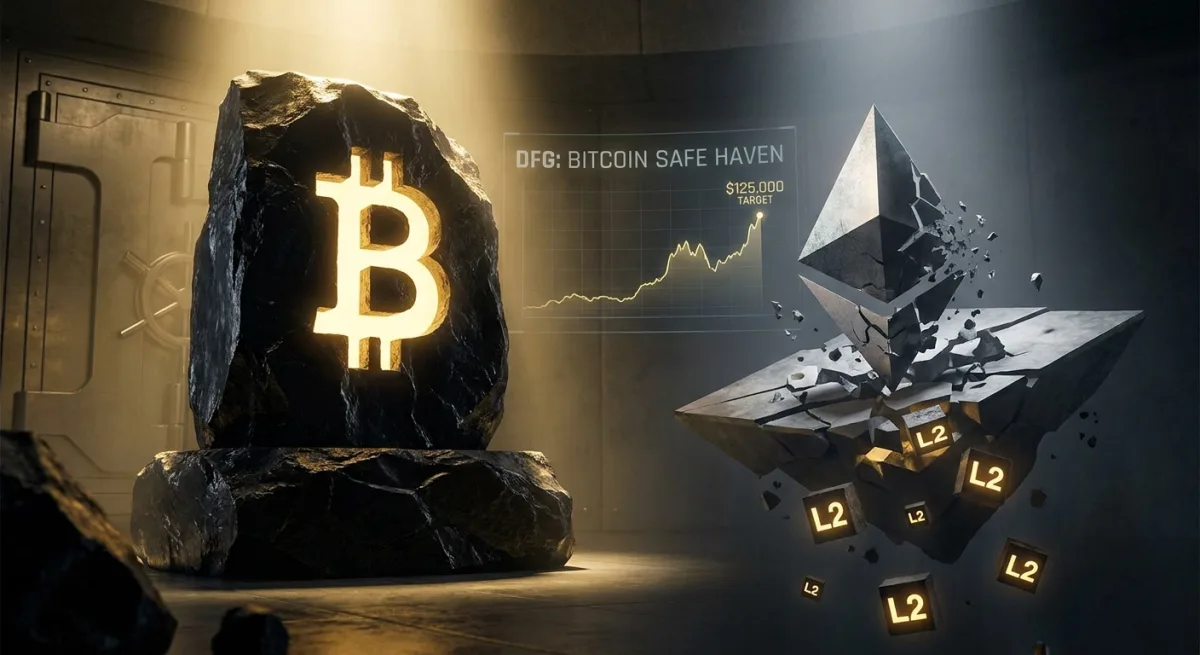
James Wo, the founder of the $1 billion crypto investment firm DFG, is doubling down on his long-term James Wo Bitcoin prediction while issuing a stark warning about the future of Ethereum. Drawing on a decade of market experience, Wo argues that Bitcoin has firmly cemented its status as an institutional safe haven, whereas Ethereum's underlying value is being actively diluted by its own scaling solutions.
This analysis is critical for crypto investors and portfolio managers weighing the long-term viability of base-layer tokens versus established digital gold. Understanding this structural shift helps traders avoid overexposing themselves to assets that may be losing their core fee utility.
Speaking at the Proof of Talk conference in Paris, Wo explicitly rejected the recent forecast by Bitmine Immersion Technologies Chairman Tom Lee, who projected that ether would eventually reach $250,000. "I totally disagree with him," Wo stated, emphasizing that Ethereum lacks the universal consensus that currently bolsters Bitcoin. At the time of his comments, ether was trading around $1,775, while Bitcoin hovered near $63,000.
Wo's skepticism stems from the rapid rise of Layer-2 networks. He explained that Ethereum's fundamental valuation relies heavily on localized applications running directly on the base layer to capture fee value. With modern Layer-2 solutions now diverting transactional volume and capturing that fee utility independently, the network's economic model has fundamentally changed.
The Ethereum token as a whole is not going to capture a lot of value. Onchain activity is not as big as people expected... I don't think Ethereum will even hit an all-time high.
- James Wo, CEO, DFG
This perspective is not universally accepted. In February, Ethereum co-founder Vitalik Buterin reignited community debates by suggesting that Layer-2 networks might "no longer make sense" as the base Ethereum layer becomes faster and cheaper. However, Wo remains unconvinced that the base layer can reclaim its lost economic activity.
From a $20 Million Family Stake to a $125,000 Bitcoin Target
Wo's market outlook carries the weight of a highly successful track record. After observing classmates trade during the 2014 bear market, he secured $20 million in initial capital from his mother, who managed a private equity firm in China. He deployed those funds into Bitcoin during the market lows of late 2014 and 2015.
As the 2016 bull market took off, Wo diversified DFG's portfolio into alternative layer-1 protocols, becoming an early venture participant in Solana, Polkadot, and Near. He also directed a $10 million allocation into Circle's USDC stablecoin project in January 2018. Today, DFG manages over 100 portfolio entities with more than $1 billion in total assets under management.
Looking ahead, Wo expects Bitcoin to outperform both the U.S. and Chinese stock markets due to its unmatched global liquidity. He calculates that a near-term market correction could see Bitcoin bottom out between $60,000 and $62,000, barring an extreme geopolitical black swan event. Ultimately, he projects a new all-time high of approximately $125,000, peaking in either 2027 or 2028.
Other Notable Updates: Tokenized Bank Deposits
In a separate development highlighting the ongoing evolution of digital assets, major traditional financial institutions are preparing to challenge the dominance of stablecoins.
- JPMorgan Chase, Bank of America, Citigroup, and other major lenders are planning to launch a shared tokenized deposit network.
- The initiative will be facilitated through The Clearing House and is targeted for launch by the first half of 2027.
- The network aims to enable round-the-clock blockchain-based settlement of bank deposits, directly countering the rise of stablecoins like USDC and USDT.
The Layer-2 Paradox Threatening Smart Contract Chains
Wo's critique exposes a critical vulnerability in the current roadmap for smart contract platforms: the "Layer-2 Paradox." By successfully offloading congestion to secondary networks, Ethereum has drastically improved user experience but inadvertently outsourced its own revenue generation. If Layer-2 solutions capture the bulk of transaction fees, the base-layer token risks becoming a mere settlement mechanism rather than a high-yield asset.
This dynamic starkly contrasts with Bitcoin's trajectory. Because Bitcoin has largely abandoned complex on-chain programmability in favor of pure store-of-value mechanics, it does not suffer from this specific architectural cannibalization. As traditional finance increasingly embraces Bitcoin for its liquidity and simplicity, Ethereum must urgently prove that its base layer can still accrue meaningful value, or risk permanently losing its appeal to institutional capital.
This article was written by AI from reporting by coindesk.com.