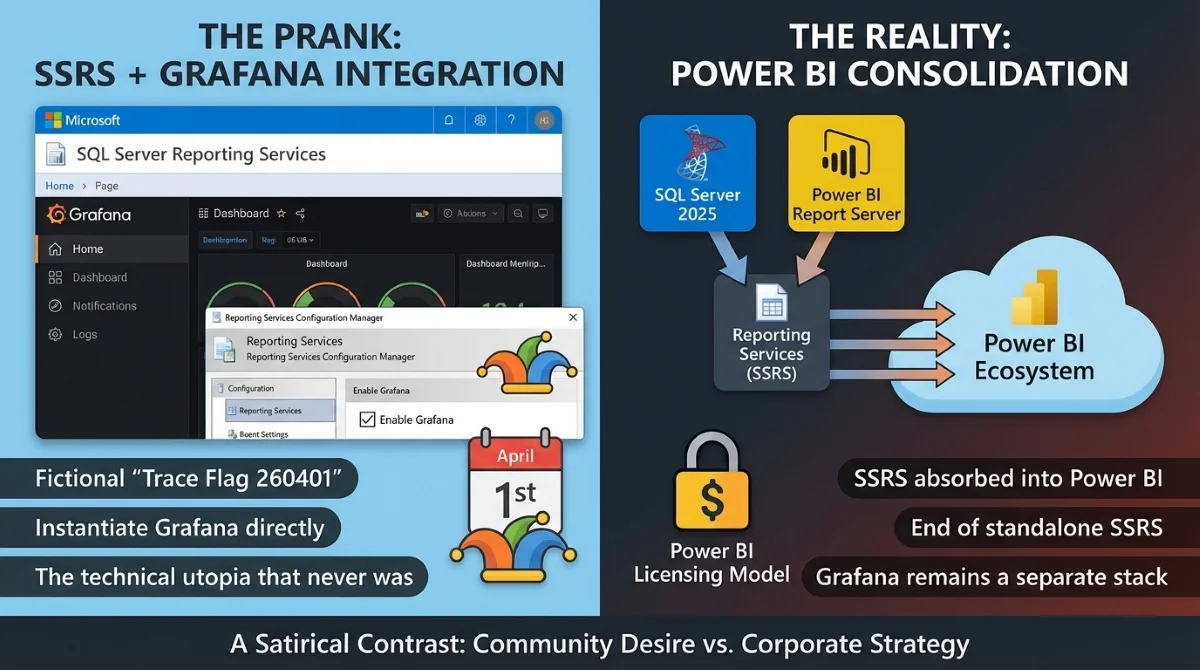
The highly anticipated native Grafana SSRS integration for SQL Server Reporting Services is officially nothing more than an elaborate April Fools' joke. Published by Steve Jones at SQLServerCentral, the satirical guide claimed that users could natively embed Grafana dashboards inside SSRS using a hidden trace flag. The fictional pilot program supposedly originated in SQL Server 2022, designed to instantiate a Grafana instance directly from an SSRS server and extend the user interface to read standard SSRS RDL files.
For database administrators and data analysts, this prank strikes a chord because it addresses a real pain point in the Microsoft data ecosystem. With the upcoming release of SQL Server 2025, Microsoft is officially absorbing Reporting Services into the Power BI Report Server, signaling the end of standalone SSRS development. The joke played on the community's desire for an open-source visualization alternative to display disparate data sources without being forced into the Power BI licensing model.
The Fictional Setup: How the Prank Worked
To make the joke convincing, the article provided specific, albeit fake, technical instructions for enabling the feature. The process required the SSRS server to run on the same machine as the SQL Server database.
- Open the SQL Server Configuration Manager and navigate to the Startup Parameters tab.
- Add the global trace flag 260401 to the startup parameters.
- Restart both the SQL Server and the SSRS instance.
- Open the Reporting Services Configuration Manager and locate the service status on the main tab.
- Check the newly fabricated Enable Grafana box at the bottom of the screen, then stop and start the configuration.
According to the prank, this would add a Grafana sidebar to local SSRS reports, allowing users to choose RDL files as new visualizations and embed them into broader dashboards. The author even warned users to adjust their sizing, noting that SSRS reports typically default to full screen, before finally revealing the April 1st punchline.
My Take: The Reality of Microsoft's Reporting Strategy
While the idea of seamlessly mixing and matching reporting solutions is incredibly appealing, this April Fools' joke highlights a stark market reality. Microsoft has spent years positioning Power BI as its flagship enterprise reporting tool. Allowing a native, open-source competitor like Grafana to hook directly into SSRS would actively cannibalize potential Power BI Report Server revenue.
The transition to SQL Server 2025 makes it clear that on-premises reporting is moving exclusively under the Power BI umbrella. Data professionals looking for the flexibility of Grafana will need to continue running it as a completely separate stack, manually connecting it to SQL Server databases rather than hoping for native SSRS integration. The prank was clever precisely because it offered a technical utopia that Microsoft's current business model will simply never allow.
This article was written by AI from reporting by sqlservercentral.com.