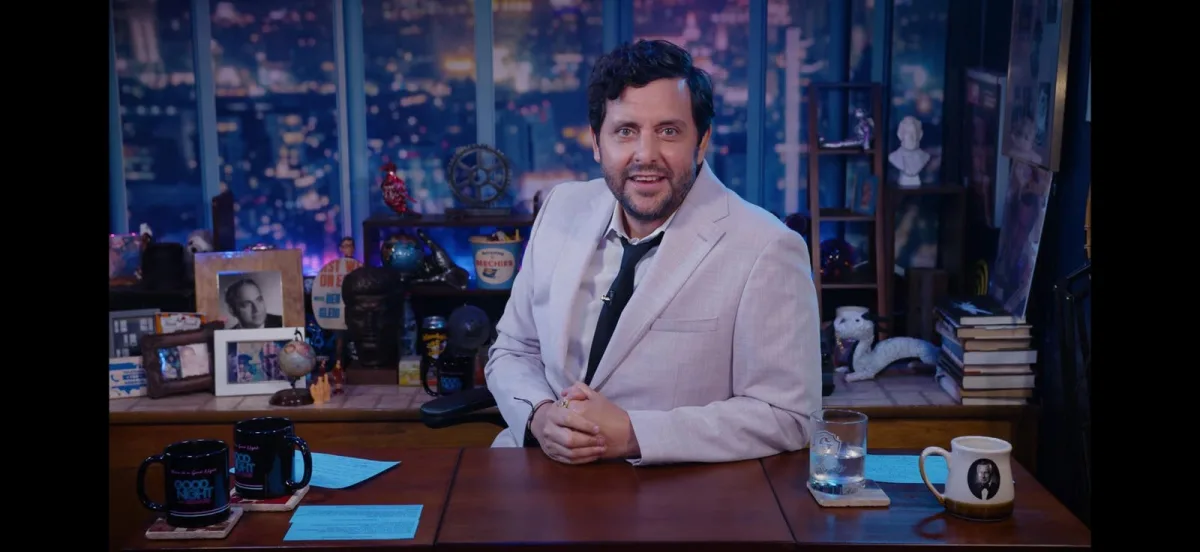
Traditional broadcast late-night television is hemorrhaging advertising revenue, plummeting from an estimated $439 million in 2018 to just $220 million in 2024. As legacy networks struggle with bloated overhead and declining viewership, comedian Ben Gleib is proving that a YouTube late-night show can successfully replace the outdated broadcast model. By launching Good Night With Ben Gleib directly from his Los Angeles home, he is merging the classic late-night architecture - complete with a desk, house band, and celebrity guests - with the agile monetization strategies of the modern creator economy.
This structural shift allows creators to bypass network executives entirely, retaining full ownership of their intellectual property while directly monetizing their most dedicated fans. Gleib now serves as the head writer, booker, executive producer, and CEO of his own media company. The production releases a new episode every Thursday, proving that high-quality entertainment no longer requires a traditional studio lot. Instead, it requires a deep understanding of audience retention, diversified revenue streams, and the willingness to carry the financial risk of production.
Rebuilding the Late-Night Format for the Creator Economy
The traditional late-night format is rigid, dictated by commercial breaks and strict broadcast schedules. In contrast, a YouTube-first approach offers unparalleled editorial freedom. When the cameras leave Gleib's makeshift studio, they follow him into the rest of his house, where conversations with guests become longer and considerably less structured. An interview can run for eight minutes or stretch to forty, depending entirely on the quality of the conversation rather than a network time slot.
This agility extends to the writing and production process. Gleib noted that showrunner Stewart Bailey and writer Caroline Choi developed a brand-new audience segment on the morning of a recording. They printed the material on cards and performed it that same evening. "It came to life within hours, which I think is a very unique thing," Gleib explained. While traditional television development can take months of approvals, this creator-led model executes new concepts in a single afternoon.
Data drives the editorial strategy, but it does not dictate the creative vision. Gleib’s team actively monitors click-through rates (Click-through rates), average watch time (Average watch time), and the percentage of each video watched. Editors make live notes during interviews to instantly identify moments that can be clipped for short-form platforms. However, Gleib maintains a strict creative boundary, stating he will never make a compromise for analytics that he fundamentally disagrees with.
Diversified Monetization: Beyond YouTube AdSense
Relying solely on programmatic advertising is a notoriously fragile business model. To build a sustainable company, Good Night has integrated the audience directly into the financial architecture of the program. Viewers are no longer passive consumers; they are active participants and financial backers. This multi-tiered approach ensures that the company generates income that does not depend entirely on algorithmic recommendations.
The show's revenue architecture relies on several distinct monetization channels designed to maximize the Customer Lifetime Value (LTV) of its core audience:
- Virtual Audience Tickets: Fans can purchase tickets to appear on video walls behind Gleib during the recording, with the potential to interact directly with celebrity guests.
- Patreon Memberships: Paying subscribers gain access to the "Nightcap" after-show, a looser, unedited continuation of the main program filmed in different areas of the house.
- Direct Sponsorships and Integrations: Bypassing traditional ad breaks, the show integrates brand messaging directly into the content, securing higher premiums.
- Future Expansion: The long-term roadmap includes merchandise sales, live touring, and eventually, consumer products.
Kendall Breitman, Head of Community at Riverside, observes this exact pattern across successful digital businesses. "More people need to focus on how they can build a space for their audience beyond their YouTube channel or podcast," she noted. By gating the premium after-show behind a Patreon paywall, Gleib is effectively converting top-of-funnel YouTube traffic into Monthly Recurring Revenue (MRR).
The Living Room Takeover
The justification for investing in a high-production YouTube late-night show lies in shifting consumer hardware habits. YouTube is no longer just a mobile application; it is actively competing for traditional television viewing time. According to internal data, television has overtaken mobile as the primary device for watching YouTube content in the United States, with users consuming more than 1 billion hours of content on TV screens every single day.
Furthermore, Nielsen data revealed that YouTube accounted for a record 13.8% of all US television viewing in May 2026, maintaining the largest share of any media distributor for the third consecutive month. Long-form creator shows are dominating this space. Viewers watched more than 700 million hours of podcasts on living-room devices in October 2025, a massive jump from 400 million hours the previous year.
This hardware shift means Gleib can produce content designed specifically for large screens while maintaining the distribution freedom of the internet. A single recording session yields a flagship full-length episode for the living room, individual interview segments for desktop viewers, and dozens of vertical clips optimized for mobile discovery.
The Burden and Reward of Creator Ownership
The transition from hired talent to media CEO is fraught with financial risk. Gleib previously hosted 210 episodes of the series Idiotest for the Game Show Network. Despite the show later being licensed to Netflix and Pluto TV, he received no backend financial benefit. With Good Night, the goal is to build a tangible asset that he and his investors fully own and control.
The plan is to create the Good Night Network and give shows to others who are breakouts from our show, other people I believe in, and create a whole network of shows that entertain people, for decades to come.
- Ben Gleib, CEO and Host
However, creator ownership is not purely about creative freedom; it requires managing a complex operational machine. Producing a weekly entertainment show is vastly more expensive than recording a standard two-microphone podcast. Gleib manages a decentralized team of 33 people, many working part-time. He personally books guests, reviews edits late into the night, and carries the payroll risk. "The buck stops with me in every department," he admitted.
The ultimate blueprint for this model is Hot Ones, hosted by Sean Evans. What began as a simple creator-led interview format evolved into a massive intellectual property asset, expanding into hot sauce empires, retail products, and international licensing. Evans views his role as continuing the tradition of aspirational talk shows, building a new structure on top of a classic foundation.
The Inevitable Collapse of Network Overhead
The $219 million evaporation of broadcast late-night ad revenue over the last six years is not a temporary dip; it is a permanent market correction. Legacy networks are burdened by unionized crew costs, massive studio leases, and rigid broadcast schedules that modern audiences actively reject. Gleib’s 42-episode first season is a direct stress test of a leaner, more aggressive media model. If a creator can deliver celebrity interviews and high-quality comedic writing from a home studio with a fraction of the overhead, the traditional network late-night show is structurally obsolete.
We are likely to see a mass exodus of mid-tier celebrities and comedians abandoning network development deals in favor of self-funded YouTube pilots. The barrier to entry has shifted from securing a network executive's approval to mastering audience acquisition costs and Patreon conversion rates. The creators who survive this transition will be those who understand that the desk, the tie, and the band are just marketing tools for the real product: a direct, monetizable relationship with a loyal community.