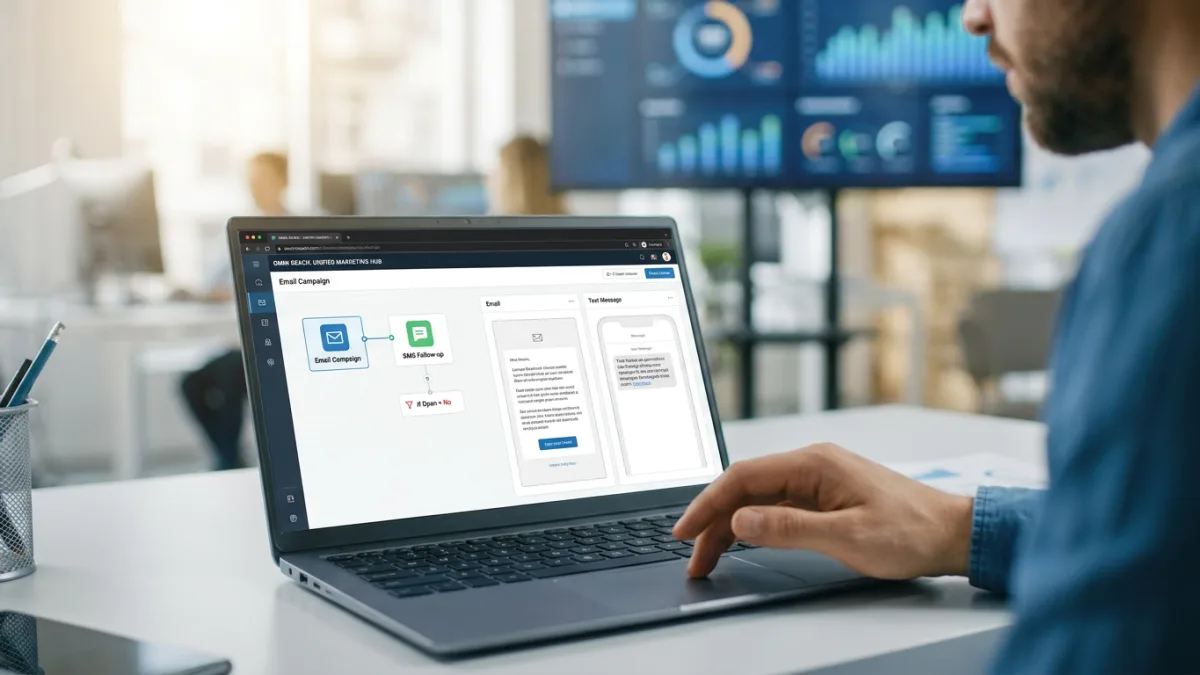
Digital marketers and eCommerce founders struggling to synchronize their outreach can eliminate fragmented campaigns by adopting a unified omnichannel platform. Running disjointed campaigns often leads to lost revenue when email and text messages fail to trigger based on the same customer behavior. Consolidating these channels into a single SMS and email marketing software allows teams to build unified automation workflows that react instantly to user actions.
Finding a platform that treats both channels equally is notoriously difficult. Most email marketing tools either lack SMS capabilities entirely or treat them as a basic afterthought with restrictive send limits. After analyzing over 670 platforms, only seven tools offer the robust automation, CRM integration, and two-way messaging required to run a true omnichannel strategy.
ActiveCampaign: Best for Behavioral Automation
ActiveCampaign excels at building complex, behavior-driven automated journeys. The platform allows marketers to coordinate email and SMS steps within the same workflow, such as sending a text-message follow-up when an email goes unopened. It also supports two-way messaging through a dedicated inbox, making it ideal for onboarding sequences and lead nurturing.
The system recently introduced Active Intelligence, an AI tool that reviews existing sequences and suggests improvements. In recent tests, it successfully spotted an unfinished A/B testing setup, though users must manually apply the suggested split actions. However, SMS functionality requires an additional add-on, and unused text credits expire at the end of each month.
Pricing requires careful calculation. The Starter plan begins at $15 per month for 1,000 contacts, but users must upgrade to at least the Plus plan ($49 per month) to purchase the SMS add-on. The SMS add-on itself starts at $16.83 per month for 1,000 credits, bringing the minimum functional cost for both channels to $65.83 per month on annual billing.
Ontraport: The All-in-One CRM Solution
Ontraport provides a simpler, bundled approach by including email marketing, SMS automation, and a built-in CRM on every plan. The platform supports two-way text messaging and allows businesses to define a personal phone number so customers can save them as a recognized contact. Users can automate both channels using pre-built templates or a drag-and-drop builder.
While the SMS features are robust, the email marketing capabilities are noticeably weaker than competitors. The email builder feels dated, and the visual templates lack modern design inspiration. It is a highly functional system for basic automation, but it struggles to match the dynamic workflow capabilities of more advanced platforms.
Pricing is determined by contact volume and user seats, starting at $83 per month for 2,500 contacts. This entry price allows for unlimited emails and SMS messages, with the first phone number provided for free. Additional phone numbers require extra fees, making it a cost-effective choice for businesses that do not need complex email designs.
Omnisend: The eCommerce Powerhouse
Omnisend is purpose-built for online retailers using platforms like Shopify or WooCommerce. Every feature, from web push notifications to popups, is designed specifically to drive eCommerce sales. The reporting dashboard directly ties campaign performance to revenue and online sales, providing clear visibility into which channel is driving conversions.
The platform offers a highly intuitive automation builder stocked with templates for the most common eCommerce customer journeys. While it lacks the deep dynamic branching of ActiveCampaign, it covers essential triggers like cart abandonment and post-purchase follow-ups perfectly. It also includes unique content blocks to integrate products and discounts directly into emails.
Omnisend's pricing structure is highly advantageous for heavy SMS users. The Pro plan starts at $59 per month for 2,500 contacts, and the platform matches that monthly fee with an equivalent dollar amount in free SMS credits. A $90 monthly subscription for 5,000 contacts automatically includes $90 worth of text credits, offering massive savings for scaling brands.
Brevo: The Affordable Multichannel Hub
Brevo expands the omnichannel definition by supporting SMS, email, WhatsApp messaging, web push notifications, and live chat within a single interface. It includes a completely free CRM to house customer data and offers some of the best transactional email features available at its price point. This makes it a highly flexible option for both B2B and B2C companies.
Unlike Omnisend, Brevo does not include free SMS credits in its standard plans; users must pay for every text message sent. However, it remains one of the most affordable email marketing systems on the market, featuring a generous free tier and low-cost premium plans. The automation features are slightly more advanced than Omnisend's, though the email templates remain somewhat basic.
Because Brevo charges based on email volume rather than contact list size, it is highly cost-effective for businesses with large databases that send infrequent broadcasts. Purchasing 10,000 SMS credits costs $109, making it a viable option for companies that use text messaging primarily as a backup to other communication channels.
GetResponse, Sendlane, and Klaviyo
For marketers who need specific integrations or advanced predictive analytics, three other platforms round out the top tier of omnichannel tools:
- GetResponse: Offers SMS alongside webinars, web chat, and paid advertising tools. However, SMS features are locked behind the custom-priced MAX2 plan, which includes 5,000 monthly credits as standard. It boasts excellent deliverability and send-time optimization.
- Sendlane: A premium eCommerce solution featuring intelligent popups and two-way MMS messaging. It carries a steep entry price of $173 per month for 5,000 contacts and 5,000 SMS credits, making it best suited for established retailers willing to pay for dedicated support and high deliverability.
- Klaviyo: A direct rival to Sendlane, offering deep predictive insights and benchmarks for larger eCommerce brands. It provides a more accessible entry point at $35 per month for 500 contacts and 1,250 SMS credits, though the interface can feel clunky compared to Sendlane's visual builders.
Platform Pricing Comparison
Pricing for omnichannel tools varies drastically based on how they calculate contact limits and message volume. The table below outlines the minimum monthly cost for combined email and SMS access based on list size.
| Platform | 2,500 Contacts | 10,000 Contacts | 100,000 Contacts |
|---|---|---|---|
| ActiveCampaign | $95 + SMS add-on | $189 + SMS add-on | Custom Quote |
| Ontraport | $83 | $208 | $583 |
| Omnisend | $59 | $150 | $1,150 |
| Brevo | $0 (Email only) | $16 (Email only) | $181 (Email only) |
| Sendlane | $173 (Starts at 5k) | $319 | $1,007 |
| Klaviyo | $75 | $165 | $1,395 |
Because SMS costs are often decoupled from email subscriptions, the table below highlights the minimum cost to purchase specific volumes of text message credits across the platforms.
| Platform | 2,500 SMS Credits | 10,000 SMS Credits | 100,000 SMS Credits |
|---|---|---|---|
| ActiveCampaign | $36.83 | $88.83 | Custom Quote |
| Ontraport | $19.75 | $79 | $790 |
| Omnisend | $37.50 | $150 | $1,500 |
| Brevo | N/A | $109 | $1,090 |
| Sendlane | $90 | $180 | $900 |
| Klaviyo | $25 | $90 | $900 |
The Hidden Cost of SMS Integration
The true differentiator among these platforms is not their email builders, but their underlying SMS pricing architecture. Brands scaling their text message marketing often hit a profitability wall because they treat SMS like email, where the marginal cost of sending an extra message is near zero. In reality, aggressive SMS campaigns can rapidly inflate a company's Customer Acquisition Cost (CAC) if the software's pricing model does not scale efficiently.
Omnisend's dollar-for-dollar credit matching on its Pro plan fundamentally alters this equation for eCommerce brands. By effectively subsidizing the SMS channel using the margin from the email software subscription, it becomes the most mathematically sound choice for high-volume retailers. It allows marketers to maintain a healthy Return on Ad Spend (ROAS) without constantly monitoring their text credit balance.
Conversely, Brevo's strict pay-per-message model is better suited for service businesses or B2B companies that use SMS purely for high-value transactional alerts rather than bulk promotions. Marketers must audit their expected monthly SMS volume before committing to a platform, as choosing the wrong pricing structure will quickly erase the revenue gains generated by the omnichannel strategy.