

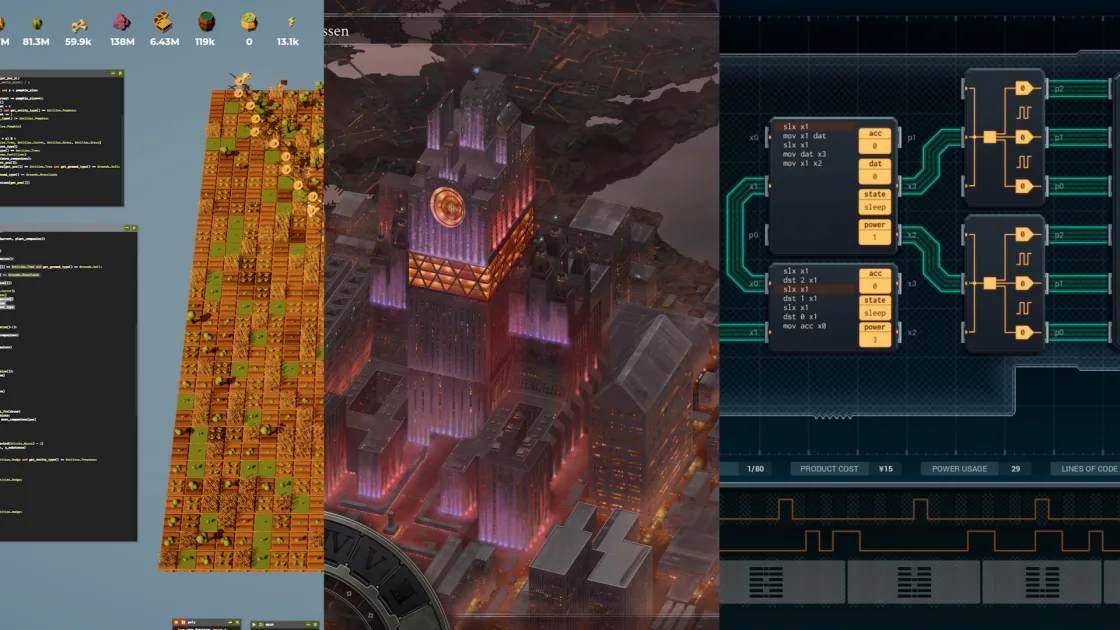
The Steam Programming Fest 2026 is officially live, offering massive discounts on titles that turn complex software engineering and hardware design into addictive gameplay. Running from September 10 through September 14, the event highlights everything from accessible logic puzzles for beginners to hardcore simulations that require writing actual JavaScript or assembly code. For players looking to test their problem-solving skills, this festival provides the perfect opportunity to dive into the world of automation, hacking, and machine learning.
To help narrow down the massive catalog, here are ten of the strongest recommendations based on user reviews, originality, and how meaningfully each game engages with programming concepts:
- Blackdoor: This newly released hacking simulator hands players four deliberately terrible scripts and challenges them to write better ones. Using a custom Python-like language, players utilize variables, loops, and port scanning to infiltrate fictional servers. It currently holds an 82% positive rating from its initial 17 reviews.
- The Farmer Was Replaced: Manual farming quickly evolves into programming an autonomous agricultural drone. Players automate planting and harvesting using loops and functions, earning a 95% positive rating for turning optimization into a highly visible, rewarding system.
- Human Resource Machine: Presenting programming as a bleakly comic office job, this game asks players to arrange simple instructions for tiny employees moving data. It requires no previous coding experience and boasts a 93% positive rating.
- Kaizen: A Factory Story: Developed by Coincidence, a team featuring former Zachtronics developers, this game transports automation puzzles to 1980s Japan. Players program equipment to assemble consumer electronics, earning a 91% positive rating for its deep optimization mechanics.
- Opus Magnum: Arguably the most approachable Zachtronics title, players construct programmable machines to create alchemical products. With an Overwhelmingly Positive 97% rating, optimizing machines for speed or cost becomes wonderfully obsessive.
- Radiotext: Set in a 1990s communications network, this terminal-based cyberpunk adventure focuses on radio wave communication. While the full game launches on September 28, the festival demo offers an early look at its unconventional hacking mechanics.
- Replicube: Combining programming with voxel art, players write code to generate specific 3D objects. This unique blend of coding puzzle and creative tool has earned an Overwhelmingly Positive 97% rating.
- Screeps: World: The most uncompromising game on the list, this open-source MMO requires players to write actual JavaScript to control a colony in a persistent online world. Scripts run even when offline, earning it an 86% positive rating.
- SHENZHEN I/O: Players construct circuits and write assembly-inspired code for a fictional engineering company. It is so demanding that it includes a printable technical manual, resulting in a 95% positive score.
- Turing Complete: Starting with a humble NAND gate, players gradually learn to build a fully functioning computer architecture. It grants immense freedom to design custom CPUs, securing a 94% positive rating.
The Gamification of Hard Skills
The success of the Steam Programming Fest 2026 highlights a fascinating shift in PC gaming: the line between educational software and hardcore entertainment has completely blurred. Titles like Screeps: World and SHENZHEN I/O do not just simulate technical concepts; they demand actual proficiency in JavaScript and assembly logic. By wrapping these dry, complex languages in compelling gameplay loops, developers are effectively tricking players into acquiring highly marketable engineering skills.
Furthermore, the overwhelming popularity of Zachtronics-style games proves that modern gamers are hungry for experiences that respect their intelligence. Instead of relying on traditional combat or reflex-based challenges, these games leverage the intrinsic satisfaction of solving a difficult optimization problem. As the tech industry continues to emphasize coding literacy, we can expect this niche genre to expand, potentially serving as a legitimate gateway for the next generation of software engineers.
