

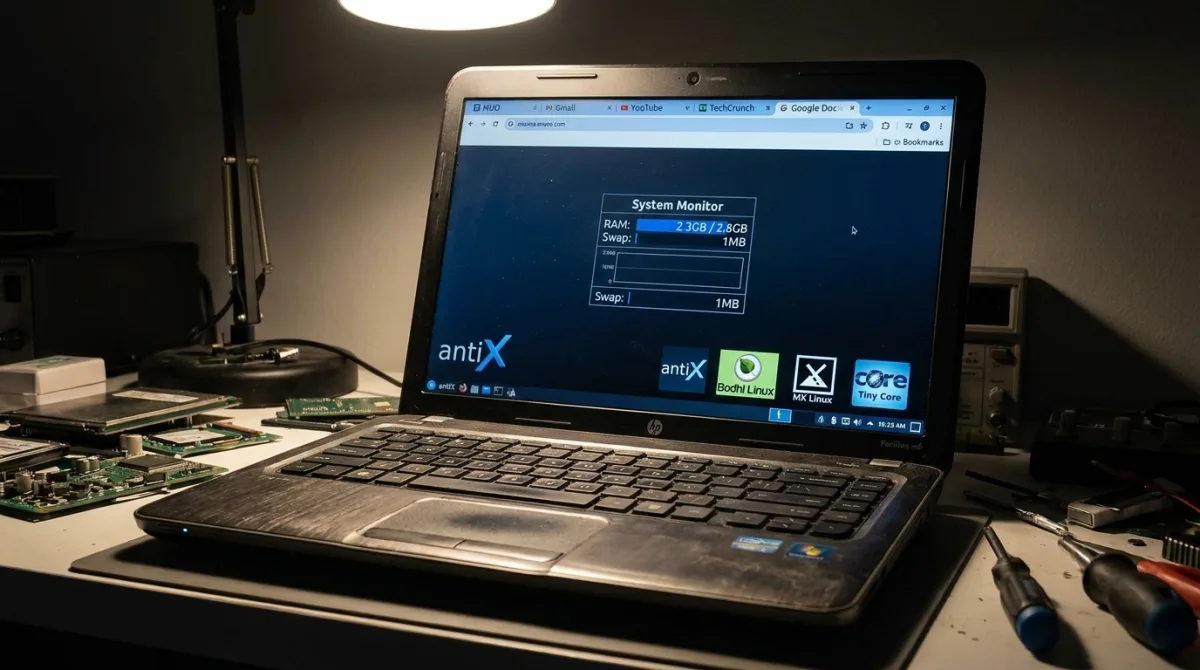
Finding lightweight Linux distros that actually breathe life into aging hardware is harder than official download pages suggest. For users trying to revive old laptops, the reality of modern web browsing quickly separates true performers from operating systems that simply crash under pressure.
According to recent testing by MakeUseOf on a 2012-era HP Pavilion m6 capped at just 2.8GB of RAM, one distribution built specifically to be tiny completely fell apart when tasked with basic multitasking. Getting the machine restricted to a clean 2GB was the first hurdle, as the standard kernel parameter crashed the bootloader every time:
mem=Instead, a stable and repeatable 2.8GB limit was achieved using an alternative parameter:
memmap=The benchmark involved a fresh installation, a brief idle period, and opening five specific browser tabs: MUO, Gmail, YouTube, TechCrunch, and a Google Doc. This real-world test revealed exactly how each operating system manages memory under load.
antiX: Flawless Performance Under 3GB
The antiX distribution officially recommends just 512MB of RAM, and it lived up to its reputation. The system idled at a mere 475MB of used memory. After loading all five browser tabs, consumption climbed to 2.3GB, with swap usage remaining under a single megabyte.
Switching between tabs felt as responsive as a modern PC, with zero stuttering or screen redraw delays. While available memory dropped to around 529MB by the end of the test, the operating system never had to aggressively compensate or slow down to maintain stability.
Bodhi Linux: The Leanest Idle Footprint
Bodhi Linux, featuring the Moksha desktop environment, recorded the lightest idle footprint of the group at just 296MB. Surprisingly, Bodhi ships with Chromium by default rather than Firefox, a choice that typically consumes more memory per tab.
Despite the heavier browser, loaded memory peaked at only 1.9GB - lower than antiX - with swap usage staying light at 54MB. Tabs and content loaded rapidly without any slowdown. The interface feels familiar to Windows users, though the terminal is uniquely named Terminology, and the standard keyboard shortcut did not launch it as expected.
MX Linux: Capable but Heavy on Swap
MX Linux is a collaborative project between the antiX and MX communities, sharing the same installer and setup process. However, that shared DNA did not translate to identical memory efficiency. MX Linux idled higher at 924MB.
Once the browser was fully loaded, memory usage climbed to 2.6GB, engaging 973MB of real swap space. While it felt slightly slower than a modern machine and tabs took a moment longer to settle, the system did not stutter. It remains a viable choice for 2.8GB systems, though it pushes the hardware noticeably harder.
Tiny Core: The Lightweight Illusion
On paper, Tiny Core is as minimal as Linux gets and should have dominated a low-RAM test. In practice, it reported an oddly low 915MB of total memory on the exact same hardware, a discrepancy that severely impacted performance.
Tiny Core exhausted its swap space during the identical five-tab test and visibly lagged when opening new pages. Furthermore, it lacks a default browser and failed to detect the laptop's Wi-Fi card out of the box. Installing Firefox required manual research and resulted in background warnings about missing graphics libraries, making its real-world usability the worst of the bunch.
The Real Test for Aging Hardware
These results prove that the "lightweight" label is virtually meaningless until an operating system is subjected to the demands of modern web browsing. Tiny Core's failure isn't a sign of bad software; rather, it highlights that the distro is engineered for embedded devices and rescue media, not for users who want to check their email five minutes after installation.
Bodhi Linux emerges as the most practical choice for daily driving an aging laptop. Its ability to run a resource-heavy browser like Chromium smoothly on just 2.8GB of RAM, combined with a modern-feeling UI, proves that aggressive optimization is the true key to hardware longevity. For anyone looking to keep e-waste out of landfills, prioritizing real-world memory management over theoretical minimalism is the only way forward.
