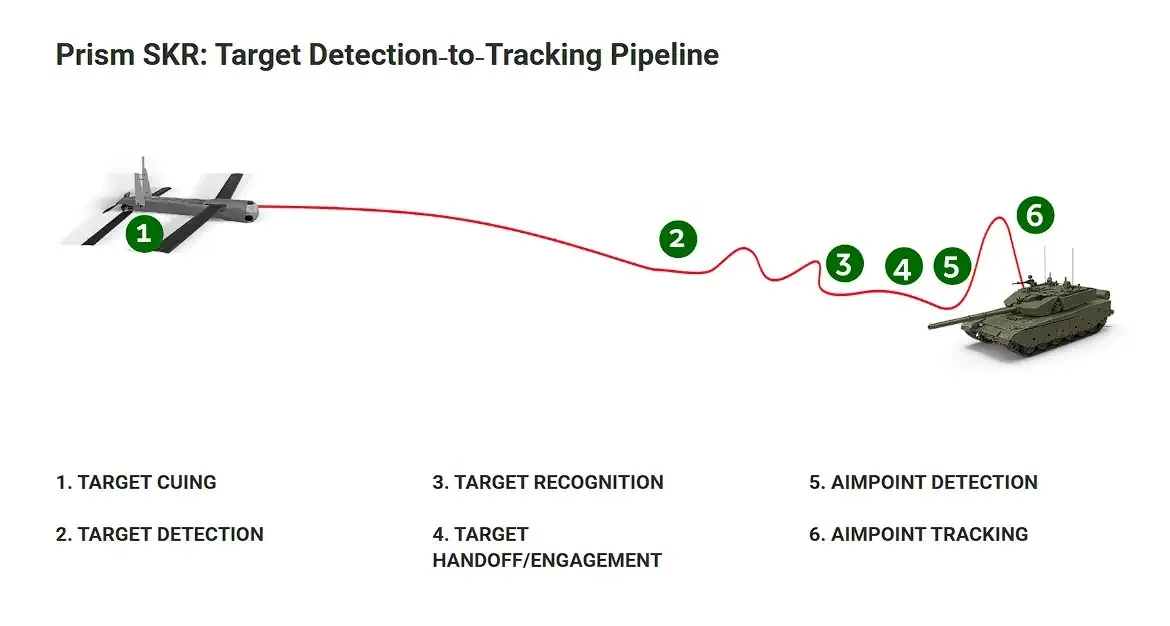
Teledyne FLIR OEM has officially launched a major upgrade to its Prism SKR software, transforming the automated targeting system into a unified, closed-loop autonomy platform. Designed to eliminate signal interference failures in the final moments of drone flights, this update provides defense developers with a robust solution for precision targeting in highly contested environments. The software now manages the entire mission lifecycle, delivering perception-based automatic target recognition (ATR) that scales from assisted AI to fully autonomous execution.
Aimed specifically at developers of guided weapon systems, first-person view (FPV) drones, and counter-UAS platforms, the upgraded Prism SKR addresses the critical vulnerability of manual control loss during terminal mission phases. According to Jared Faraudo, vice president of product management at Teledyne FLIR OEM, the integration of intelligent supervision gives operators significantly greater mission confidence. To accelerate deployment, the platform supports AI-driven development tools, allowing engineers to use Large Language Models (LLMs) like GitHub Copilot for advanced mission scripting.
Core Technical Enhancements
The latest iteration of Prism SKR introduces several critical features designed to maintain operational integrity when traditional communication links fail. These capabilities are built to support a wide range of scenarios, including air-to-ground and air-to-air operations.
- Pixel-Lock Targeting and ReID: Ensures precise, persistent re-identification tracking even through severe signal degradation, which is vital for the final meters of an FPV drone mission.
- Spatial Awareness: Introduces 3D interactive aimpoint selection alongside terrain-aware operations for complex environments.
- Workflow Integration: Features a QgroundControl plugin that naturally fits these new autonomous capabilities into existing operator workflows.
Built for rapid deployment at the edge, the Weapon Open Systems Architecture (WOSA) compliant software operates efficiently on low-power embedded platforms. It is fully compatible with NVIDIA Orin and Teledyne FLIR OEM’s AVP system-on-module (SOM), which is powered by the Qualcomm Dragonwing QCS8550. Furthermore, the system integrates seamlessly with Boson and Neutrino IR cameras, providing real-time target tracking through a comprehensive API and SDK. For more details, developers can explore the Prism family of embedded software.
The Strategic Shift Toward Edge Autonomy
The evolution of Prism SKR highlights a critical industry pivot from manual remote operation to edge-based AI autonomy in defense technology. By addressing the "final meter" problem - where electronic warfare and signal jamming frequently neutralize FPV drones - Teledyne FLIR is effectively removing the human bottleneck during the most vulnerable phase of a flight. This ensures that once a target is locked, the system can complete its objective independently of operator connectivity.
Furthermore, the explicit support for LLM tools like GitHub Copilot in mission scripting represents a fascinating modernization of defense software development. By lowering the barrier to programming complex autonomous behaviors, Teledyne FLIR is enabling faster iteration cycles for defense contractors. This combination of low-power edge computing via NVIDIA Orin and AI-accelerated development positions the Prism SKR platform as a foundational tool for the next generation of attritable, autonomous systems.
This article was written by AI from reporting by suasnews.com.