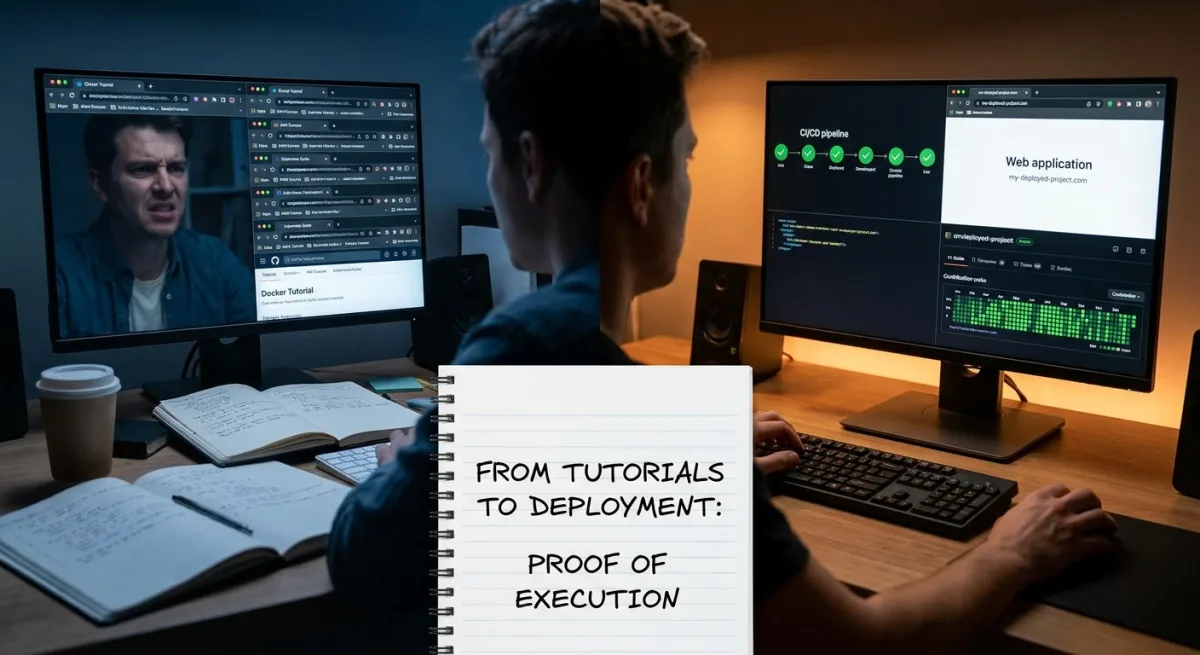
Landing your first DevOps role requires a fundamental shift in how you approach learning and applying technical skills. You might have completed multiple AWS courses, taken extensive notes on Docker tutorials, and memorized the definitions of Kubernetes and CI/CD. Yet, when you send out applications, you receive zero callbacks. This frustrating cycle happens because most beginners optimize for passive learning, while hiring managers optimize for concrete proof of execution.
Hiring managers cannot see your YouTube watch history or the hours you spent reading documentation. They can only evaluate what is visible on your GitHub profile and your live deployments. Courses and certifications only prove that you have been exposed to a concept. To actually get hired, you must demonstrate that you can take a system from zero to deployed, documented, and fully operational.
The Three Patterns That Keep Beginners Stuck
Many aspiring engineers fall into the "Tutorial Loop," where they jump from an eight-hour Docker video to an AWS course, and then to a Kubernetes series. Watching tutorials feels like progress because it is comfortable and lacks a failure state. Nothing breaks, but nothing tangible is produced for a hiring manager to evaluate.
This leads directly to the "Theory-Practice Gap." You might be able to explain the conceptual difference between a container and a virtual machine fluently. However, if you have never containerized a simple application, connected it to a pipeline, and deployed it to a cloud server with a real URL, your theoretical knowledge is practically useless in an interview. Hiring managers hear "I understand how it works" from hundreds of candidates, but they only call back the ones who say, "I have built this, and here is the link."
The final trap is "Silent Learning." You might be putting in the work every day, but if you have no GitHub activity, no LinkedIn presence, and no community engagement, you remain invisible. Sending cold applications to Applicant Tracking Systems (ATS) often results in automatic rejection. People get hired through people, and a hiring manager who sees your public documentation of a solved problem is significantly more likely to review your résumé.
Factor 1: Proof of Work (The Non-Negotiable)
If you take away only one rule from this guide, it is this: no portfolio means no serious consideration. The most technically capable candidate is invisible without proof of work. This is not about building overly complex systems; it is about proving you can manage an end-to-end deployment.
Before you consider any portfolio project complete, it must meet a strict set of criteria. If your project only meets four out of these six requirements, it is still a work in progress. Finish it completely before you start applying for jobs.
- It is deployed: There must be a real URL you can share, not just code that works locally on your machine.
- It has a CI/CD pipeline: Code changes must be automatically tested and deployed without manual intervention.
- Infrastructure is defined as code: Resources must be provisioned via code, not manually clicked together in the AWS console.
- It has monitoring and alerting: You must know when the system breaks before your users report it.
- It is documented: A comprehensive README must explain what the project does, how to run it, and how the architecture works.
- It is on GitHub publicly: The repository must show a real commit history that demonstrates iterative, consistent work.
The Three Projects That Cover Everything
You do not need ten fragmented projects to impress a hiring manager. You only need two to three comprehensive projects that collectively demonstrate the full spectrum of modern DevOps skills.
Project 1: The Full-Stack Deploy Pipeline
This is the foundational DevOps project every beginner must build first. Take a simple web application, such as a Python Flask app, a Node.js API, or a static site, and containerize it using Docker. You must then write a CI/CD pipeline that runs tests, builds the Docker image, and deploys it to a cloud server automatically on every push to the main branch.
To elevate this project, set up Nginx as a reverse proxy and add an uptime monitor using a free tier service like UptimeRobot. The recommended tools for this stack include GitHub Actions, Docker, AWS EC2 or Render.com, and Nginx. This project proves to a hiring manager that you can automate a full deployment workflow end-to-end.
Project 2: Infrastructure as Code with Terraform
Write Terraform code that provisions a complete, secure environment. This should include a Virtual Private Cloud (VPC), public and private subnets, an EC2 instance with properly scoped security group rules, and an S3 bucket for remote state management. You must destroy and recreate this infrastructure from scratch to prove the code is functional.
Next, integrate a GitHub Actions workflow that automates the infrastructure deployment. You should configure it to run the planning phase on pull requests:
terraform planThen, configure it to apply the changes automatically upon merging to the main branch:
terraform applyInfrastructure as Code is a mandatory skill at almost every company running cloud infrastructure. Demonstrating that you can write, version-control, and automate Terraform proves a core professional competency.
Project 3: Monitoring and Observability Stack
Deploy a comprehensive monitoring stack using Docker Compose. Configure Prometheus to scrape metrics from your application and the host server. Set up Grafana dashboards to visualize CPU usage, memory consumption, request rates, and error rates. Finally, configure Alertmanager to send notifications to Slack or email when specific thresholds are breached.
Connect this observability stack to your first project so that the pipeline deploys the application and the monitoring system watches it. Most beginner portfolios completely lack observability work. This project immediately signals to senior DevOps engineers and Site Reliability Engineering (SRE) teams that you understand production environments.
Factor 2: System-Level Thinking
System-level thinking is the mindset that separates a true DevOps engineer from someone who merely memorized a collection of tools. You must be able to see the entire architecture and trace a user request from the initial click to the final database query. Hiring managers constantly test if you can explain what happens at every layer of the stack.
- User's Browser: The user types a URL, and the browser initiates the process to find the server.
- DNS Resolution: The domain name is translated into an IP address. DNS misconfigurations at this stage mean users cannot reach your service at all.
- CDN / Edge Network: Traffic hits a Content Delivery Network (CDN) like Cloudflare or CloudFront. Static assets are served from the nearest edge location, and SSL termination occurs here.
- Load Balancer: The request is routed to an available application server. If all target servers are unhealthy, users will receive 502 or 503 error codes.
- Compute / Application Servers: The application code executes here within containers, on virtual machines, or via serverless functions to process business logic.
- Database Layer: The application reads from or writes to a database. Slow queries or a full disk at this layer will cause severe latency or complete outages.
- Cache Layer: Systems like Redis or Memcached serve frequently-read data. Cache misses will cause unnecessary load on the primary database.
- Response Returns: The processed response travels back through the entire stack until the user sees the result on their screen.
- Logging and Monitoring: Every single step above must emit logs and metrics. Proper monitoring alerts the engineering team before users even notice a problem.
When asked about a production failure in an interview, system-level thinking dictates your response. Instead of saying "the website was down," a strong candidate explains that load balancer health checks failed because application containers ran out of memory, which was identified via Grafana metrics and resolved by implementing container memory limits.
Factor 3: Software Engineering Fundamentals
Many beginners rush to learn Kubernetes and Terraform before mastering the foundational technologies that make those tools function. This creates a fragile knowledge structure. You must solidify your understanding of Linux, networking, scripting, version control, and containerization.
DevOps tools run natively on Linux, and CI/CD jobs execute within Linux containers. If the command-line interface makes you uncomfortable, you are not ready for a production environment. Similarly, networking fundamentals like DNS, TCP/IP, HTTP/HTTPS, firewalls, and subnets are the backbone of cloud architecture. Without them, Terraform is just a magic box.
Scripting is equally critical. If you cannot write a Bash or Python script that reads a configuration file, calls an API, and handles errors gracefully, your automation capabilities are severely limited. Furthermore, Git usage must go beyond simple commits.
git commit
git push
You must understand branching strategies, pull requests, merge conflicts, and release tagging. Finally, Docker is the universal packaging format for modern software. You must write your Dockerfiles by hand and understand multi-stage builds, volumes, and container security.
Factor 4: Communication Skills and Documentation
Technical skills determine your career ceiling, but communication skills determine how fast you reach it. Two candidates with identical technical abilities will experience vastly different career trajectories based on how clearly they articulate their decisions. You must be able to describe your architecture to someone who has never seen it and confidently explain the trade-offs you made.
Your project's README is essentially its cover letter. A well-structured README demonstrates engineering maturity. It must explain what the project does, display an architecture diagram, provide local setup instructions, and document the technical decisions you made. If you need guidance on formatting, review the official GitHub - How to Write a Good README documentation.
Factor 5: Consistency Over Intensity
Hiring managers are pattern recognition machines. They review your GitHub contribution graph and LinkedIn activity to form an impression before reading your résumé. A binge-learning approach - working 10-hour weekends followed by weeks of inactivity - tells the wrong story.
Thirty minutes of focused daily practice for six months is vastly superior to a monthly 10-hour binge. To build consistency, protect a specific 30-minute time slot in your day. Define a four-week learning sprint with a highly specific goal, such as building and deploying a VPC with Terraform, rather than a vague goal like "learning cloud."
Factor 6: Networking and Visibility
Most entry-level DevOps jobs are filled through referrals, community connections, and LinkedIn conversations. A warm introduction from an industry peer outweighs fifty cold applications. You must build visibility without it feeling performative or forced.
Join communities where DevOps engineers actively discuss their work, such as AWS User Groups, local meetups, or Reddit communities like r/devops. Post on LinkedIn once a week to document something you built or a specific problem you solved. By month three, recruiters searching for DevOps talent in your area will naturally encounter your consistent activity.
Factor 7: Ownership Mindset
An ownership mindset is an observable behavior, not a personality trait. Hiring managers look for evidence that you finish what you start. A single, complete, and deployed project is worth ten times more than a dozen incomplete, overly complex repositories.
Ownership also means taking responsibility without assigning blame when systems break. It involves identifying the root cause, deploying a fix, and adding monitoring to prevent recurrence. Furthermore, you must self-direct your learning by identifying your own knowledge gaps and actively closing them without waiting for instructions.
Factor 8: Business Awareness
Technical skill gets you the interview, but business awareness secures the job. Hiring managers want to know if you can connect your infrastructure decisions to cost, uptime, and user impact. Cloud costs are typically the second-largest engineering expense at most companies, right behind salaries.
You must be able to answer benchmark business questions comfortably. For example, a 99.9% SLA equates to approximately 43 minutes of allowed downtime per month. Moving workloads from on-demand EC2 instances to Reserved Instances typically yields a 40 - 60% cost saving. When documenting your projects, always frame technical choices through a business lens, such as explaining how auto-scaling eliminated the cost of over-provisioning.
Factor 9: Learning Agility
Claiming to be a "fast learner" is the most overused phrase in tech applications. You must prove it with concrete evidence. Proof sounds like stating you had never used a specific tool before, but within 48 hours, you built a working pipeline that runs tests and deploys to AWS.
Learning agility is not about having shallow knowledge of fifty different tools. It is about grasping new tools rapidly because you deeply understand the underlying concepts of networking, automation, and observability. Tool names change constantly, but the core engineering principles remain static.
Your 90-Day Action Plan
This sequential plan will take you from the tutorial loop to an interview-ready state. Do not skip ahead; each phase builds the foundation for the next.
- Month 1 (Build Your Foundation): Focus entirely on Project 1. Build the full-stack deploy pipeline, get the live URL, and ensure it meets all six checklist criteria. Dedicate 30 minutes daily to Linux and Bash scripting practice.
- Month 2 (Expand Execution and Visibility): Begin Project 2 focusing on Terraform Infrastructure as Code. Write your first specific LinkedIn post documenting your progress. Join one professional DevOps community and introduce yourself.
- Month 3 (Complete the Portfolio): Finish all three projects to the full checklist standard. Polish every README, add architecture diagrams, and optimize your GitHub profile. Pin your three best repositories and ensure all live URLs are functional.
- Month 4 Onward (Apply with Strategy): Do not start applying until month four. Target five to ten high-quality applications per week instead of spamming job boards. Include your GitHub and live project URLs in every application, and track your progress in a spreadsheet to analyze what works.
Honest Self-Assessment: Where Do You Stand?
Before applying for roles, evaluate your readiness with absolute honesty. If you cannot explain a web request end-to-end from DNS to logging, you must revisit system-level thinking until you can draw the architecture from memory.
If you do not have at least one deployed project with a live URL, this is your absolute highest priority. If your best project lacks a CI/CD pipeline that auto-deploys on push, you must integrate one immediately. Count your gaps and treat them as a prioritized build list, not a reason for anxiety.
Essential Resources for Cloud Engineers
To support your journey, rely on official documentation and industry-standard roadmaps. Use roadmap.sh/devops to sequence your learning and avoid random topic jumps. Read the DORA State of DevOps Report to understand the vocabulary hiring managers use regarding software delivery performance.
For practical implementation, rely heavily on the GitHub Actions Documentation to build your CI/CD pipelines. Utilize ExplainShell.com to break down complex terminal commands, and follow the official Terraform AWS getting-started guides to ensure your infrastructure code aligns with best practices.
The Shift From Certifications to Tangible Engineering
The current hiring landscape for junior cloud roles has fundamentally shifted away from credentialism. Five years ago, stacking AWS certifications might have been enough to secure an interview, but today's hiring managers are overwhelmed by candidates who possess theoretical knowledge but lack practical execution. The market is demanding tangible engineering artifacts over multiple-choice exam scores.
This shift heavily favors candidates who treat their personal GitHub repositories as production environments. By implementing strict CI/CD pipelines, comprehensive observability, and business-aware documentation, you are essentially simulating the exact environment you will be hired to manage. The execution gap is where the real work lies, and those who bridge it with deployed, functional projects will bypass the ATS filters entirely.