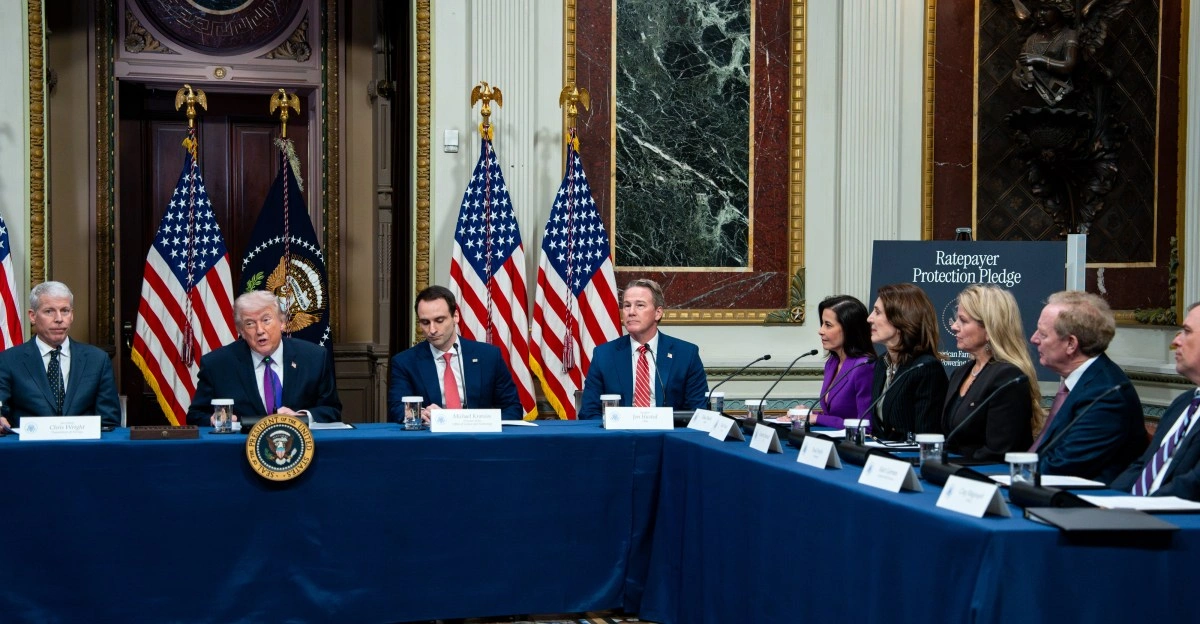
The new AI data center energy pledge signed by seven major tech companies aims to prevent soaring electricity costs for local communities. On March 4, 2026, leaders from Google, Meta, Microsoft, Oracle, OpenAI, Amazon, and xAI met at the White House to formally sign the "Ratepayer Protection Pledge." This initiative directly addresses growing bipartisan concerns over the massive power consumption required to train and run generative AI models.
This development is critical for local communities, utility providers, and tech investors. It ensures that the financial burden of upgrading power grids falls on the tech corporations rather than everyday consumers, enabling communities to welcome technological investment without fearing utility rate hikes. The move comes at a crucial time; according to a December 2025 report from Climate Power, household electricity bills rose 13 percent nationally. Furthermore, the Department of Energy estimates that data center electricity demand could double or triple by 2028.
The Ratepayer Protection Pledge Details
The presidential proclamation requires these tech giants to build, bring, or buy the new generation resources needed for their facilities. Crucially, the companies must pay for all new power delivery infrastructure upgrades required to service their data centers. They are also required to negotiate separate rate structures with utilities to ensure they pay a fair rate for the extra pressure placed on the grid.
To prevent the creation of "stranded assets" if the AI hype cools down, the companies will remain financially responsible for these infrastructure costs even if their data centers do not utilize all the newly generated electricity. Additionally, the pledge mandates that companies make their backup generation resources available to local grids during times of scarcity, such as severe winter storms or heatwaves, helping to prevent power outages during disasters.
xAI and Meta's Specific Infrastructure Commitments
During the event, SpaceX President and COO Gwynne Shotwell detailed ambitious plans for xAI, noting the development of a 1.2 gigawatt power plant to serve as the primary power source for its supercomputer. xAI also plans to expand its Megapack installations to provide backup power to Memphis, Tennessee, and Southaven, Mississippi. This announcement follows threats of lawsuits from the NAACP regarding pollution from xAI's temporary gas turbines in those areas.
Meanwhile, Meta announced a new pilot program in Ohio designed to train local fiber technicians. This aligns with a specific clause in the pledge that requires companies to hire from the local communities where their data centers are under construction.
| Company | Key Infrastructure Commitment |
|---|---|
| xAI | Developing a 1.2 gigawatt power plant and expanding Megapack backup power in TN and MS. |
| Meta | Launched a pilot program in Ohio to train and hire local fiber technicians. |
| All Signatories | Funding grid upgrades and providing backup power to local grids during emergencies. |
Frequently Asked Questions
What is the Ratepayer Protection Pledge?
It is an agreement signed by major tech companies committing them to pay for the power grid upgrades necessary to support their AI data centers, ensuring local residents do not face increased electricity bills.
Which companies signed the data center energy pledge?
The pledge was signed by leaders from Google, Meta, Microsoft, Oracle, OpenAI, Amazon, and xAI on March 4, 2026.
How will this affect local electricity grids during emergencies?
The tech companies have agreed to make their backup power generation resources available to local grids during times of scarcity, such as severe winter storms, to help prevent blackouts.
My Take
The signing of this pledge marks a necessary maturation in the AI industry. For the past two years, the narrative has been dominated by unchecked expansion, but the Department of Energy's projection that data center power demand could triple by 2028 has forced a reality check. By legally committing to fund grid upgrades and absorb the risk of stranded assets, companies like Microsoft and Amazon are acknowledging that sustainable AI growth requires massive physical infrastructure investments. xAI's commitment to building a dedicated 1.2 gigawatt power plant is a prime example of this shift; tech giants are no longer just software companies, they are rapidly becoming major players in the energy sector. This policy will likely accelerate investments in proprietary green energy and advanced battery storage solutions across the tech industry.