For decades, connecting distant quantum bits required constant, active measurement - a fragile process that has bottlenecked the development of large-scale quantum computers. Now, physicists at the Institute of Science and Technology Austria (ISTA) have bypassed this limitation by creating a "quantum bath" that puts distributed entanglement on autopilot. Published in the journal Physical Review X, the breakthrough provides a fully autonomous foundation for stabilizing qubits, offering a critical new pathway for engineers building future quantum networks.
Entanglement allows particles to share correlations that defy classical physics, and distributing this state across physically separated qubits is essential for scaling quantum hardware. Historically, researchers relied on two strategies: sending a single, actively controlled photon between qubits, or having each qubit emit a photon that is then matched. While the latter approach earned the 2022 Nobel Prize in Physics, it remains heavily dependent on repeated measurements and post-selection, meaning the process frequently fails to produce a stable connection.
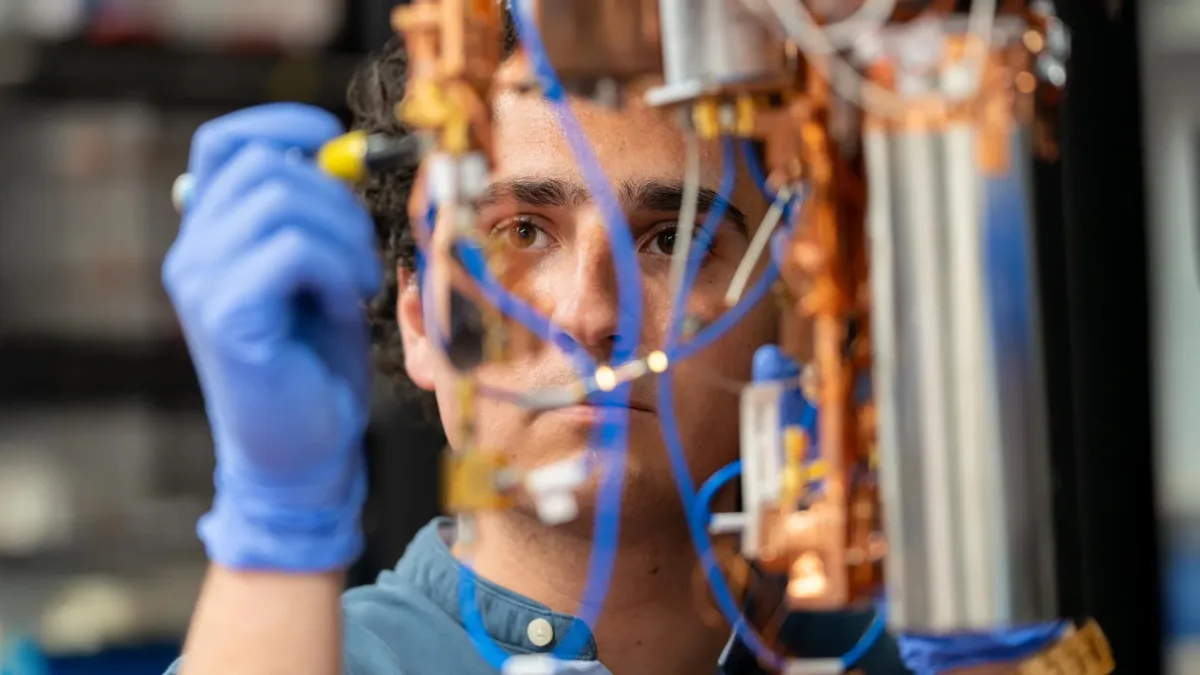
To overcome these hurdles, PhD student Alejandro Andrés-Juanes and professor Johannes Fink developed a prototype device that uses a shared source of correlated light particles to synchronize distant qubits automatically. This experimental realization validates a theoretical prediction proposed more than 20 years ago. By utilizing microwave photons - low-energy light particles already central to superconducting-qubit technology - the team successfully bridged the gap between easily produced continuous-variable entanglement and the discrete-variable forms required for practical quantum applications.
Harnessing the Environment for Stability
Maintaining quantum coherence is notoriously difficult because environmental noise typically destroys delicate quantum states. The ISTA researchers flipped this paradigm by making the surrounding environment responsible for generating and preserving the entanglement itself.
In our method, the quantum bath -- meaning the qubits' environment -- is the source of entanglement. It creates a new ground state through a continuous stream of correlated photons.
- Johannes Fink, ISTA
Because this entangled state is stabilized continuously, it remains available as a resource well beyond the natural lifetime of the qubits. To verify that the isolated qubits were genuinely synchronized, the team employed quantum tomography. This technique reconstructs the system's behavior by taking rapid measurements lasting just 20 to 80 nanoseconds. As Andrés-Juanes noted, measuring the qubits forces their superposition to collapse into a definitive 0 or 1 state, allowing the researchers to map the underlying quantum mechanics accurately.
The Shift from Active Control to Environmental Design
While the ISTA prototype successfully proves a two-decade-old theory, it currently transfers only about 10% of the bath's available entanglement. This efficiency is lower than traditional methods that rely on active control, but the conceptual leap here is far more significant than the initial yield. By shifting the burden of entanglement from precise, active laser pulses to the ambient "bath" itself, the researchers are treating the environment as a stabilizing resource rather than a source of decoherence.
If this autonomous synchronization can be scaled to connect multiple distant qubits with higher efficiency, it could drastically reduce the massive error-correction overheads currently required in distributed quantum networks. The original theory took 20 years to realize because it relied on idealized conditions that are notoriously difficult to replicate in a lab. Now that the physical factors preventing a functional quantum bath have been identified and overcome, this architecture could fundamentally alter how we design fault-tolerant quantum processors, paving the way for robust, self-sustaining quantum internet nodes.
This article was written by AI from reporting by sciencedaily.com.