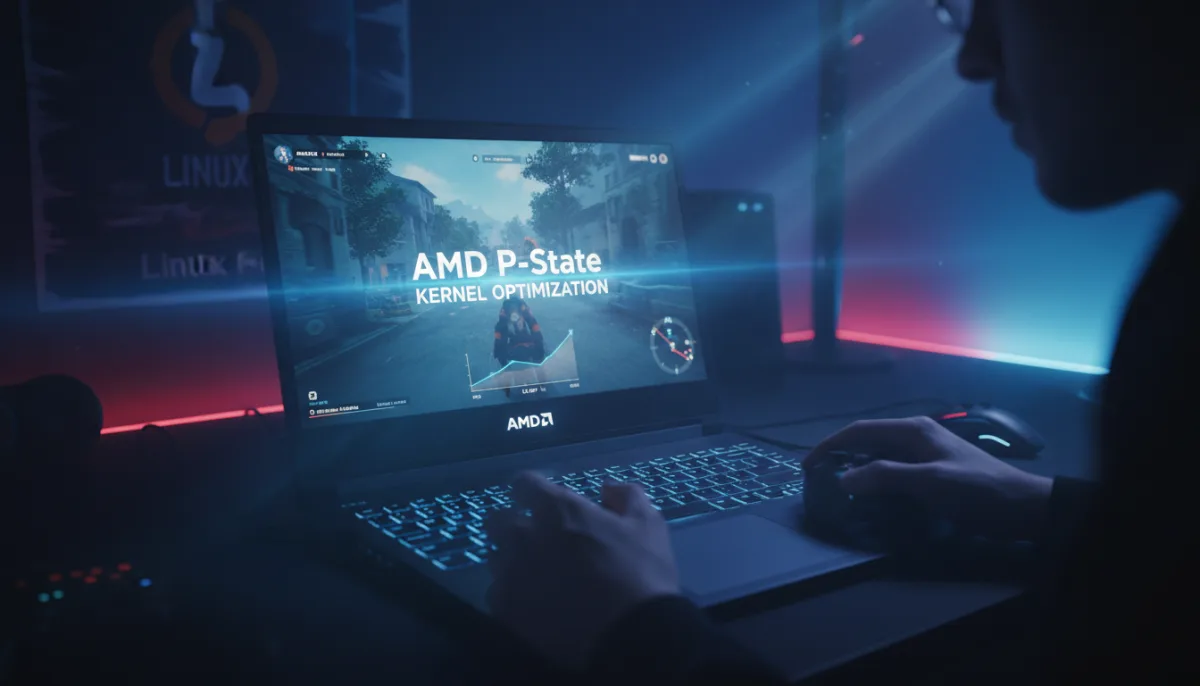
A newly proposed patch for the Linux kernel's AMD P-State CPU frequency scaling driver is delivering significant frame rate boosts for Ryzen users. By allowing processors to respond more aggressively to sudden workload spikes, the optimization targets CPU-bound games without requiring any hardware upgrades. This development is crucial for Linux gamers utilizing modern Ryzen desktop and mobile processors, as it directly addresses the micro-stutters caused by delayed clock speed adjustments.
Rather than relying on the older ACPI CPUFreq driver, AMD P-State communicates directly with the processor to adjust clock speeds based on real-time workload demands. Most modern Linux distributions already support this modern driver natively through kernel.org. Its primary goals include:
- Faster frequency scaling
- Improved power efficiency
- Better responsiveness
- Higher performance during demanding workloads
- Lower power consumption when the system is idle
The new patch specifically targets the latency that occurs when a game suddenly demands additional CPU performance. Because many titles rapidly alternate between light and heavy workloads, a slow processor response can cause short performance dips. The proposed optimization reduces that delay, helping maintain smoother gameplay.
According to early testing highlighted by phoronix.com, the patch delivers meaningful improvements across several Linux gaming workloads. The reported benefits include:
- Higher average frame rates
- Better 1% low FPS performance
- Faster CPU frequency response
- Improved responsiveness during gameplay
- More consistent frame delivery
The biggest gains appear in CPU-limited games where processor performance has a greater impact than GPU performance. The patch targets systems using the AMD P-State driver, which generally includes:
- Ryzen desktop processors
- Ryzen mobile CPUs
- EPYC processors with AMD P-State support
- Newer Zen-based architectures
Users still relying on the legacy ACPI CPUFreq driver will need to switch to AMD P-State to benefit once the optimization becomes available. This update adds another piece to the rapidly improving Linux gaming ecosystem, which has seen major contributions from:
- Valve's Proton compatibility layer
- Mesa graphics driver improvements
- Vulkan optimizations
- Better scheduler tuning
- Continued AMD kernel development
The End of Micro-Stutters on Zen Architecture
The focus on improving 1% low FPS performance is the most critical takeaway from this AMD P-State patch. While higher average frame rates look great on benchmark charts, it is the 1% lows that dictate whether a game actually feels smooth or suffers from jarring micro-stutters during intense action sequences. By reducing the frequency scaling delay, AMD is effectively eliminating the CPU bottleneck that occurs during rapid workload transitions.
This optimization also highlights a broader shift in Linux gaming infrastructure. With Valve's Proton and Mesa drivers already handling the GPU translation layer exceptionally well, kernel-level CPU scheduling was one of the last remaining hurdles for native-like performance. Once this patch is merged into the mainline kernel, Ryzen-powered Linux machines - including handhelds like the Steam Deck - could see a tangible responsiveness advantage over their Windows counterparts in heavily CPU-bound titles.