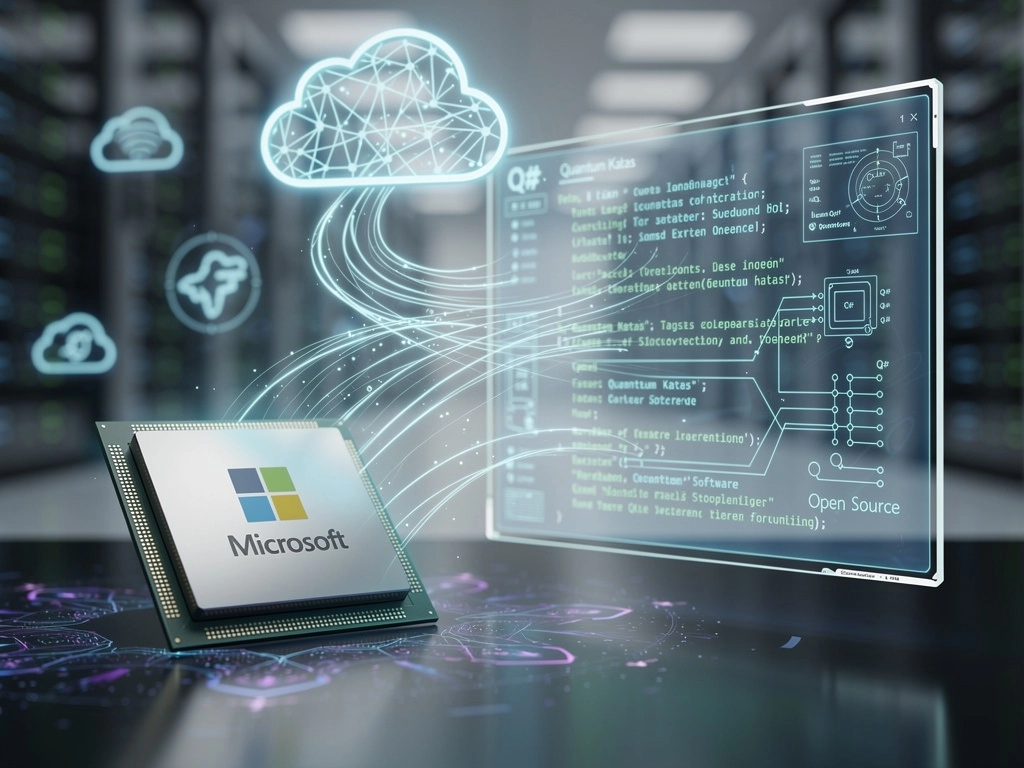
Microsoft's Strategic Pivot to Quantum Software Leadership
Microsoft is aggressively advancing its quantum computing agenda by emphasizing software development over waiting for mature hardware, a move dubbed the 'quantum gambit.' This approach allows the tech giant to build a comprehensive ecosystem of tools, languages, and algorithms that will be ready when scalable quantum hardware emerges, potentially giving Microsoft a decisive edge in the global quantum race.
At the heart of this strategy is the **Quantum Development Kit (QDK)**, which integrates seamlessly with Visual Studio and supports the Q# programming language. Q# enables developers to write quantum algorithms that can run on both simulators and actual quantum processors, bridging the gap between theory and practice. Microsoft's Azure Quantum platform further amplifies this by providing cloud access to diverse quantum hardware from partners like IonQ, Quantinuum, and Rigetti, allowing users to experiment without owning expensive machinery.
Overcoming Hardware Hurdles with Hybrid Solutions
Quantum hardware faces monumental challenges, including high error rates, limited qubit coherence times, and scalability issues. Current noisy intermediate-scale quantum (NISQ) devices operate with fewer than 1,000 qubits and error rates above 1%, far from the millions of logical qubits needed for practical applications. Microsoft counters this with **topological qubits**, a pioneering architecture based on Majorana fermions that promises inherent error resistance due to their non-local properties.
In the interim, Microsoft promotes **hybrid quantum-classical computing**, where quantum processors handle specific tasks like optimization or simulation, offloaded from classical supercomputers. This is evident in applications for drug discovery, materials science, and financial modeling, where even small quantum advantages yield significant gains. For instance, Microsoft's partnerships with pharmaceutical giants like Merck demonstrate quantum algorithms accelerating molecular simulations by orders of magnitude.
Key Milestones and Ecosystem Building
- 2025 Majorana Milestone: Microsoft announced a breakthrough in detecting Majorana zero modes, a critical step toward stable topological qubits, validated through advanced cryogenic experiments.
- Azure Quantum Ecosystem: Over 1 million developers have engaged with the platform, fostering a vibrant community around Q# and quantum-ready libraries.
- Education Initiatives: Quantum Ready and K-12 programs aim to train the next generation, with universities worldwide integrating Microsoft's tools into curricula.
These efforts position Microsoft ahead of competitors like IBM, Google, and Amazon. While Google claimed 'quantum supremacy' in 2019 with Sycamore, Microsoft's focus on software portability ensures its solutions work across hardware vendors, creating a defensible moat.
Industry Impact and Future Prospects
The implications extend beyond computing. In optimization, quantum algorithms like QAOA (Quantum Approximate Optimization Algorithm) could revolutionize supply chains, reducing logistics costs by 20-30%. In cryptography, Shor's algorithm threatens RSA encryption, prompting Microsoft to lead post-quantum cryptography standards via NIST collaborations.
Critics argue software-first risks obsolescence if hardware paradigms shift, but Microsoft's agnostic approach mitigates this. With investments exceeding $1 billion annually in quantum R&D, the company projects commercial viability by 2030, aligning with industry forecasts from McKinsey and BCG.
This gambit not only secures Microsoft's software dominance but accelerates global quantum adoption, potentially unlocking a $1 trillion market by 2040. As hardware inches forward, Microsoft's prepared stack ensures it will orchestrate the quantum symphony.