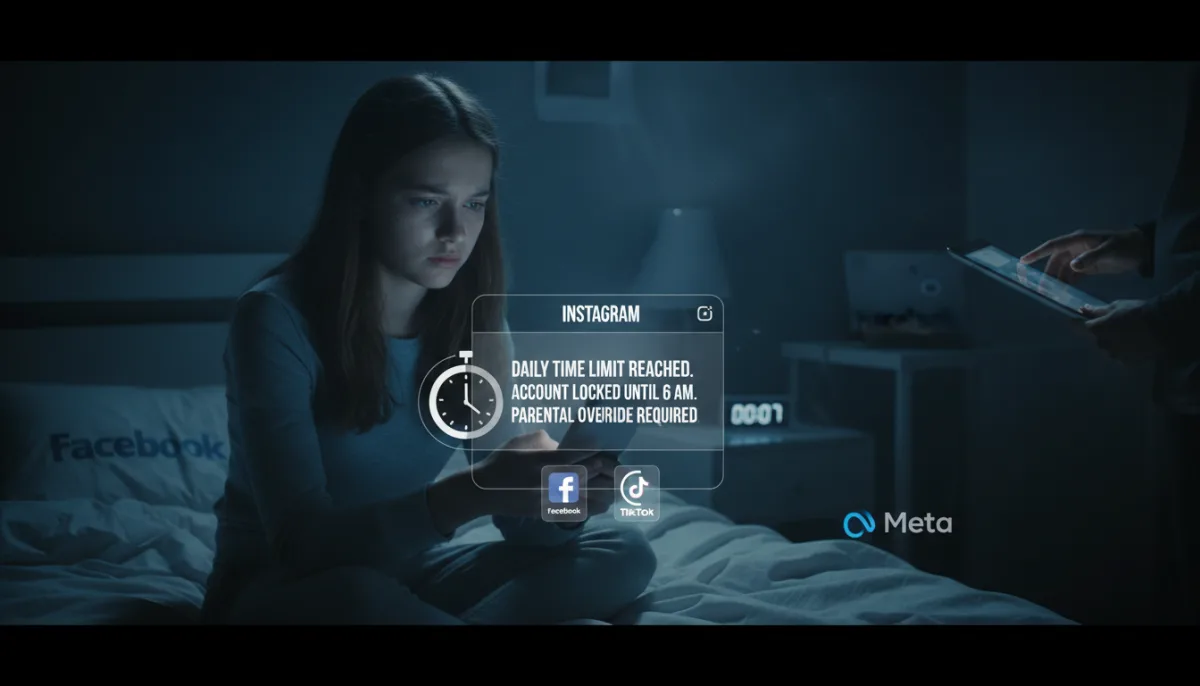
A landmark Meta teen safety settlement is fundamentally altering how adolescents use Facebook and Instagram, introducing strict daily time limits and overnight lockouts. Driven by a massive $18 billion agreement with U.S. states, the sweeping changes aim to curb social media addiction and provide parents with unprecedented oversight. However, the company is now leveraging billions of dollars to force rivals TikTok and YouTube to adopt the exact same restrictions.
This update directly impacts millions of teenage users and their parents, providing concrete tools to limit screen time while fundamentally changing the algorithmic nature of the platforms. Meta today confirmed it will implement major changes to its child safety features if the settlement is officially approved. The agreement arrives just before Meta CEO Mark Zuckerberg was scheduled to testify in a federal trial.
New Restrictions for Users Under 18
The settlement mandates a comprehensive overhaul of how teens interact with Meta's ecosystem. The following features will be enforced for all users under the age of 18:
- Time Limit: Teens face a two-hour daily limit combined across Facebook and Instagram, which can only be overridden by a parent.
- Night Mode: Accounts will be blocked from posting and viewing content between midnight and 6 a.m.
- School Mode: All notifications are automatically muted between 8 a.m. and 3 p.m.
- Prompts: The apps will issue warnings after every 15 minutes of continuous screen time, with additional alerts when daily usage hits 60 and 90 minutes.
- Feed Control: Teens can opt for a non-algorithmic feed that disables personalization through Meta's recommendation systems. Parents can mandate this setting.
- Autoplay Control: The ability to turn off autoplay will be available, and parents can require it to remain off.
- Hidden Likes: Likes and reactions on posts will be hidden by default for teen accounts.
- Filters: Access to cosmetic surgery and extreme makeup filters will be entirely blocked.
- Age Assurance: Meta will strengthen its detection tools to catch users under 13, and ensure those aged 13 to 17 are placed in appropriate experiences.
- Parental Controls: Parents will receive periodic usage updates and notifications if a teen links a second account or interacts with suspicious profiles.
- Direct Messages: Notably, direct messages are completely exempt from the Time Limit, Night Mode, and School Mode restrictions.
The $18 Billion Payout and the TikTok Ultimatum
To resolve the litigation, Meta will pay approximately $18 billion to participating states over a 10-year period to fund online youth safety initiatives. While substantial, this figure is significantly lower than the company's 2025 net income of $60.5 billion, and far below the $200 billion in civil penalties that states like California, Colorado, Kentucky, and New Jersey were originally seeking. Florida has declined the settlement and will continue litigation, while New Mexico was excluded after winning its own case earlier this year.
In a highly unusual move, Meta is intentionally withholding $5.3 billion of the settlement funds unless competitors TikTok and YouTube implement identical safety measures. Meta posted an open letter demanding that both rival platforms add a one-hour daily limit, a night mode, and age assurance protocols, while also paying $5.3 billion each to match Meta's withheld funds.
If TikTok and YouTube agree to these terms, Meta has promised to lower its own daily usage limits from two cumulative hours to just one hour per app, and expand its Night Mode to run from 10 p.m. to 7 a.m.
The Competitive Strategy Behind the Safety Mask
Meta's aggressive callout of TikTok and YouTube reveals the underlying business anxiety driving this settlement. By implementing strict two-hour limits and overnight lockouts, Meta risks a massive exodus of teenage users who will simply migrate to unrestricted competitor platforms. Withholding $5.3 billion is a calculated strategy to weaponize a legal defeat into an industry-wide standard, ensuring Meta does not suffer a unilateral drop in engagement and ad revenue.
Furthermore, the explicit exemption of Direct Messages from all time limits and curfews highlights a critical loophole. Meta knows that private messaging is the stickiest feature for user retention. By keeping DMs active 24/7, the company ensures teens remain tethered to the ecosystem for communication, even when their public feeds are locked down. This settlement is as much about leveling the competitive playing field as it is about protecting adolescents.
This article was written by AI from reporting by macrumors.com.