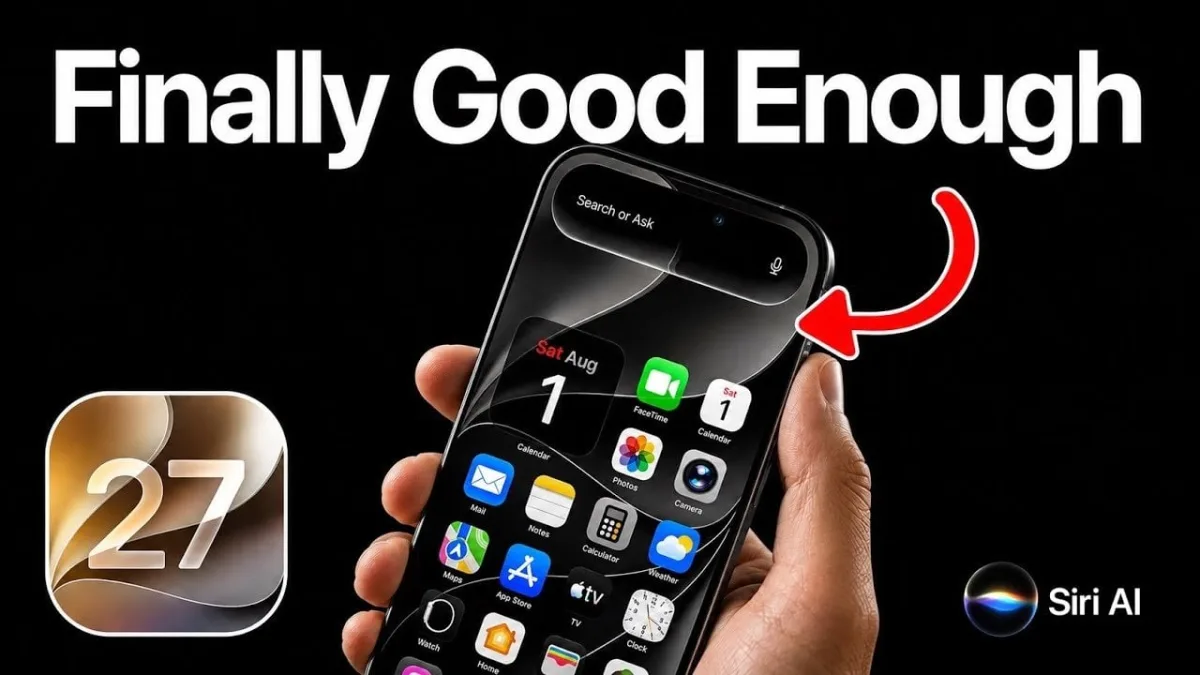
Apple's upcoming iOS 27 update is directly targeting the most persistent user complaints: battery drain and sluggish artificial intelligence. With the rollout of developer beta 4 and public beta 2, the new operating system demonstrates significant strides in power optimization and introduces a vastly smarter Siri capable of on-screen contextual awareness.
For iPhone users holding onto older devices or relying heavily on multitasking, this update promises to extend daily longevity and streamline workflows. By deeply integrating advanced AI into the core system, Apple is enabling users to execute complex tasks without constantly jumping between third-party applications.
Siri's AI Evolution: Reading the Screen
The standout feature of the iOS 27 update is the comprehensive overhaul of Siri's underlying architecture. Moving beyond basic voice commands, the assistant now utilizes advanced artificial intelligence to interact directly with what is currently displayed on your device.
According to testing highlighted by iDeviceHelp, Siri's new capabilities drastically reduce the need for external AI platforms. The key enhancements include:
- Improved contextual awareness: Siri can now understand and respond to the specific content actively visible on your screen.
- Seamless contact integration: The assistant leverages your personal network for highly personalized, context-aware interactions.
- Expanded global knowledge: Siri delivers more accurate, detailed answers to complex queries directly within the native interface.
These upgrades make routine tasks - such as scheduling appointments based on a text message or retrieving detailed information from a webpage - significantly faster and more precise compared to iOS 26.
Reviving Older iPhones: Battery and Performance
Battery performance has historically been a major pain point, particularly for aging hardware. The iOS 27 update directly addresses this with aggressive power management optimizations. While early beta iterations were inconsistent, the current developer beta 4 and public beta 2 have stabilized power consumption.
Users can expect extended battery life even during intensive usage, alongside reduced power draw specifically tailored to enhance the longevity of older devices. Beyond battery life, Apple has prioritized a fluid user experience by eliminating UI lag and choppiness, even when the device is operating in low power mode.
System stability has also seen a major boost. Applications launch faster, animations are smoother, and resource-heavy tasks like gaming or video editing run without triggering overheating or crashes. Additionally, Apple has enhanced Face ID functionality, allowing for quicker biometric recognition in low-light environments.
How to Navigate the Beta Rollout
Currently, iOS 27 remains in its testing phase. Apple is expected to roll out developer beta 5 and public beta 3 in early August 2026. Based on the company's historical release cadence, the final, stable version is anticipated to launch in mid-September.
If you want to test the new features early, follow these actionable guidelines:
- Use a secondary device: Beta software inherently contains bugs that can disrupt daily tasks. Never install a beta on your primary work phone.
- Monitor app compatibility: While developers report fewer compatibility issues in this cycle, essential banking or enterprise apps may still crash.
- Wait for September if unsure: If your device is critical for daily communication and productivity, waiting for the official mid-September release is the safest strategy.
The Invisible Moat Around Apple's Ecosystem
The most consequential shift in the iOS 27 update isn't just the battery life - it is Apple's strategic move to neutralize third-party AI competitors. By granting Siri on-screen contextual awareness, Apple is effectively cutting out the middleman. When your native OS can read the webpage you are looking at and summarize it instantly, the friction of copying text and pasting it into a standalone AI app becomes obsolete.
This deep system-level integration is something external developers simply cannot match due to iOS sandboxing restrictions. As we approach the mid-September launch, this update signals a clear warning to third-party AI platforms: Apple is building an invisible moat around its user base, ensuring that the most seamless AI experience is the one built directly into the iPhone itself.