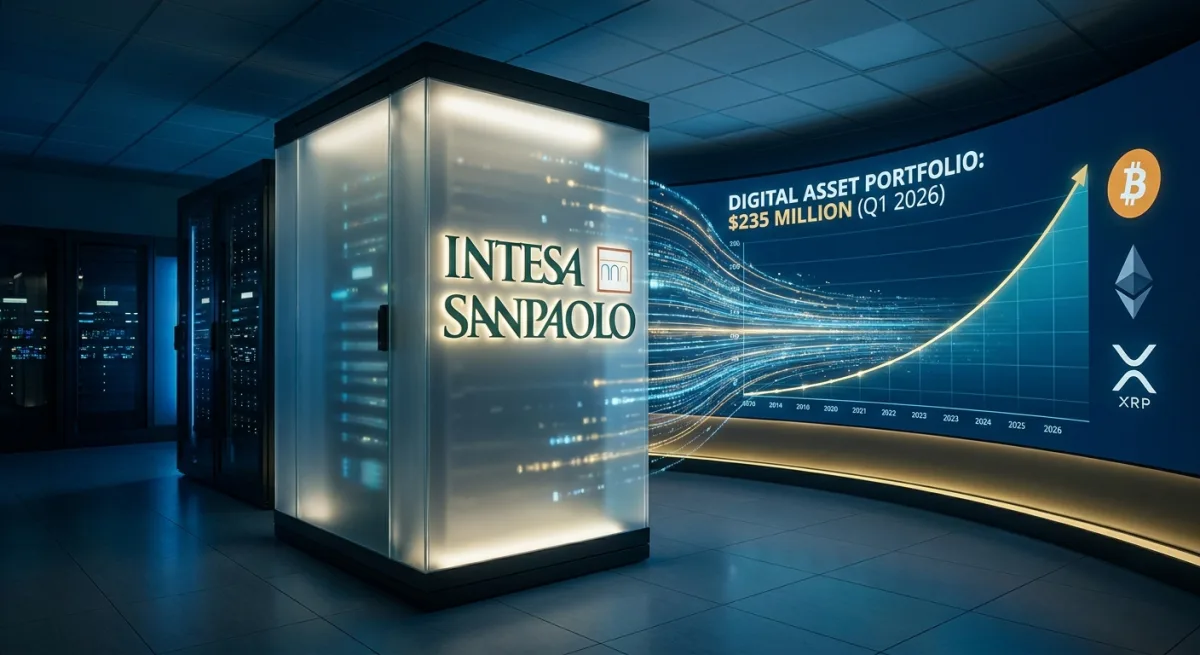
Italy's largest bank, Intesa Sanpaolo, has aggressively expanded its digital asset footprint, more than doubling its Intesa Sanpaolo crypto portfolio to $235 million in the first quarter of 2026. Up from approximately $100 million at the end of 2025, this surge highlights a calculated institutional pivot toward diversified cryptocurrency holdings. The bank's latest filings reveal a strategic shift away from certain altcoins in favor of established Bitcoin and Ethereum exchange-traded funds.
The portfolio growth was primarily driven by expanded Bitcoin positions through the ARK 21Shares BTC ETF and BlackRock's iShares Bitcoin Trust ETF. Marking a significant milestone, Intesa Sanpaolo entered the Ethereum market for the first time via BlackRock's iShares Staked Ethereum Trust. The bank also acquired a fresh $26 million stake in Ripple's XRP through the Grayscale XRP Trust ETF. In its first derivatives play within the sector, the institution opened a new position in iShares Bitcoin Trust call options. These holdings are currently maintained for proprietary trading purposes, though it remains undisclosed whether they serve as hedges for professional client products.
Equities Reshuffle and the Solana Exit
While accumulating major market-cap assets, Intesa Sanpaolo drastically reduced its exposure to Solana. The bank's position in the Bitwise Solana Staking ETF was slashed from 266,320 shares down to a mere 2,817, representing a near-total exit from the asset. This reallocation extended into the bank's crypto-related equity holdings, where it made several decisive adjustments.
The institution acquired 165,600 shares of BitGo for the first time while completely liquidating its position in Bitmine. Additionally, Intesa closed out its put options on MicroStrategy, increased its Coinbase shares from 1,500 to 10,357, and trimmed its stake in Cantor Equity Partners II - the vehicle associated with tokenization firm Securitize. These equity moves align with the bank's deepening operational ties to the sector, following last month's development where Ripple announced it would provide custody services to the Italian banking group.
The European Banking Crypto Wave
Intesa Sanpaolo's aggressive accumulation reflects a broader trend across the European financial landscape. Major institutions are rapidly transitioning from crypto-skeptics to active market participants. Banks like Spain's BBVA, France's BPCE, and Belgium's KBC have already launched retail trading services. BBVA now offers 24/7 Bitcoin and Ether trading through its mobile app, while BPCE is targeting 12 million customers by 2026 via its regulated subsidiary, Hexarq.
At the foundational infrastructure level, a consortium of 12 major European banks - including BNP Paribas, ING, UniCredit, and Deutsche Bank - has formed Qivalis. This joint venture aims to issue a MiCA-compliant, euro-backed stablecoin, targeting a launch in the second half of 2026, signaling that European banks are building proprietary ecosystems rather than relying solely on external crypto networks.
The Institutional Flight to Regulated Quality
Intesa Sanpaolo's Q1 reshuffle is a textbook example of institutional risk management in the Web3 era. By dumping its Solana staking ETF and pivoting heavily into BlackRock's Bitcoin and Ethereum trusts, the bank is clearly prioritizing regulatory clarity and deep liquidity over higher-yield, higher-risk altcoin plays. The $26 million entry into the Grayscale XRP Trust, coupled with their direct custody partnership with Ripple, suggests a targeted strategy to leverage assets with established institutional utility.
More importantly, the formation of the Qivalis stablecoin consortium by rival European banks indicates that the continent's financial sector is preparing for a post-MiCA reality. Intesa's aggressive portfolio expansion isn't just speculative trading; it is a defensive positioning maneuver. As European competitors build native stablecoin infrastructure and roll out retail crypto trading, holding a robust, diversified digital asset portfolio becomes a mandatory baseline for tier-one banks looking to maintain relevance in the next decade of decentralized finance.