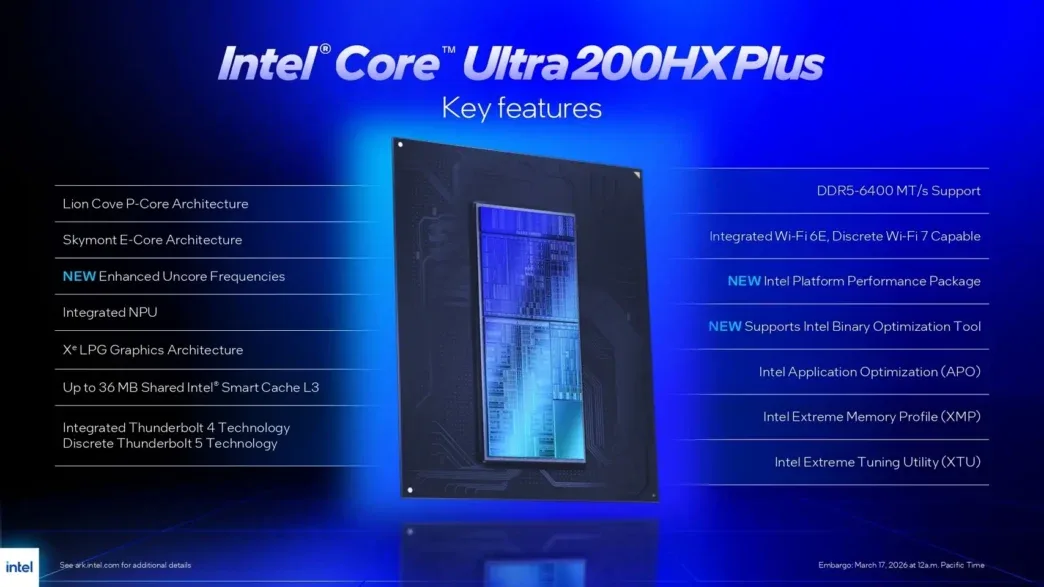
Intel has officially unveiled its new Arrow Lake Refresh laptop processors, introducing the flagship Core Ultra 9 290HX Plus and the Core Ultra 7 270HX Plus for high-end gaming laptops. These enthusiast-grade chips aim to deliver modest generational gains and reduced system latency for premium portable powerhouses. The announcement signals Intel's continued push to dominate the mobile PC hardware space with desktop-class performance.
This hardware update is crucial for hardcore gamers, creative professionals, and PC hardware enthusiasts looking to invest in top-tier mobile workstations. By boosting die-to-die frequencies and integrating new optimization tools, these processors enable smoother 4K gaming and faster rendering workflows on the go. Buyers planning to upgrade from older architectures will see the most significant return on investment.
The mobile PC gaming market continues to demand uncompromising performance in portable form factors, driving manufacturers to refine their silicon architectures. While the generational leap from the previous Core Ultra 9 285HX is iterative, the massive gains over older architectures highlight Intel's strategy to capture users upgrading from aging machines. This release sets the stage for the next wave of ultra-premium gaming laptops hitting the market.
Architectural Upgrades and Performance Metrics
The new Arrow Lake Refresh lineup is spearheaded by the Core Ultra 9 290HX Plus, which boasts a robust configuration of 24 cores and 24 threads. It is accompanied by the Core Ultra 7 270HX Plus, which features a slightly scaled-back 20 cores and 20 threads. Both processors are specifically pushed further for hardware enthusiasts and feature the Intel Binary Optimization Tool, designed to improve native performance in select games.
According to Intel's reference materials, the flagship Core Ultra 9 290HX Plus delivers an 8 percent increase in gaming performance over the last-generation Core Ultra 9 285HX. However, the performance delta becomes massive when compared to older hardware. Intel claims a staggering 62 percent uplift in 1080p gaming on high settings when compared to the four-year-old Alder Lake Core i9-12900HX processor, which featured 16 cores and 24 threads.
In creative applications, the performance narrative remains consistent. Intel's internal charts indicate that the Core Ultra 9 290HX Plus scores 7 percent higher than the Core Ultra 9 285HX in Cinebench 2026 single-thread performance. Furthermore, it achieves a 30 percent higher score than the older Core i9-12900HX in the same benchmark. Currently, Intel has not released equivalent test claims for the Core Ultra 7 270HX Plus.
| Processor Model | Cores / Threads | Gaming Performance Gain (vs i9-12900HX) | Cinebench 2026 Single-Thread Gain (vs 285HX) |
|---|---|---|---|
| Core Ultra 9 290HX Plus | 24 / 24 | + 62% (1080p High) | + 7% |
| Core Ultra 7 270HX Plus | 20 / 20 | Undisclosed | Undisclosed |
| Core Ultra 9 285HX (Previous Gen) | Undisclosed | Baseline for Gen-on-Gen | Baseline |
| Core i9-12900HX (Alder Lake) | 16 / 24 | Baseline for 4-Year Upgrade | - 30% (vs 290HX Plus) |
Hardware Integration and OEM Rollout
Beyond core counts, the new Arrow Lake Refresh chips will feature up to a 900MHz boost to the die-to-die frequency. This specific architectural enhancement is engineered to reduce system latency by increasing the speed of the link between the CPU and the memory controller. Such low-level improvements are critical for maintaining high frame rates in demanding PC gaming scenarios.
Intel's performance charts showcased test results running on an MSI Titan 18, a massive gaming laptop that costs nearly $6,000. This specific test rig was previously reviewed with the older Core Ultra 9 285HX chip and an NVIDIA RTX 5090 Laptop GPU, proving to be a formidable machine for 4K gaming. While Intel has not announced an exact launch date for laptops featuring the new chips, the company confirmed that OEMs like Asus, Acer, MSI, Alienware, Lenovo, HP, and Razer will launch new models soon.
My Take
Intel's marketing strategy for the Core Ultra 200HX Plus series is highly revealing of the current PC hardware landscape. By openly acknowledging a modest 8 percent gen-on-gen gaming improvement while heavily emphasizing the 62 percent leap over the four-year-old Core i9-12900HX, Intel is clearly targeting the pandemic-era laptop upgrade cycle. They know that users with last year's hardware have no reason to upgrade, but those sitting on Alder Lake machines are prime targets for these new $6,000 flagship systems.
Frequently Asked Questions
What are the core counts for the new Intel processors?
The flagship Core Ultra 9 290HX Plus features 24 cores and 24 threads, while the Core Ultra 7 270HX Plus comes with 20 cores and 20 threads.
How much faster is the Core Ultra 9 290HX Plus?
Intel claims it offers an 8 percent gaming performance increase over the previous Core Ultra 9 285HX, and a 62 percent uplift in 1080p gaming compared to the older Core i9-12900HX.
When will laptops with these new CPUs be available?
While an exact release date is undisclosed, major OEMs including Asus, Acer, MSI, Alienware, Lenovo, HP, and Razer are expected to launch new models soon.
This article was written by AI from reporting by theverge.com.