Consumer indecision is the silent killer of conversion rates, a psychological friction point that legacy home improvement brand Behr explicitly identifies as "paint paralysis." To combat this massive drop-off at the point of purchase, the latest Behr digital marketing strategy completely reengineers the customer journey. By blending generative artificial intelligence, targeted influencer campaigns, and a strategic e-commerce pivot, the company is transforming how consumers navigate the highly visual and often overwhelming process of color selection.
According to recent research commissioned by the brand, home improvement shoppers heavily rely on social media for top-of-funnel inspiration, whether they are executing a DIY project or hiring a professional. However, this inspiration frequently fails to translate into bottom-of-funnel action. The data reveals a critical bottleneck: 40% of respondents cited deciding on a color as the most difficult step in the process. More alarmingly for marketers, 40% of consumers completely abandon their projects solely due to their inability to make a final color choice.
There’s definitely a need for helping consumers get from before to after faster.
- Andy Lopez, Chief Marketing Officer, Behr
This staggering abandonment rate forced the company to rethink its digital touchpoints. Under the leadership of newly elevated Chief Marketing Officer Andy Lopez, the brand is leaning heavily into these consumer insights to map and eliminate the specific pain points that derail project completion. The resulting digital transformation strategy focuses on making the color selection process more connected, inquisitive, and ultimately, confidence-building for the end user.
Architecting the ChatHue AI Agent with Google Cloud
To directly address the cognitive overload of color selection, Behr partnered with Google Cloud to develop a highly specialized artificial intelligence agent. Launched in July 2025, the AI-powered assistant, dubbed ChatHue, was engineered to guide consumers toward the perfect hue through personalized, conversational recommendations. This is not a generic chatbot; it is a sophisticated deployment of enterprise AI tailored for a specific retail friction point.
From a technical marketing perspective, ChatHue represents a deep integration of proprietary brand data and advanced cloud infrastructure. The agent was built utilizing Behr’s extensive internal color database combined with Google Cloud’s robust AI platforms, specifically leveraging Gemini, Vertex AI, BigQuery, and Cloud Run. This architecture allows the system to process natural language queries and cross-reference them against thousands of proprietary color profiles in real time.
However, the initial text-based guidance proved insufficient for a product that is inherently visual. In March, the brand and Google Cloud deployed a critical update, adding advanced color visualization capabilities to ChatHue. This allowed consumers to see how recommended colors would actually look in real-world spaces, bridging the gap between abstract advice and concrete visual proof. According to Lopez, this specific visualization upgrade successfully boosted customer satisfaction by 15%, proving that AI in marketing must be highly contextualized to the product experience.
Nostalgia-Driven Influencer Activation
While AI handles the technical side of color matching, Behr’s digital marketing strategy also leverages human connection to build consumer confidence. This spring, the brand launched a highly targeted social media campaign that cleverly tapped into the growing nostalgia trend across platforms like Instagram and TikTok. The campaign urged users to call a newly introduced hotline to get their DIY and paint questions answered directly by popular creators.
The activation featured five prominent creators, including popular real estate and DIY influencers, some boasting millions of followers. They appeared in a video holding phones against vibrant backgrounds, set to an upbeat soundtrack. By stating, "Let’s be honest… You have painting questions," the campaign directly acknowledged the consumer's primary pain point before offering a tangible, retro-style solution.
The engagement metrics validate the approach. The primary video generated over 13,000 likes, and more importantly, drove high-intent action, with more than 3,400 consumers actually calling into the hotline. By combining the massive reach of modern influencer marketing with the analog intimacy of a phone hotline, the brand successfully cut through standard social media noise to provide genuine, value-added assistance.
Decoupling Brand Experience from E-Commerce
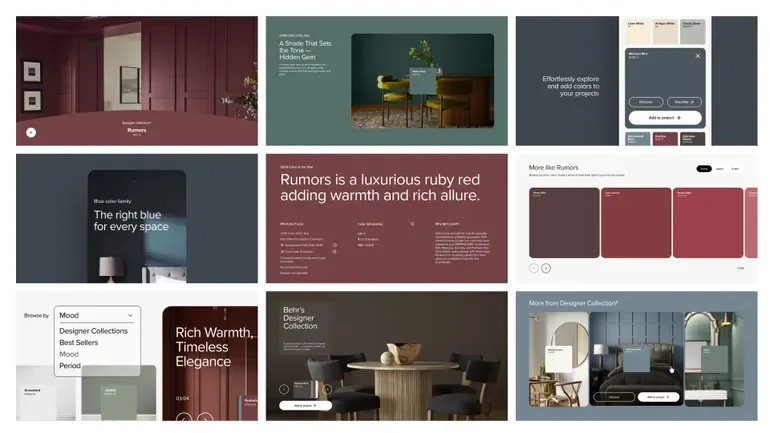
Perhaps the most strategic maneuver in Behr's digital transformation is its approach to web architecture and e-commerce. Recognizing that its target audience - which now includes a growing segment of millennial, Gen Z, and Hispanic consumers - needs inspiration more than a standard digital shopping cart, the company recently relaunched its website. The new platform was intentionally redesigned to serve as a "color destination" rather than a traditional e-commerce storefront.
The site is now optimized purely for navigation, understanding, and confidence-building. To handle the actual transactional phase of the customer journey, the brand shifted its e-commerce operations entirely to the website and physical stores of its exclusive partner, The Home Depot. This allows Behr to focus its digital resources entirely on user experience (UX) and overcoming "paint paralysis," while leveraging The Home Depot's massive logistical infrastructure for fulfillment.
This omnichannel alignment requires intense cross-functional collaboration. Lopez emphasized that marketing, product strategy, research and development, finance, and sales must all operate with a shared understanding of the consumer's challenges. By aligning these internal disciplines with their retail partner, the brand ensures a seamless transition from the digital inspiration phase directly through to the physical purchase.
The Strategic Blueprint for Legacy Retail Brands
The Behr digital marketing strategy offers a masterclass in identifying and systematically dismantling a specific conversion barrier. By isolating "paint paralysis" as the primary culprit behind a 40% project abandonment rate, the marketing team avoided the trap of generic brand awareness campaigns. Instead, they deployed technology and creative capital exclusively toward building consumer confidence at the exact moment of friction.
The decision to offload direct e-commerce to The Home Depot while transforming Behr.com into a pure UX-driven "color destination" is particularly brilliant. It acknowledges that for highly visual, high-consideration DIY products, the brand's primary digital job is not to process credit cards, but to eliminate doubt. When a brand successfully uses tools like Vertex AI and targeted influencer hotlines to remove that doubt, the actual transaction becomes an inevitable byproduct rather than a forced conversion.
This article was written by AI from reporting by marketingdive.com.