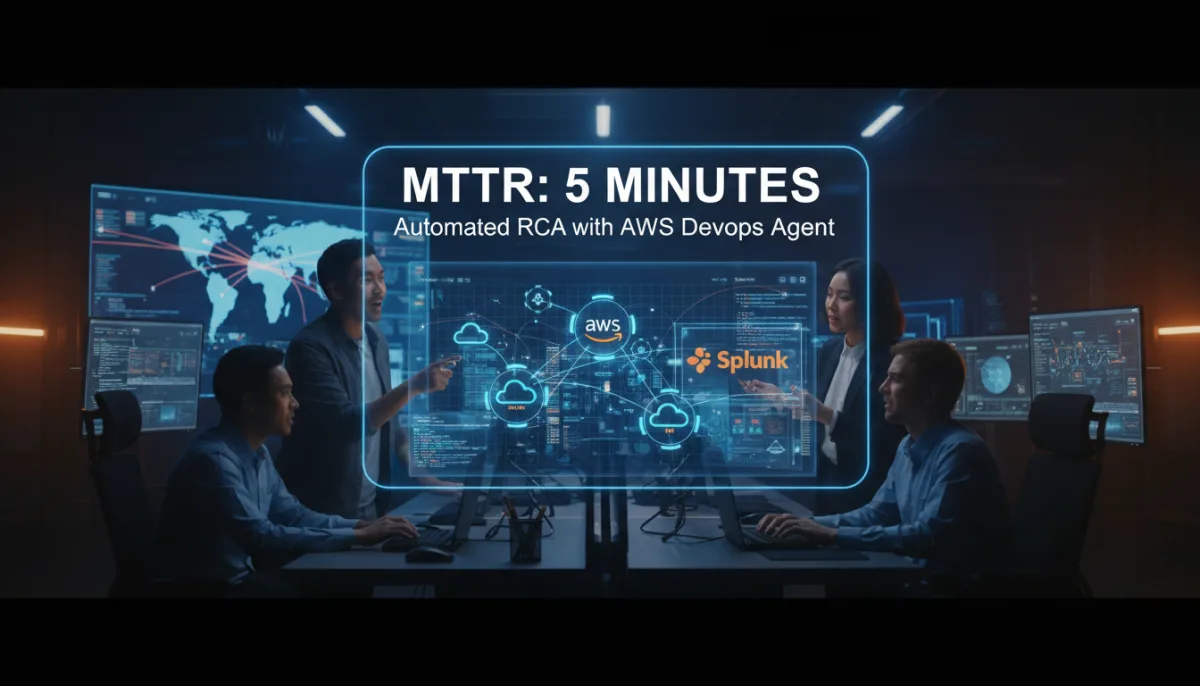
When performance degrades across distributed cloud applications, operations teams often lose critical time manually correlating signals across multiple tools. The new AWS DevOps Agent integration with Splunk automates end-to-end root cause analysis (RCA), reducing mean time to resolution (MTTR) from hours to minutes. By leveraging AI-driven investigations, teams can now pinpoint issues across AWS and external systems without manual log hunting.
The MTTR Challenge in Distributed Systems
Distributed applications span dozens of microservices, multiple AWS accounts, and hybrid infrastructure. Root causes can originate anywhere, from a misconfigured connection pool to a downstream dependency hitting rate limits. Traditional incident response relies heavily on manual queries and the institutional knowledge of on-call engineers.
This manual approach leads to inconsistent MTTR and operator fatigue. A senior engineer might resolve an issue in 30 minutes, while a newer team member covering the same rotation might take hours to escalate the problem, creating a reactive operational posture that does not scale.
How AWS DevOps Agent and Splunk Work Together
AWS DevOps Agent acts as an always-on operations teammate built on Amazon Bedrock AgentCore. It operates within isolated logical containers called Agent Spaces, which unify AWS accounts, telemetry sources, code repositories, and external tools into a single governed context. The agent builds topology intelligence by auto-discovering resources and mapping dependencies across your application architecture.
Operating read-only via an AWS Identity and Access Management (IAM) role, the agent maintains an immutable audit journal of every reasoning step. Crucially, it extends its reach by connecting to external observability platforms via the Splunk MCP Server, available on AWS Marketplace. This allows the agent to combine discoveries from Splunk with AWS-native signals like Amazon CloudWatch metrics and AWS CloudTrail API activity.
Actionable Guide: Setting Up the Integration
To enable autonomous investigations triggered directly from Splunk alerts, follow these configuration steps:
- Create an Agent Space that includes your AWS accounts, repositories, and telemetry sources.
- Connect the Splunk MCP server as a tool within your Agent Space using a bearer token created by your Splunk administrator.
- Add the AWS DevOps Agent webhook URL to your Splunk webhook allow list by navigating to Settings, Server settings, and then Webhook allow list.
- Configure webhooks in Splunk to receive and send alerts by selecting the custom header option instead of standard authorization.
Real-World Scenario: Healthcare Claims Processing
Consider a healthcare claims processing pipeline where AWS Lambda functions orchestrate intake and Amazon Elastic Container Service (ECS) containers handle batch adjudication. If a sudden traffic spike causes an external clearinghouse API to exhaust its rate limit, Splunk detects the anomaly and fires a webhook to the AWS DevOps Agent. The agent's Triage persona uses pre-built topology to immediately identify the blast radius without manual tracing.
The Root Cause Analysis persona then queries Amazon CloudWatch metrics to rule out internal infrastructure failures before using the Splunk MCP to confirm HTTP 429 rate-limit responses starting at 17:25 UTC. The agent correlates request volume, identifying 2,737 total HTTP 429 responses versus only 655 successful ones, representing an 80.7% failure rate. Finally, the Mitigation persona delivers a plan, such as implementing exponential backoff with jitter, in under 8 minutes.
Actionable Guide: Clean Up Resources
To avoid ongoing charges after testing the integration, remove resources in this specific order:
- Disable or delete the alert action in Splunk that triggers the AWS DevOps Agent (Splunk webhook alert actions).
- Delete the Agent Space by selecting it in the AWS DevOps Agent console, choosing Actions, and clicking Delete agent space.
- Delete the associated IAM roles (DevOpsAgentRole-AgentSpace and DevOpsAgentRole-WebappAdmin) and any customer managed policies prefixed with AIDevOps in the IAM console.
The End of the Manual War Room
The integration of AWS DevOps Agent with Splunk represents a fundamental shift in incident response, moving the industry away from reactive, manual war rooms. By reducing a complex cross-domain investigation to under 8 minutes, AWS is proving that AI agents are ready for production-grade operational tasks. The real breakthrough here isn't just the speed; it is the cross-domain correlation.
Without the Splunk MCP connection, AWS telemetry would only show Lambda timeouts and Amazon SQS queue growth, leaving engineers blind to the external API failure. This architecture sets a new standard for observability, where existing alerting logic - refined over months - becomes the starting point for an autonomous investigation rather than just a page waiting for a human to wake up and respond.
This article was written by AI from reporting by aws.amazon.com.