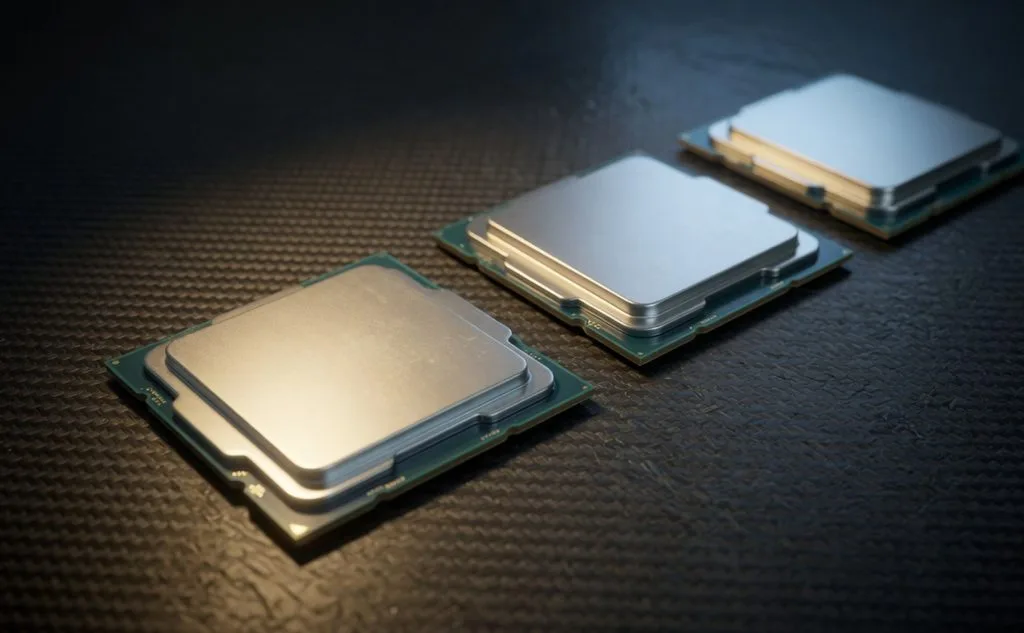
PC builders who believe CPU innovation has stagnated need to look closely at the evolution of AMD Ryzen 7 processors over the last two years. The leap from the Zen 3-based 5800X3D to the new AMD Ryzen 9800X3D delivers a massive 50% performance increase, proving that desktop silicon is still making generational strides. These comparable 8-core chips, all equipped with 3D V-Cache, demonstrate exactly how modern processors are evolving beyond simple clock speed bumps.
According to Geekbench 6 data, the performance trajectory is staggering. The 2024 chip is 47% faster on a single core than its 2022 predecessor, and 58% faster when utilizing all cores. Surprisingly, raw frequency did not drive this massive gain. The maximum boost clock only increased by 15%, moving from 4.5 GHz on the 5800X3D to 5.2 GHz on the AMD Ryzen 9800X3D.
The Architectural Shift: Wider Cores and More Transistors
To understand how AMD extracted 50% more performance from a mere 15% clock speed increase, you have to look at the transistor count. The total number of transistors surged from roughly 11 billion in Zen 3 to 16 billion in Zen 5. Crucially, most of these extra transistors were invested directly into the core itself, rather than just expanding the cache.
AMD's strategy was to make the core significantly wider, giving it more instructions to process simultaneously. The dispatch width increased from a maximum of 6 instructions per cycle to 8. Meanwhile, the reorder buffer grew from 256 entries to 448, allowing the processor to keep far more instructions in flight and schedule them with greater efficiency.
| Processor | Architecture | Single-Core Score | Multi-Core Score | Max Boost |
|---|---|---|---|---|
| 5800X3D (2022) | Zen 3 | 2,016 | 11,832 | 4.5 GHz |
| 7800X3D (2023) | Zen 4 | 2,426 | 15,508 | 5.0 GHz |
| 9800X3D (2024) | Zen 5 | 2,969 | 18,751 | 5.2 GHz |
The 512-Bit SIMD Upgrade
Memory and data parallelism also received substantial upgrades to feed these wider cores. The L2 cache per core doubled from 512 KB to 1 MB, while the L1 data cache expanded from 32 KB to 48 KB. Integer ALUs (Arithmetic Logic Units) were also bumped from 4 to 6, providing more raw computational muscle per cycle.
For data parallelism (SIMD), the Zen 5 architecture is fundamentally a different machine. While Zen 3 and Zen 4 relied on four 256-bit SIMD arithmetic units, Zen 5 upgrades this to four 512-bit units. Loads and stores were widened to match, now capable of handling two 512-bit loads and one 512-bit store per cycle, drastically increasing the amount of data the CPU can move and process at once.
The End of the Megahertz Myth
This architectural breakdown highlights a critical reality for the future of PC hardware: we have firmly entered the era of instruction-level parallelism. Because pushing clock speeds past 5.5 GHz yields diminishing returns and massive thermal penalties, AMD's strategy of widening the pipeline is the only sustainable path forward for desktop performance.
Looking ahead to the upcoming Zen 6 architecture, the implications are massive. With reports pointing to a 256-core Epyc processor codenamed 'Venice' featuring a gigabyte of L3 cache, the desktop variants are poised to be incredibly dense. However, this hardware widening means the bottleneck now shifts to software developers. Game engines and heavy applications must be explicitly optimized to feed these massive 512-bit pipelines and 8-wide dispatch queues, otherwise, those billions of extra transistors will simply sit idle.