Unplanned manufacturing downtime costs the industry billions of dollars annually, turning minor equipment faults into massive supply chain disruptions. By integrating artificial intelligence with Power BI predictive maintenance, plant operators can now detect mechanical anomalies weeks before a catastrophic failure halts the production line. This shift from reactive repairs to data-driven foresight is fundamentally changing how modern factories operate.
Manufacturing plants operate in highly interconnected environments where a single failure cascades across warehouses, suppliers, and logistics networks. Common causes of this downtime include unexpected equipment failures, mechanical wear and component degradation, electrical faults, poor maintenance planning, human error, limited visibility into equipment performance, and delayed identification of operational issues. To combat this, organizations are abandoning outdated maintenance schedules in favor of continuous, intelligent monitoring.
The Shift from Preventive to Predictive Intelligence
Historically, facilities relied on reactive maintenance - repairing equipment only after it broke down - or preventive maintenance, which involves scheduled servicing based on calendar intervals. While preventive measures reduce unexpected failures, they introduce significant inefficiencies into the production cycle.
The limitations of traditional preventive maintenance include:
- Healthy components may be replaced unnecessarily.
- Maintenance schedules rarely reflect actual equipment conditions.
- Hidden issues can still develop between scheduled inspections.
- Organizations often struggle to optimize their maintenance resources effectively.
Predictive maintenance changes the core operational question from "Why did the machine fail?" to "Is this machine showing early signs of failure?" By continuously analyzing operational data, maintenance teams can schedule repairs during planned production windows, drastically reducing operational disruptions and improving overall asset reliability.
How AI and IIoT Detect Early Warning Signs
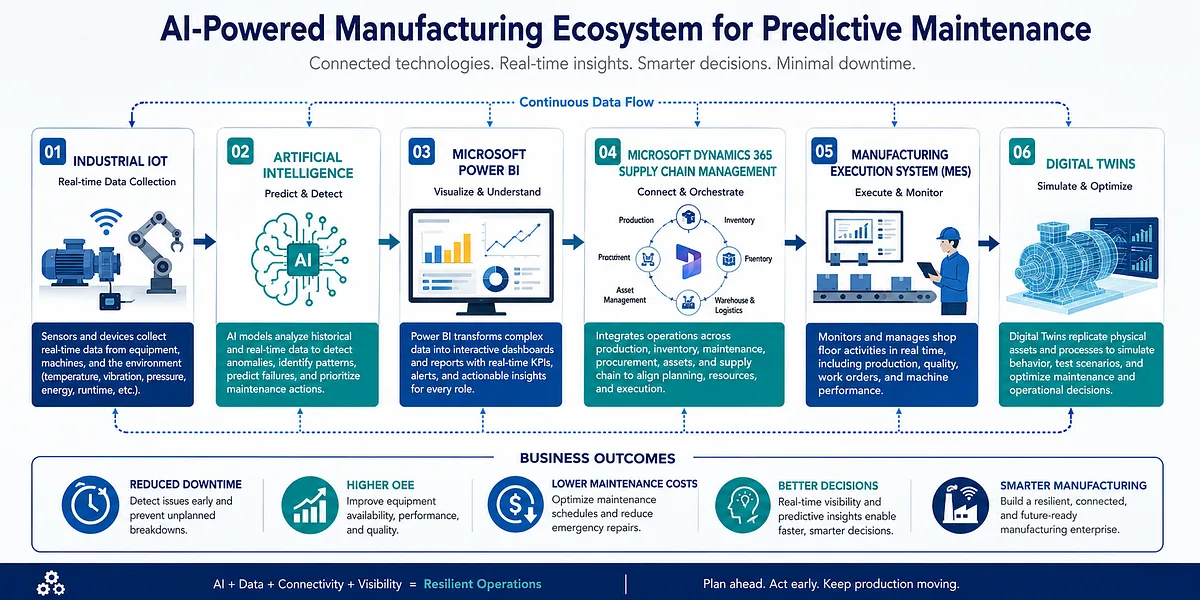
Modern manufacturing facilities generate millions of data points every second. Industrial Internet of Things (IIoT) devices serve as the foundation for this predictive infrastructure. Common data sources include temperature sensors, vibration sensors, pressure sensors, flow meters, energy monitoring systems, motor current measurements, and environmental monitoring devices.
Without AI, identifying meaningful patterns within this massive dataset is impossible. AI models continuously analyze this telemetry to detect subtle trends - such as a motor's vibration levels gradually increasing alongside rising operating temperatures - that indicate early bearing wear. This proactive approach delivers several critical benefits:
- Detect equipment anomalies earlier.
- Prioritize maintenance activities based on risk.
- Improve asset reliability.
- Reduce emergency maintenance.
- Increase equipment availability.
- Support more informed operational decisions.
Visualizing Operations with Power BI Dashboards
Identifying a potential issue is only half the battle; decision-makers need a clear, real-time view of operational performance to act effectively. This is where Microsoft Power BI transforms raw operational data from Programmable Logic Controllers (PLCs), Manufacturing Execution Systems (MES), and Enterprise Resource Planning (ERP) platforms into actionable intelligence.
When an AI model identifies an abnormal trend, Power BI immediately visualizes the critical context:
- Equipment health scores.
- Assets at highest risk of failure.
- Production lines affected.
- Estimated maintenance priorities.
- Maintenance backlog.
- Overall Equipment Effectiveness (OEE).
- Downtime trends.
- Equipment utilization.
- Energy consumption patterns.
These insights are distributed across specialized interfaces. The Equipment Performance Dashboard tracks machine availability and efficiency, while the Maintenance Performance Dashboard monitors overdue work orders and technician workloads. Simultaneously, the Production Dashboard displays reject rates and delays, feeding into an Executive Operations Dashboard that gives leadership a consolidated view of KPIs across multiple facilities.
This centralized visibility answers critical operational questions: Which production line is operating below expected efficiency? Which equipment requires immediate maintenance? Which assets have experienced recurring failures? How is downtime affecting production output? Where are maintenance costs increasing? Which facilities are achieving the highest asset utilization?
Integrating Dynamics 365 and Digital Twins
Manufacturing analytics reach their full potential when connected to enterprise business processes. By integrating Power BI with Microsoft Dynamics 365 Supply Chain Management, operational data becomes accessible across the entire organization, breaking down departmental silos.
This deep integration provides several strategic advantages:
- Production orders can be analyzed alongside machine performance.
- Inventory availability can be monitored together with maintenance schedules.
- Equipment failures can be correlated with production delays.
- Procurement teams gain visibility into spare parts inventory before maintenance activities begin.
- Executive teams receive a complete operational picture through a single dashboard.
Furthermore, organizations are leveraging Digital Twin technology to create virtual representations of physical assets. When AI flags an anomaly, engineers can use the Digital Twin to simulate equipment degradation over time, test alternative maintenance schedules, evaluate the production impacts of planned shutdowns, optimize resource allocation during maintenance, and refine equipment replacement strategies before making physical changes on the factory floor.
Implementation Strategy and Future Trends
Successful implementation requires a strong data foundation across all production equipment and IIoT devices. Manufacturers must focus on measurable business outcomes, such as reducing equipment downtime, improving OEE, lowering maintenance costs, increasing asset utilization, and improving production planning. Starting with high-value assets allows teams to demonstrate ROI before scaling the technology.
As the Industry 4.0 landscape matures, future manufacturing environments will rely increasingly on advanced technologies:
- AI-assisted maintenance planning.
- Autonomous production monitoring.
- Intelligent scheduling.
- Digital Twins for operational simulation.
- Connected Industrial IoT ecosystems.
- Decision intelligence platforms.
- Generative AI for operational insights.
- AI copilots that assist maintenance and production teams.
The Strategic Edge of Supply Chain Elasticity
While the immediate benefit of Power BI predictive maintenance is keeping machines running, the deeper value lies in supply chain elasticity. When an AI model forecasts a motor failure three weeks in advance, it does more than just trigger a routine work order for the maintenance team.
This foresight allows procurement teams to dynamically adjust raw material intake, preventing inventory bottlenecks. Simultaneously, it enables sales departments to reroute fulfillment from other facilities without missing customer delivery commitments. By connecting machine-level telemetry to enterprise-level planning, maintenance transforms from a reactive cost center into a proactive shield that protects profit margins during volatile market conditions.