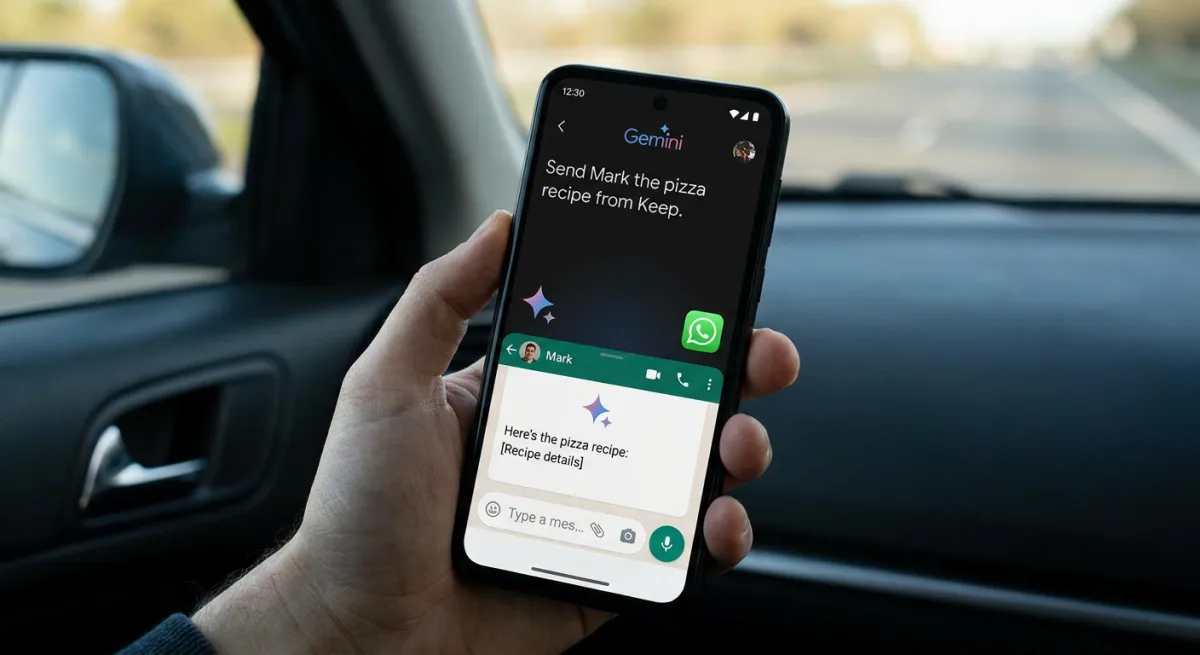
The goal of a true AI assistant is to take actions where users already spend their time, rather than forcing them into isolated chat windows. Google's Gemini has officially evolved from a passive chatbot into an active operating system bridge, allowing users to instantly fire off messages and initiate calls directly through WhatsApp using natural text or voice prompts. This integration marks a significant leap from the rigid voice-to-text commands of the past, turning the AI into a genuine cross-app agent.
Unlike the legacy Google Assistant, which could only dictate a string of words without contextual awareness, Gemini treats WhatsApp as an extension layer for the rest of the smartphone's ecosystem. It can reason, connect data points between different applications, and execute multi-step workflows that previously required manual copying and pasting.
How to Enable the WhatsApp Extension
Before utilizing hands-free messaging, users must manually enable the integration. This setting is strictly limited to the mobile application and cannot be accessed via the Gemini web interface. Furthermore, Google has made this feature an Android-exclusive privilege; the toggle is currently missing from iOS devices.
- Open the Gemini app on a compatible Android device and tap your profile icon.
- Navigate to the Settings menu, then select Personal Intelligence.
- Tap on Connection Apps.
- Scroll down and flip the toggle to enable the WhatsApp extension.
Cross-App Workflows in Action
According to hands-on testing by Android Police, the true power of this integration lies in its ability to pull data from other Google services directly into a WhatsApp chat. For example, a user can issue a single prompt: "Get my pizza recipe from Google Keep and send it to Mark on WhatsApp." Because Gemini has access to connected apps, it silently retrieves the specific note, drafts a clean message, and preps it in the chat window, entirely removing the friction of app-switching.
The system also handles spatial reasoning seamlessly. If a user says, "Find the travel distance from my place to Daytona Beach and send the details to my friend on WhatsApp," Gemini works behind the scenes to hit Google Maps. It calculates the route, extracts the key travel details, formats them into a readable draft, and pulls up the exact conversation. It connects the data and builds the context automatically.
Hands-Free Messaging in Android Auto
The WhatsApp integration also extends to Android Auto, replacing rigid legacy voice commands with natural language processing. Drivers can hit the microphone icon on their car's display or hold the steering wheel voice button to initiate a command.
For instance, a driver can say, "Send a WhatsApp to Sonal that I am coming home in around 10 minutes." The system processes the natural speech, confirms the action via the Android Auto interface, and executes the command flawlessly, allowing the driver to communicate without taking their eyes off the road. Beyond WhatsApp, Google has also optimized Gemini to work with other third-party tools like Spotify for seamless media control.
The OS-Level Orchestrator We Have Been Waiting For
This WhatsApp integration is exactly what the future of mobile productivity should look like. By allowing Gemini to reach into Google Keep, query Google Maps, and format that data directly into a third-party messaging app, Google is finally delivering on the promise of an OS-level AI orchestrator. It transforms the assistant from a fun tech gimmick into an essential, hands-free command center.
Strategically, keeping this feature exclusive to Android is a calculated move by Google. By locking iOS users out of these deep cross-app workflows, Google is positioning Android as the superior platform for AI-driven productivity. As Apple Intelligence prepares to roll out its own contextual app integrations, Google has already established a high benchmark for how seamlessly an AI should bridge the gap between first-party data and third-party communication tools.
This article was written by AI from reporting by androidpolice.com.