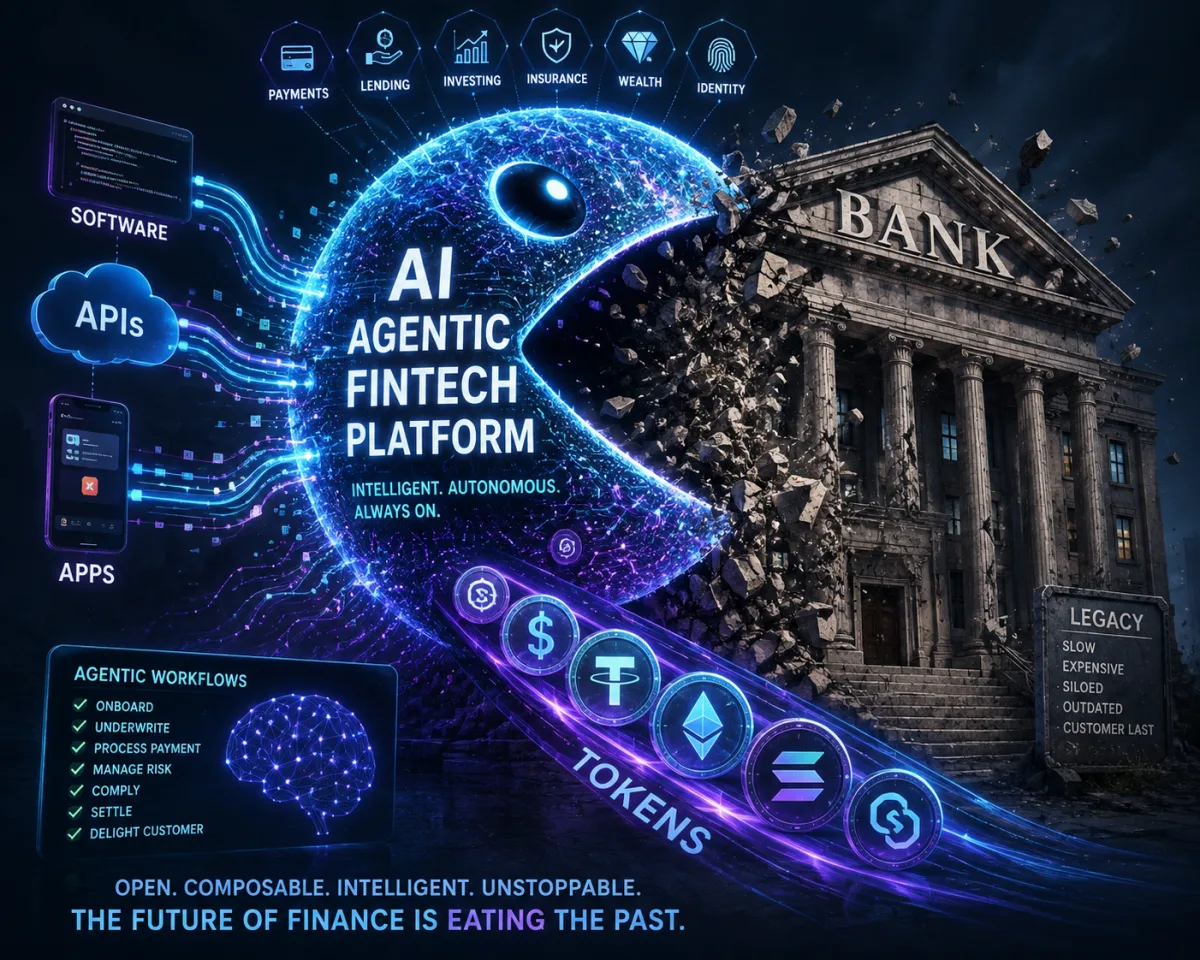
The traditional boundary between fintech startups and legacy banks is rapidly collapsing. What began two decades ago as a mission to unbundle inefficient banking services has transformed into a massive rebundling effort, with technology companies now absorbing core financial infrastructure. Fintech is no longer just disrupting the banking sector; it is actively consuming it from the inside out.
This structural shift is accelerating across global markets, driven by aggressive expansions and regulatory backing. Recent developments highlight how rapidly these platforms are scaling into full-fledged financial institutions. Key market movements this week include:
- European fintechs aggressively entering the US banking market.
- Revolut securing a French banking license to fuel its European expansion.
- Robinhood launching zero-fee digital asset trading in the UK.
- The FCA Scale-up Unit officially welcoming ClearScore, Modulr, and Zilch to boost UK fintech growth.
The Rise of Embedded Finance and Rebundling
Ten years ago, startups focused on solving single points of friction. Wise attacked international transfers, Klarna transformed consumer credit, and Stripe simplified merchant payments. Today, these same companies are building comprehensive financial ecosystems. Revolut is transitioning into a global bank, while Robinhood increasingly resembles a digital financial supermarket.
This evolution is powered by embedded finance, which fundamentally changes where financial transactions occur. Consumers no longer need to visit a bank to secure a loan or a dedicated provider to buy insurance. Instead, credit, payments, and treasury services are integrated directly into the software platforms and retail workflows where customers already spend their time. The underlying regulated institution providing the balance sheet often remains entirely invisible to the end user.
Agentic AI: The New Financial Decision Maker
While embedded finance changes where services are delivered, artificial intelligence is changing who makes the financial decisions. Historically, digital banking simply provided humans with better interfaces to manage their money. Now, agentic AI is shifting that dynamic by understanding user goals, analyzing available choices, and executing actions autonomously.
When embedded finance and AI converge, finance transitions from a destination to a background process. An AI agent can automatically determine how much cash to keep in a current account, route excess liquidity to high-yield options, or select the most cost-effective foreign exchange route. The customer relies on the agent's intelligence rather than loyalty to a specific banking brand.
The Threat of the "Dumb Pipe" Bank
The architecture of digital finance is moving rapidly from apps, APIs, and AI toward a future dominated by agents, tokens, and data. As AI agents take over the customer interface, traditional banks face a severe existential risk: becoming mere utility providers, or "dumb pipes," that supply the regulated balance sheet while tech companies capture all the margin and customer loyalty.
To survive this transition, legacy banks cannot simply launch better apps; they must integrate their services into the exact platforms where these AI agents operate. Institutions that fail to adapt their infrastructure for programmable money and agent-driven transactions will find themselves entirely disintermediated by the very fintechs they once dismissed as niche disruptors.