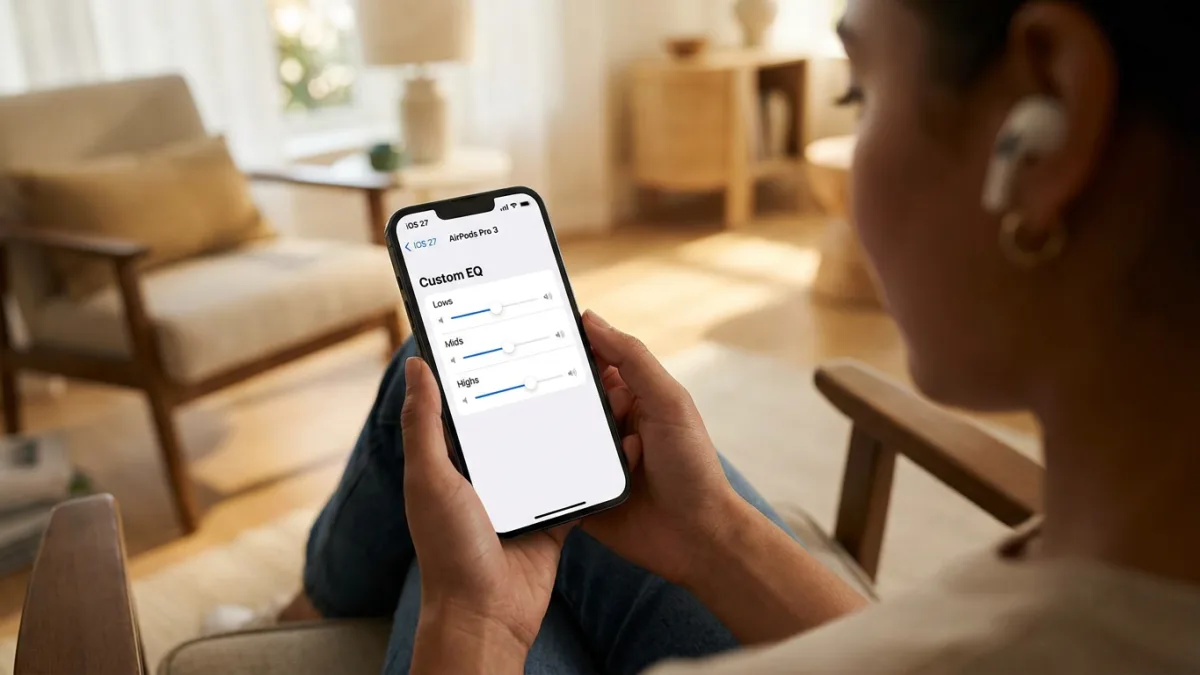
Apple is finally handing over the audio reins to its users with a long-awaited custom EQ feature for its wireless earbuds. Rolled out quietly alongside the release of iOS 27, the latest firmware update introduces a three-band equalizer that lets listeners manually tweak their sound profile for the first time. The update carries build number 9A350 for the AirPods 5, while the rest of the supported lineup receives build 9A348.
The firmware update is rolling out to a wide range of Apple's audio hardware. The official support list includes the AirPods Pro 3, AirPods 4, AirPods 4 with Active Noise Cancellation, AirPods 5, AirPods 5 with Wireless Charging Case, AirPods Pro 2 (both Lightning and USB-C variants), and the AirPods Max 2.
However, the flagship custom EQ capability is not universally available across all updated devices. Apple has restricted the new equalizer strictly to models powered by the H2 chip, which limits access to the AirPods Pro 2, AirPods Pro 3, AirPods 4, and AirPods Max 2.
How to Access and Use Custom EQ
Apple does not offer a manual installation button for audio firmware. The update installs automatically when the earbuds are charging and within Bluetooth range of an iPhone, iPad, or Mac connected to Wi-Fi. Once the firmware is updated, users can access the new audio controls directly from their device.
- Navigate to the Settings app and select your connected AirPods from the top menu.
- Scroll down to the "Audio and Routing" section to find the new custom EQ feature.
- Adjust the three available sliders for lows, mids, and highs to match your personal preference.
- Play a track from Apple Music directly within the Settings menu to hear your adjustments applied in real time.
Beyond the Equalizer: New iOS 27 AirPods Features
The custom EQ is the headline addition, but iOS 27 introduces several other notable upgrades for Apple's audio ecosystem. These changes focus heavily on interface organization and deeper ecosystem integration.
- Settings app redesign: The AirPods interface has been reorganized, featuring dedicated menus for Hearing Health, Find My, and Live Translation.
- Adaptive Audio slider: Users now have a dedicated slider to fine-tune the intensity of the Adaptive Audio mode.
- GymKit expansion: The full GymKit experience is now available directly through the iPhone and AirPods Pro 3, removing the previous Apple Watch requirement.
- Precision Finding: Apple Watch owners can now use Precision Finding within the Find My app to locate a misplaced pair of AirPods Pro 3.
- Siri AI integration: When paired with a compatible iPhone, supported earbuds can now interact directly with Apple's upgraded Siri AI.
The End of Apple's "We Know Best" Audio Era
For years, Apple’s audio philosophy relied heavily on computational audio and Adaptive EQ, essentially telling users that the H-series chips knew how to mix a track better than they did. By finally introducing a manual three-band EQ, Apple is conceding ground to audiophile demands and matching a standard feature long offered by competitors like Sony and Sennheiser.
While a three-band system is relatively basic compared to the granular multi-band equalizers found in dedicated audiophile applications, it represents a massive philosophical shift for the company. It acknowledges that subjective preference matters just as much as algorithmic perfection, especially as the AirPods Max 2 and AirPods Pro 3 push deeper into premium audio territory.