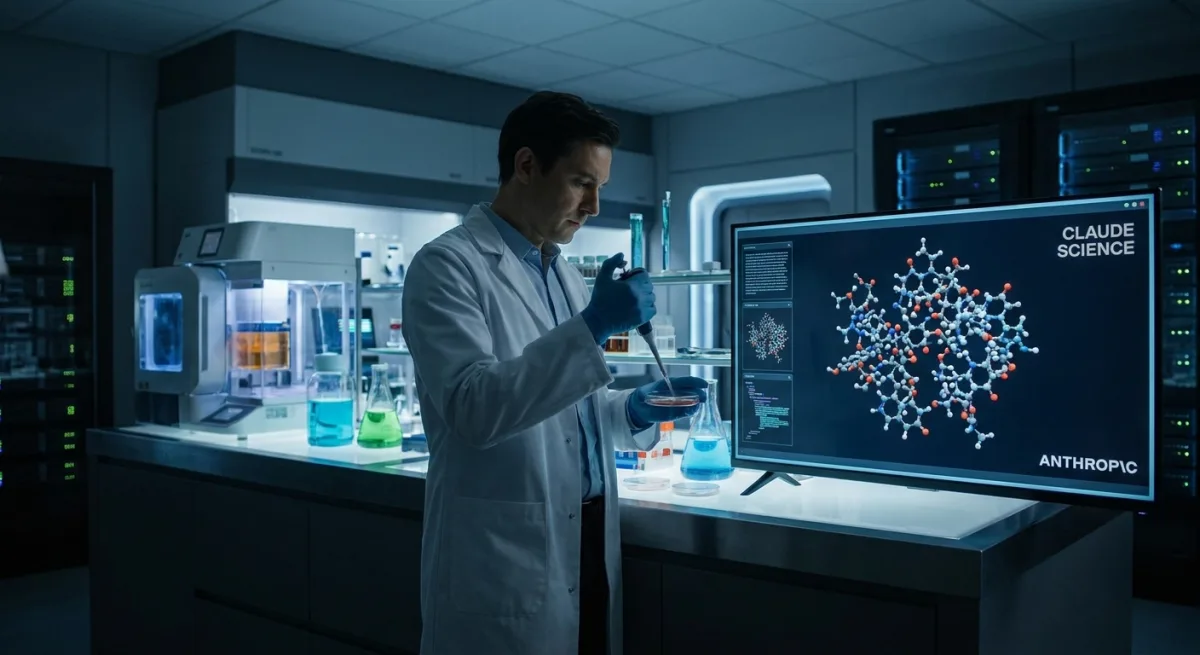
Anthropic is stepping beyond software to become a pharmaceutical player, announcing plans to develop its own drugs for neglected diseases. The ambitious pivot positions the AI giant in direct competition with the very biotech firms it hopes to court as customers. The announcement marks one of the most aggressive public attempts by a frontier AI company to transition from providing digital tools to conducting physical scientific research.
The revelation came during “The Briefing: AI for Science” event earlier this week, where the company also unveiled Claude Science. Billed as an AI workbench for scientists, the new platform consolidates fragmented datasets and research tools into a single environment capable of generating complex figures and visuals. Eric Kauderer-Abrams, Anthropic’s head of life sciences, framed the launch around generative AI's potential to dramatically accelerate healthcare interventions.
The Race for the AI Laboratory
While tech giants like OpenAI, Amazon, and Google have aggressively marketed their life sciences platforms, Anthropic is taking a more hands-on approach. The company is actively building its own wet labs and recruiting biologists, successfully poaching talent from Big Pharma and prestigious academic institutions. This places Anthropic in a crowded race alongside AI-first drug companies like Insilico and Google DeepMind spinout Isomorphic Labs.
However, the exact roadmap remains unclear. Anthropic has not disclosed what it will do if it discovers promising drug candidates, nor has it confirmed whether it will partner with established manufacturers for animal testing and clinical trials. Namshik Han, a professor at the University of Cambridge, noted that AI is already applied at every single stage of drug discovery, from finding new compounds to supporting data analysis.
People are right to get excited about advancing AI models, but they haven’t yet come close to making experiments unnecessary.
- Frank von Delft, University of Oxford
Despite the computational power of modern AI, the physical realities of medicine remain a massive hurdle. Matthew Todd, a professor at University College London, emphasized that the industry is still a long way off from an AI-designed drug being approved for human use. The lack of high-quality, publicly available experimental data continues to slow down development efforts across the board.
The Clinical Trial Bottleneck
Anthropic’s foray into drug development exposes the fundamental disconnect between Silicon Valley pacing and biological reality. Generative AI is exceptionally good at solving the "search" problem - scanning vast chemical possibilities to suggest new molecules or identify disease targets. However, finding a molecule is only the first, and arguably the easiest, step in a decade-long process.
The true bottleneck in pharma is not ideation; it is validation. Drug candidates must survive rigorous real-world testing for toxicity, efficacy, and stability. While some AI-developed candidates have recently entered clinical trials, no AI-designed drug has yet successfully navigated the FDA approval process to reach the market. Anthropic will quickly find that while code compiles in seconds, human biology demands years of methodical, highly regulated experimentation.
By targeting "neglected" diseases, Anthropic is making a strategic calculation. These areas often lack the massive R&D funding of mainstream conditions, providing a less crowded proving ground for Claude Science to demonstrate its value. If Anthropic can successfully shepherd a drug from a digital prompt to a physical pharmacy shelf, it won't just validate its AI models - it will fundamentally disrupt the traditional pharmaceutical business model.