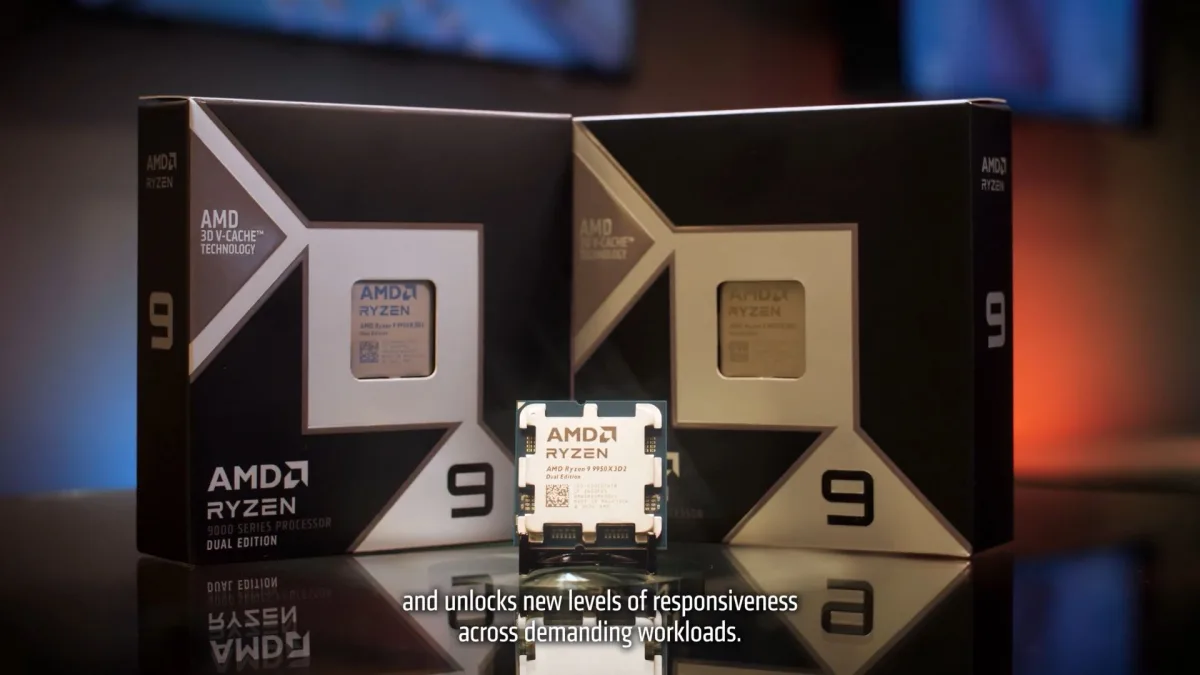
The new AMD Ryzen 9 9950X3D2 Dual Edition processor has officially arrived, bringing an unprecedented 208 MB of total cache to the mainstream desktop market. Designed specifically for extreme PC enthusiasts and professional creators, this 16-core Zen 5 powerhouse eliminates the traditional compromise between high-end gaming and heavy productivity workloads. By utilizing dual 3D V-Cache chiplets across both Core Complex Dies (CCDs), AMD is pushing desktop performance boundaries further than ever before.
This architectural shift represents a major evolution from previous generations, where the extra cache was limited to a single CCD. The massive 208 MB cache pool is achieved through a combination of 192 MB of L3 cache and 16 MB of L2 cache. Because both CCDs now have direct access to the expanded memory, the processor significantly reduces latency by storing more data closer to the cores. This design ensures superior performance across select applications, large software builds, and complex gaming environments.
Performance Gains and Power Delivery
According to statements from AMD executive Jack Huynh on Twitter, the new processor delivers a 5% to 10% performance increase over the standard Ryzen 9 9950X3D. Huynh noted that the chip is incredible in firsthand lab testing, emphasizing its dual capability for both gaming engine compiles and AI model processing. This makes it an ideal solution for complex content creation pipelines where memory bandwidth is a critical bottleneck.
To support this massive cache and maintain high clock speeds, AMD has increased the Thermal Design Power (TDP) to 200W. This is a notable jump from the 170W rating of the standard 9950X3D, providing the necessary thermal and electrical headroom to boost performance even further. The processor maintains a base clock of 4.3 GHz and can boost up to 5.6 GHz under optimal cooling conditions.
Official Specifications and Availability
The processor is scheduled to launch globally on April 22, 2026. While the official pricing remains undisclosed at this time, the hardware specifications confirm its position at the absolute top of the Zen 5 product stack.
| Specification | Details |
|---|---|
| Architecture | Zen 5 |
| Cores / Threads | 16 / 32 |
| Base / Boost Clock | 4.3 GHz / 5.6 GHz |
| L3 Cache | 192 MB |
| L2 Cache | 16 MB |
| Total Cache | 208 MB |
| TDP | 200W |
For more details on the architecture, users can visit the official AMD product page.
My Take
The introduction of the AMD Ryzen 9 9950X3D2 Dual Edition is a watershed moment for desktop computing, primarily because it finally solves the asymmetrical cache scheduling issues that plagued earlier X3D models. By equipping both CCDs with 3D V-Cache, AMD has removed the need for the operating system to guess which cores should handle gaming threads versus background tasks. This unified approach guarantees that latency-sensitive applications will always have access to the massive 192 MB L3 pool, regardless of which core is executing the instruction.
Furthermore, the decision to push the TDP to 200W is a clear signal of AMD's aggressive market strategy. They are no longer just aiming for power efficiency; they are actively securing the absolute performance crown against Intel's upcoming architectures. For professional creators who also game, the historical advice was to buy a high-clocking standard chip for work and an X3D chip for play. This 208 MB behemoth effectively destroys that paradigm, offering a single, albeit likely expensive, solution that compromises on absolutely nothing.
This article was written by AI from reporting by wccftech.com.