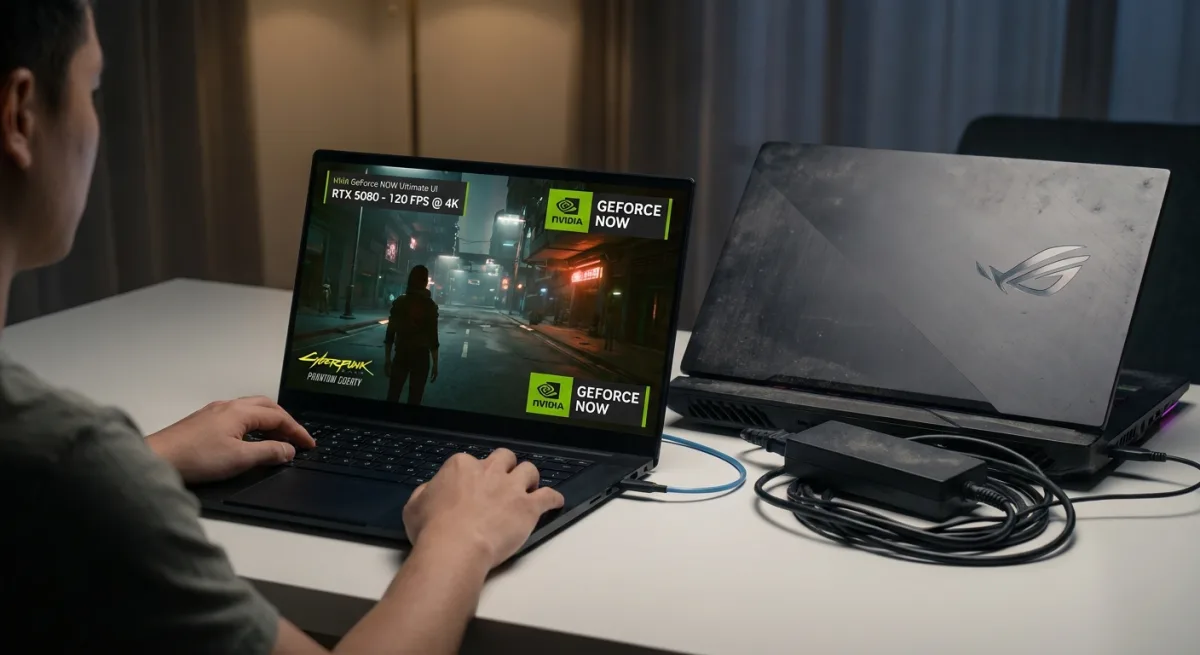
Dropping $3,000 on a high-end gaming laptop feels like a necessary evil for peak performance, until a $20 monthly subscription completely invalidates that investment. The RTX 5080 tier of Nvidia GeForce Now Ultimate has evolved into a service so responsive and visually flawless that it makes premium local hardware seem obsolete. For PC gamers exhausted by skyrocketing GPU prices and jet-engine fan noise, cloud streaming has officially crossed the threshold from a compromised alternative to a superior daily driver.
This shift fundamentally changes how players should approach their next hardware upgrade. Instead of spending thousands on a machine that will inevitably age, users with stable fiber internet can now access desktop-class path tracing on lightweight ultrabooks or aging systems.
RTX 5080 Server Specs and Pricing
Nvidia’s top-tier subscription delivers the power of a server-grade RTX 5080 for $20 a month, or $200 for a six-month package. To put that into perspective, a standalone Gigabyte GeForce RTX 5080 - featuring 16GB of memory, a 360W TDP, and 10,752 CUDA cores - retails for around $1,499. The cloud tier grants access to a staggering 62 TFLOPS of compute power and 48GB of VRAM, enabling 120 FPS at 4K resolution.
For players using high-refresh-rate monitors at lower resolutions, the service scales to 360 FPS at 1080p and 240 FPS at 1440p. It also fully integrates Nvidia DLSS 4.0 features, including AI-boosted frame generation, to maintain fluid performance in demanding titles. However, Nvidia enforces a 100-hour monthly playtime cap, limiting users to roughly 22 hours of streaming per week. A minimum broadband connection of 45 Mbps is also required to maintain a stable 4K stream at 120 FPS.
Native Hardware vs. Cloud Streaming
Running modern titles natively on a $3,000 Asus ROG Zephyrus G14 comes with significant physical drawbacks. When pushing the laptop's hardware to its limits, turbo mode generates over 52 dB of fan noise, completely ruining the audio immersion of story-driven games unless paired with noise-canceling headphones. In contrast, streaming those same titles via Chrome or the dedicated Nvidia app produces zero local system noise.
The latency gap has also closed dramatically. Nvidia claims its Ultimate tier operates at around 30ms of latency or lower. During testing with path-traced titles like Pragmata, Indiana Jones and the Great Circle, and Resident Evil Requiem, the input response felt indistinguishable from native rendering. The UI is highly intuitive, offering a console-like experience that seamlessly supports various controllers.
The Inevitable Decline of Mid-Tier Gaming Laptops
The sheer value proposition of Nvidia GeForce Now Ultimate exposes a growing vulnerability in the gaming laptop market. When a $20 subscription can deliver whisper-quiet, path-traced 4K gaming with imperceptible latency, the justification for buying a $3,000 portable heater evaporates. The 100-hour monthly cap is the only real friction point, but for the vast majority of working adults, 22 hours a week is more than enough.
As AI data centers continue to drive up the cost of native silicon, cloud gaming is no longer just a budget alternative; it is the premium experience. Hardware manufacturers will soon need to rethink their mobile strategies, as players increasingly realize that a basic OLED ultrabook paired with a fiber connection offers a vastly superior, quieter, and cheaper gaming ecosystem.
This article was written by AI from reporting by makeuseof.com.