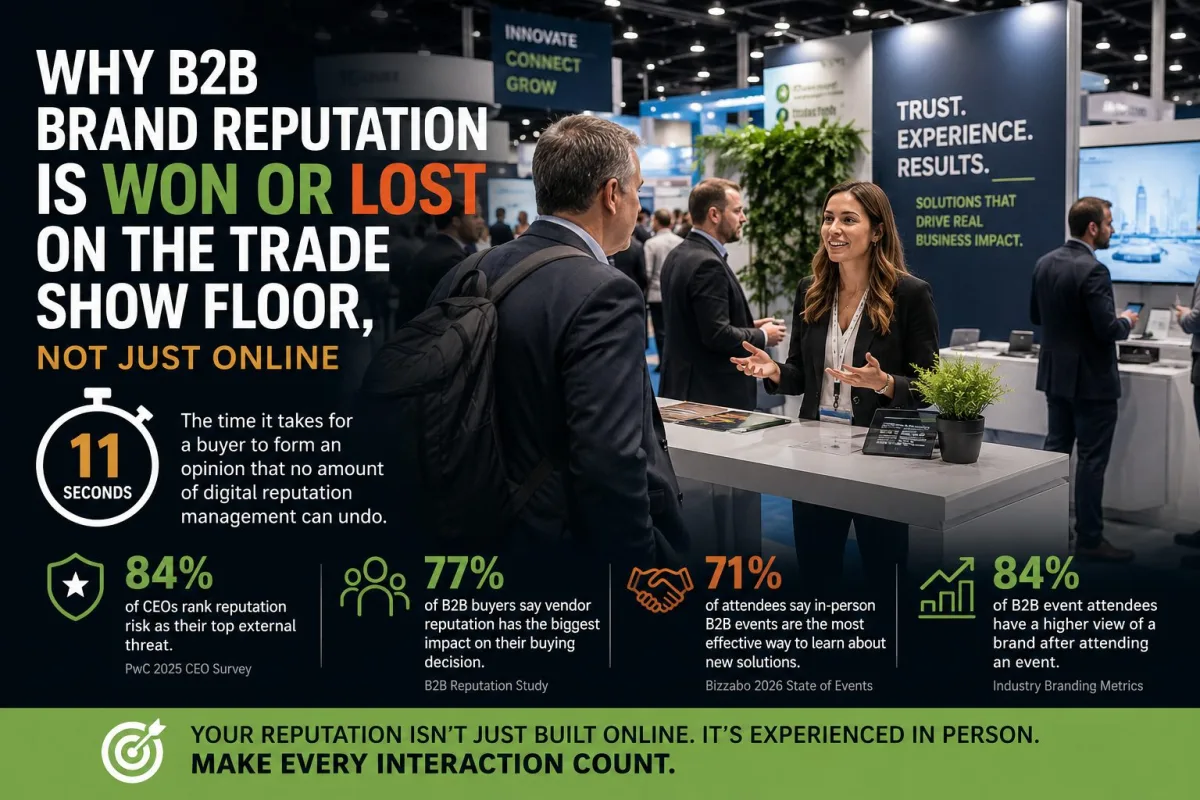
A CEO walks a trade show floor, stops at a competitor’s booth for eleven seconds, and forms an opinion that no amount of digital reputation management will undo before the next quarter’s renewal conversation. This rapid, in-person judgment happens constantly at the exact events where B2B companies invest the least strategic effort in protecting their brand. While marketing teams pour resources into review response protocols and AI search visibility, the physical, face-to-face side of B2B brand reputation is often relegated to a mere logistics function.
According to PwC’s 2025 CEO Survey, 84% of global CEOs now rank reputation risk as their top external threat, surpassing both cyber and regulatory risks. However, a critical misallocation of resources occurs when nearly all resulting investments flow exclusively into digital monitoring tools. Companies deploy sophisticated social listening platforms and SEO strategies to curate their online image, yet they neglect the executive briefing center or the sponsored conference booth.
This disparity creates a massive vulnerability in the overall marketing strategy. When a buyer experiences a disconnect between a polished digital presence and an underwhelming physical reality, the resulting cognitive dissonance immediately erodes trust. The physical dimension of reputation, formed in person and at scale, occurs in front of the exact buyers a company most needs to influence.
Why Direct Evidence Outweighs Digital Signals
B2B buyers place immense weight on vendor reputation before finalizing any purchase decision. Industry data reveals that 77% of B2B buyers consider vendor reputation the single most influential factor in their buying choice. Furthermore, 45% of firms report having lost major agreements or relationships directly due to unfavorable market perception.
While most reputation strategies attempt to mitigate this through consistent messaging across owned media, a trade show booth provides a fundamentally different signal. It delivers direct, unfiltered evidence. Buyers gather this data through their own senses, bypassing the mediated environments of review sites or curated LinkedIn feeds.
The LinkedIn 2025 B2B Marketing Benchmark, surveying 1,500 senior marketers, found that 94% agree trust is the definitive factor in B2B success. Additionally, 42% of these senior marketers rank increasing brand awareness and reputation among decision-makers as their top business priority for the year. Yet, the rigorous measurement applied to digital channels is rarely extended to physical brand presence.
The Hidden Cost of Inconsistent Brand Touchpoints
Event-specific research underscores the heavy influence of in-person experiences on the sales funnel (Sales Funnel). Bizzabo’s 2026 State of Events Benchmark Report indicates that 78% of event organizers view in-person conferences, summits, and conventions as their organization’s most impactful marketing channel. Crucially, 71% of attendees find these physical events the most effective way to evaluate new products or services, outperforming digital alternatives.
The reputational lift generated by a strong event presence is highly measurable. Industry branding metrics show that 84% of attendees at B2B marketing events report an improved view of a brand post-event. Achieving this same lift through digital-only campaigns requires exponentially more time, budget, and consistent effort.
Conversely, a poorly staffed or visibly under-funded booth acts as negative evidence. Buying committees conduct extensive research before engaging sales teams. If a company boasts a cutting-edge website but presents a forgettable booth, this inconsistency damages credibility. According to buyers, consumers lose trust when they see contradictory information across touchpoints.
This dynamic is becoming even more critical as AI-driven search engines and summarization tools begin to shape early-stage vendor perception. Executives increasingly use AI tools to research potential vendors before they even speak to a salesperson. The physical impressions made at trade shows often generate the word-of-mouth referrals, case studies, and earned media that feed these artificial intelligence systems.
Actionable Steps to Align Event Strategy with Reputation Management
To prevent physical touchpoints from undermining digital investments, organizations must pivot their approach and treat physical presence as a core reputation channel.
- Unify Reputation and Event Teams: Stop treating physical presence as a purely logistical function. Event planning, including the critical work of booking meetings before the show starts, must undergo the same reputation-conscious scrutiny as digital sentiment tracking.
- Implement Rigorous Post-Event Measurement: Deploy structured post-event surveys designed specifically to measure shifts in attendee perception. Link this data directly back to broader reputation metrics, treating it with the same weight as search visibility or review sentiment.
- Audit Digital and Physical Consistency: Conduct an explicit review of brand presentation before any major event. Do not assume existing brand guidelines will automatically translate to a physical space. If a brand emphasizes transparency and premium quality online, the booth experience must physically embody those exact traits.
Every dollar spent perfecting a digital reputation strategy can be undone by eleven unmanaged seconds at a booth nobody thought to brief properly.
- Peter Johnson, Digital Marketing Executive, Exhibit Elevate
The Human Anchor in an AI-Driven Search Landscape
Reputation management has matured into a highly sophisticated digital discipline, extending into AI search visibility and executive social presence. However, the physical dimension has dangerously lagged behind. As generative AI continues to commoditize digital content, making it harder for buyers to distinguish between genuine authority and synthetic marketing, physical events will become the ultimate verification mechanism.
In-person experiences move buyer perception faster and more durably than almost any digital channel currently measured. A forgettable physical presence does not simply fail to help; it actively robs a brand of the reliable, human-sourced information that modern reputation strategies increasingly rely on.
The organizations that dominate the next decade of B2B sales will not necessarily be those with the largest event budgets. Instead, they will be the companies that stop viewing the show floor as a logistics line item and start treating it as their most critical, high-stakes reputation channel.
This article was written by AI from reporting by webbiquity.com.