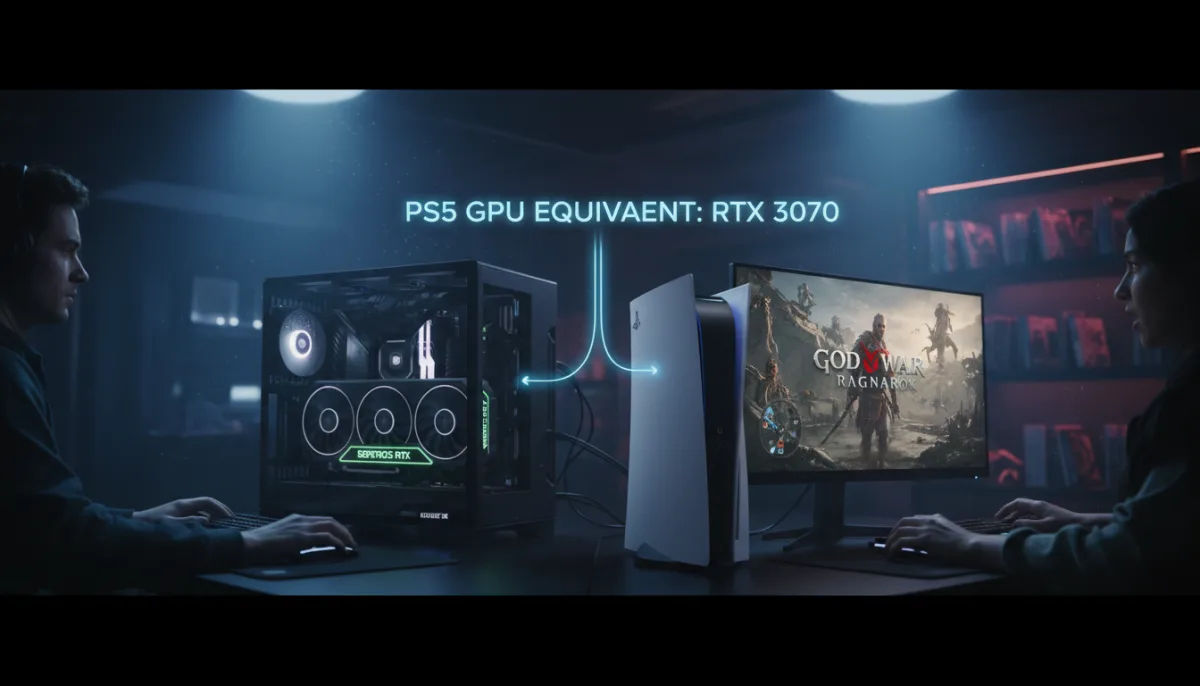
PC gamers looking to match the performance of Sony's current-generation console often wonder exactly which graphics card serves as the true PS5 GPU equivalent. While the PlayStation 5 relies on a highly customized AMD chip that cannot be bought off a store shelf, its real-world gaming output most closely aligns with the Nvidia RTX 3070. This places the console firmly in the mid-range bracket of PC hardware, delivering comparable frame rates and performance metrics at 1440p resolutions.
On paper, the PlayStation 5 is powered by a GPU featuring 36 compute units (Compute Units) running at a variable clock speed that peaks at 2.23 GHz. This architecture generates roughly 10.29 teraflops of raw compute power. Instead of dedicated video memory, the console utilizes a unified pool of 16GB GDDR6 memory shared seamlessly with its CPU, backed by a high-speed SSD to stream game assets instantly. While these specifications slightly trail the raw brute force of the Xbox Series X, Sony's system relies heavily on smart optimization to maintain parity in real-world gaming experiences.
The Nvidia and AMD Matchups
When comparing across the aisle, the AMD Radeon RX 6700 stands as the closest direct alternative to the Nvidia RTX 3070 in matching the PS5's capabilities. However, there are distinct hardware differences. The Nvidia RTX 3070 features less memory than the PS5's total shared pool but can often deliver faster raw processing performance in specific scenarios. Meanwhile, the Xbox Series X finds its closest PC counterpart in the Nvidia RTX 3060 Ti.
| Console Platform | Closest PC GPU Equivalent | Key Hardware Characteristics |
|---|---|---|
| PlayStation 5 | Nvidia RTX 3070 / AMD RX 6700 | 10.29 Teraflops, 16GB Shared GDDR6 Memory |
| Xbox Series X | Nvidia RTX 3060 Ti | Higher on-paper specs, relies on brute force |
The true advantage of console hardware becomes apparent when looking at official PC system requirements. For example, Sony's God of War Ragnarök lists an Nvidia RTX 2060 Super or an AMD RX 5700 as its recommended GPU, with the Intel Arc A770 offered as an alternative. These recommended PC cards are notably less powerful than the PS5's actual hardware, highlighting how a closed ecosystem allows developers to extract maximum performance without worrying about widespread hardware fragmentation.
Why Unified Memory Beats Raw PC Specs
The reason the PS5 remains highly competitive in 2026 despite mirroring an older mid-range PC card comes down to architectural efficiency. Because Sony's engineers selected a single, fixed set of components, developers spend their time polishing software performance rather than troubleshooting compatibility across thousands of different PC configurations. This unified approach allows the console to punch significantly above its teraflop count.
However, this closed ecosystem comes with its own modern drawbacks. Sony has notably increased the price of the PS5 since its 2020 launch, and the platform has faced criticism for a slow output of first-party titles and the underwhelming reception of the PlayStation VR2 headset. For PC builders, the RTX 3070's limited VRAM has become a known bottleneck in modern 1440p gaming, proving that the PS5's 16GB shared memory pool was a forward-thinking design choice that has aged far more gracefully than its direct PC equivalents.