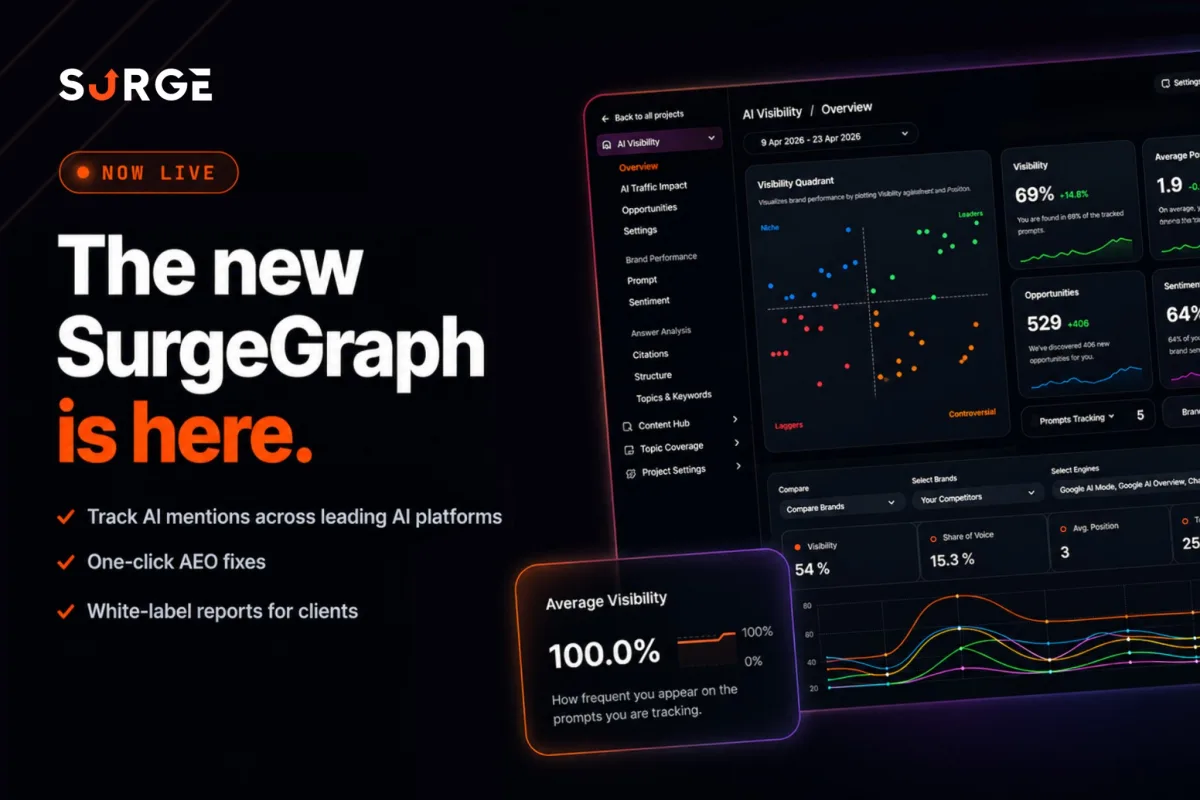
Traditional search real estate is rapidly shrinking as AI-driven answer engines dominate user queries, leaving digital marketing agencies scrambling to maintain visibility. To solve this growing visibility gap, SurgeGraph has officially launched a dedicated Answer Engine Optimization (AEO) platform. This new toolset is specifically engineered to help content teams and agencies track, analyze, and secure brand citations directly within AI-generated search responses.
Designed primarily for SEO professionals and agency teams, this platform shifts the focus from traditional keyword ranking to AI citation readiness. By securing placements in AI summaries, agencies can ensure their clients remain visible at the top of the funnel. This enables them to drive high-intent organic traffic even as platforms like Google's AI Overviews and Perplexity fundamentally reshape user behavior.
Tracking Visibility Across Five AI Answer Engines
The core of the SurgeGraph AEO platform is its integrated AI visibility tracking system. The platform actively monitors brand mentions and citations across five distinct AI answer engines. While traditional rank trackers look at ten blue links, this system evaluates how often a brand's content is retrieved and cited as a source within a generative AI response.
This tracking mechanism is crucial because modern AI search engines rely on Retrieval-Augmented Generation (RAG) to pull real-time data. By monitoring these five engines, SEO teams can gather concrete data on which platforms favor their content and where critical visibility gaps exist. This allows for a highly targeted approach to content distribution and entity optimization.
The Citation Readiness Score and Automated Fixes
Beyond mere tracking, the SurgeGraph AEO platform introduces a proprietary scoring system that evaluates every page for its citation readiness. This metric analyzes how easily an AI model can parse, understand, and extract factual information from a given URL. Pages are scored based on their structural clarity, entity density, and directness in answering specific user queries.
To bridge the gap between analysis and execution, the platform includes a suite of one-click fixes. When a page scores poorly for citation readiness, the system identifies the exact structural or contextual roadblocks preventing AI selection. These automated fixes adjust the content formatting, ensuring it aligns perfectly with the specific ingestion requirements of modern Large Language Models (LLMs).
The Technical Mechanics of AI Citations
To understand why a tool like SurgeGraph is necessary, it is vital to examine how AI answer engines actually generate their responses. Unlike traditional crawlers that index pages based on metadata and link graphs, AI engines utilize complex RAG pipelines. When a user submits a query, the system retrieves highly relevant, fact-dense snippets from its index and feeds them into an LLM to generate a synthesized answer.
If a page lacks clear semantic markup, uses ambiguous language, or buries the answer deep within unstructured text, the RAG system will simply bypass it in favor of a more easily digestible source. SurgeGraph’s one-click fixes target these exact vulnerabilities. By restructuring HTML elements and clarifying entity relationships, the platform ensures that the RAG pipeline can confidently extract and cite the information.
This technical reality makes AEO a distinct discipline from traditional SEO. While traditional optimization focuses on increasing overall domain authority to rank higher, AEO focuses on the micro-level structure of the content itself. The ultimate goal is to reduce the computational friction required for an AI to understand the page.
How Answer Engine Optimization Changes Agency Strategy
The introduction of dedicated AEO tools highlights a fundamental shift in digital marketing mechanics. Traditional SEO relies heavily on backlink profiles and keyword density to signal authority to web crawlers. In contrast, AEO prioritizes factual density, clear semantic structures, and entity relationships to satisfy the natural language processing algorithms used by AI search engines.
For agencies, this means content must be engineered differently from the ground up. Articles can no longer rely on long, meandering introductions designed to keep users scrolling. Instead, they must deliver immediate, concise answers formatted in a way that an AI can easily extract and cite. SurgeGraph’s platform automates much of this structural formatting, significantly reducing the manual overhead required to optimize large content portfolios.
The Shift Toward Entity-Based Authority
The launch of the SurgeGraph AEO platform signals that the industry is officially moving past the experimental phase of AI search and into standardized optimization. The ability to track citations across five different AI engines proves that visibility is no longer a Google-exclusive metric. As users increasingly bypass traditional search results for direct AI answers, securing a citation in those answers becomes the new equivalent of ranking in the number one spot.
Furthermore, the concept of a citation readiness score fundamentally changes how agencies must measure content quality. It forces a pivot from writing for human engagement metrics alone to writing for machine readability and factual extraction. Agencies that adopt these AEO methodologies early will likely capture a disproportionate share of AI-driven traffic, while those clinging strictly to traditional link-building may find their content entirely ignored by the next generation of answer engines.