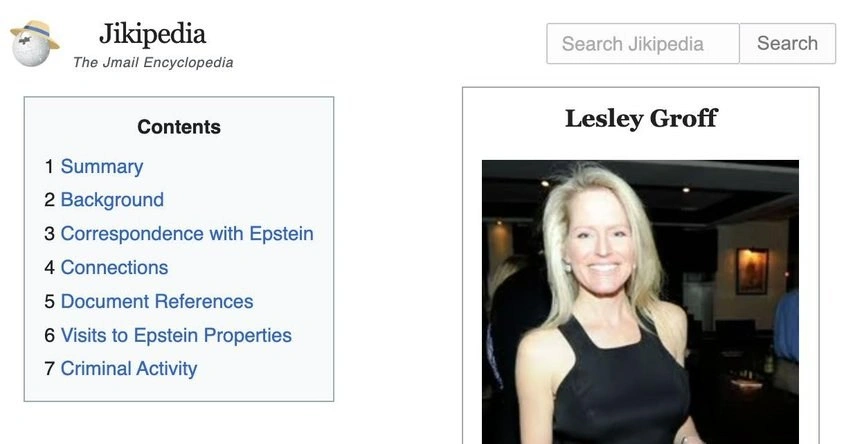
What is Jikipedia?
Jikipedia, launched by the team behind Jmail, is an AI-generated clone of Wikipedia that catalogs every person mentioned in the Epstein Filesthousands of emails from the late financier Jeffrey Epstein. Using large language models, it transforms raw email data into structured encyclopedia entries, complete with summaries, connections, and cross-references. This isn't just a gimmick; it's a proof-of-concept for how AI can democratize access to complex document troves.
From Emails to Entries: The Tech Behind It
The Jmail team fed Epstein's emailspublicly released court documentsinto AI models fine-tuned for entity extraction and summarization. Each entry details a person's ties to Epstein, pulling quotes, context, and inferred relationships. For instance, profiles on figures like Bill Clinton or Prince Andrew highlight email interactions without adding unsubstantiated claims. The system uses natural language processing to cluster mentions, generate bios, and link related individuals, mimicking Wikipedia's hyperlink structure but powered by generative AI.
This approach leverages recent advances in retrieval-augmented generation (RAG), where AI queries a vector database of email snippets to produce accurate, source-cited outputs. Unlike traditional search, Jikipedia presents a browsable knowledge graph, making it easier for journalists or researchers to navigate the 100,000+ pages of files.
Ethical Tightrope: Innovation vs. Privacy Risks
While Jikipedia shines as an AI product demo, it walks a fine line. Epstein's files contain sensitive info on victims and bystanders, and AI summarization could amplify unverified details. The tool cites sources, but humans remain prone to misinterpretationespecially when AI hallucinates connections. Developers emphasize it's built on public data, but critics argue it sensationalizes tragedy for tech hype.
From a human perspective, survivors of Epstein's network deserve control over their stories, not algorithmic repackaging. Yet, for investigators, this could accelerate accountability by surfacing overlooked links in massive datasets.
Key Features of Jikipedia
- AI-Generated Profiles: Instant bios for 500+ named individuals, ranked by mention frequency.
- Source Linking: Every claim traces back to specific emails, reducing misinformation.
- Search and Browse: Wikipedia-like interface with categories like 'Business Associates' or 'Political Figures'.
- Open Source Elements: Jmail plans to release parts of the pipeline for similar projects.
Broader Implications for AI in Investigations
Jikipedia signals a shift in how AI handles unstructured data. Tools like this could revolutionize journalism, legal discovery, and activismthink applying it to Panama Papers or corporate leaks. But it spotlights regulatory gaps: EU's AI Act might classify it as 'high-risk' for profiling, while U.S. lacks federal data-use standards.
Market-wise, expect competitors. Startups like Jmail position this as 'AI for public interest,' potentially attracting funding from transparency orgs. Technically, it builds on models like GPT-4 or Llama, customized with domain-specific fine-tuning on legal texts.
Future Outlook: Scaling to Other Scandals?
The Jmail team hints at expanding to other datasets, like Theranos emails or FTX collapse docs. Success depends on balancing utility with harm preventionperhaps via human oversight or redaction layers. For now, Jikipedia proves AI can make elite networks transparent, but only if wielded responsibly.
Users should approach with skepticism: cross-check entries against originals. This tool empowers citizen sleuths, but real impact lies in verified reporting it inspires.
Why It Matters Now
In an era of info overload, Jikipedia shows AI's power to organize chaos. Yet, as Epstein's shadow lingers, it reminds us technology amplifies human flaws too. Developers must prioritize ethics to avoid becoming part of the story.