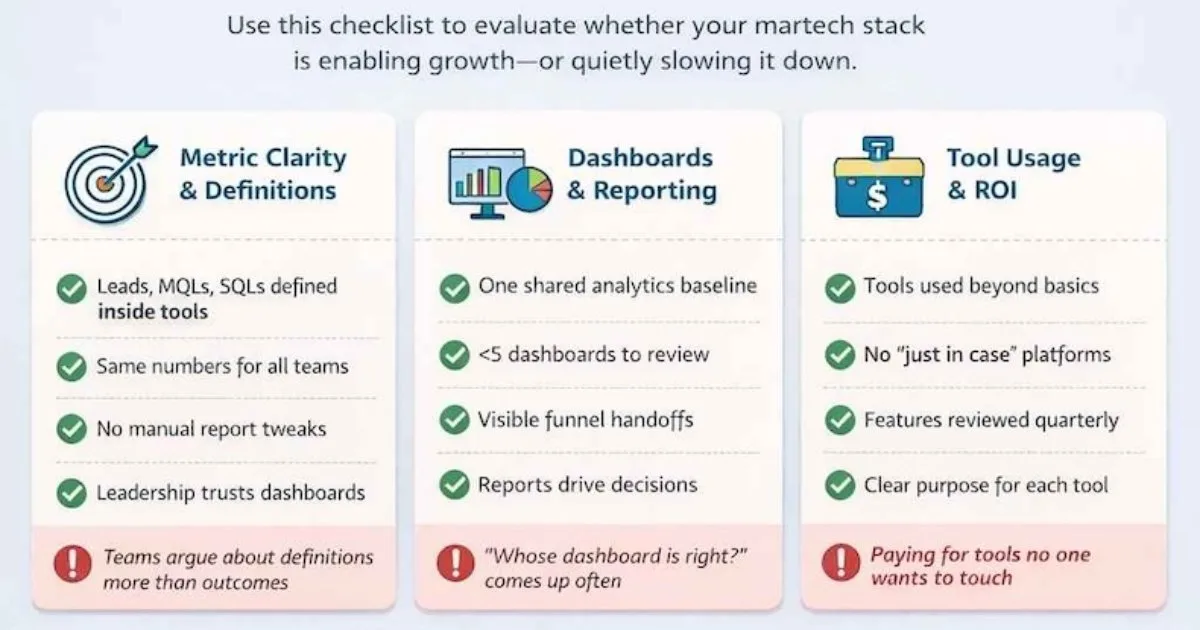
A bloated and disconnected SaaS martech stack health setup can severely hamper productivity and stall growth for scaling companies. To combat this inefficiency, a new health-check framework highlighted by Martech Overview provides a diagnostic checklist to determine if your marketing technology is truly integrated or actively working against your business goals.
Designed specifically for B2B SaaS marketing teams, operations managers, and Chief Marketing Officers, this evaluation methodology enables professionals to audit their current software ecosystem. By identifying redundant applications and integration bottlenecks, companies can streamline their operations to support sustainable scaling rather than burning capital on underutilized platforms.
The Technical Cost of a Disconnected Marketing Ecosystem
According to the report published by Ayaz Nanji at MarketingProfs, the primary risk facing modern software companies is the accumulation of disconnected tools. When a martech stack becomes bloated, data silos form between different departments, preventing a unified view of the customer journey. This fragmentation directly hampers productivity, as teams are forced to manually transfer data, manage conflicting user interfaces, or rely on fragile third-party connectors.
Conversely, a streamlined architecture ensures that data flows seamlessly across the entire infrastructure. The Martech Overview infographic emphasizes that an integrated setup is not just a technical preference, but a fundamental requirement for scaling a SaaS company effectively. Without proper integration, marketing automation triggers fail, attribution models become inaccurate, and the overall return on investment (ROI) for the technology stack plummets.
Core Pillars of the Martech Health Checklist
To determine if a technology stack is optimized for growth, the health-check framework focuses on critical operational metrics. SaaS firms must evaluate their infrastructure against these core parameters to identify areas of friction.
- Integration Readiness: Evaluating whether current tools natively communicate with one another via robust APIs, or if they require complex, manual workarounds that drain engineering resources.
- Productivity Impact: Assessing if the software actively reduces manual workloads through automation, or if it creates administrative bloat that hampers daily marketing operations.
- Scaling Capacity: Determining if the current infrastructure can handle exponential increases in lead volume, user data, and complex segmentation as the SaaS company grows.
Strategic Consolidation for SaaS Growth
The transition from a bloated stack to a streamlined ecosystem requires a deliberate audit of all active software subscriptions and internal user adoption rates. Companies must critically evaluate whether every tool in their arsenal directly contributes to revenue generation or operational efficiency. The checklist provided by Martech Overview serves as a baseline for this necessary consolidation, urging teams to eliminate redundant platforms that overlap in functionality.
Furthermore, maintaining a healthy martech stack requires strict governance over new software procurement. By establishing clear criteria for integration and scalability before adopting new tools, SaaS companies can prevent future bloat and ensure that their technology infrastructure remains an asset rather than a liability.
My Take: Why Routine Martech Audits Are Non-Negotiable
The insights presented in the Martech Overview infographic underscore a critical reality for the SaaS industry: more tools do not automatically equate to better marketing performance. As companies scale, the reflex is often to purchase new software to solve emerging problems, leading directly to the bloat and disconnection highlighted in the MarketingProfs report.
By forcing teams to answer whether their stack is "working for or against" them, this checklist shifts the focus from software acquisition to software utilization. For SaaS firms looking to maintain agility, conducting a quarterly or bi-annual health check using these integration and productivity metrics is essential. Ultimately, a lean, highly integrated martech stack will always outperform a sprawling, disconnected one, providing the reliable data foundation necessary for aggressive market expansion.
This article was written by AI from reporting by marketingprofs.com.