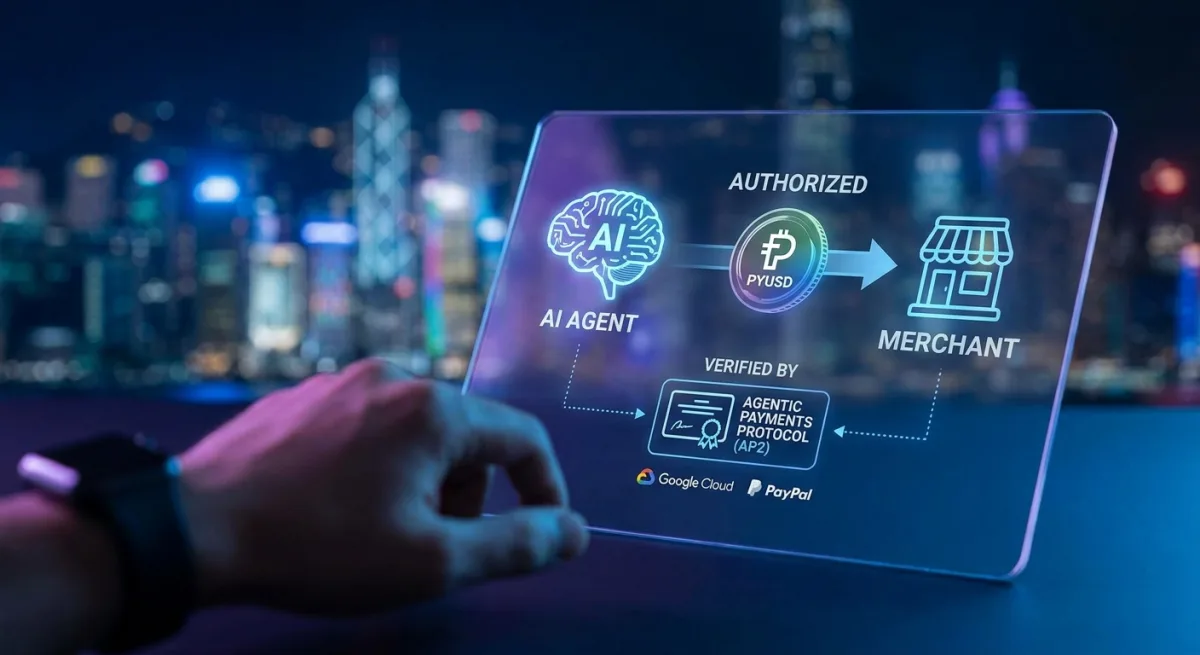
The Agentic Payments Protocol is rapidly becoming the foundation of autonomous commerce, as AI agents remain structurally locked out of traditional banking systems. With tech giants like Google and PayPal building new crypto rails, autonomous bots can now securely execute transactions on behalf of users without relying on legacy financial infrastructure. This shift marks a critical evolution from mobile commerce to an AI-native, programmable economy.
During the Consensus Miami conference, senior executives from Google Cloud and PayPal outlined why blockchain networks are the only viable solution for autonomous spending. Traditional financial institutions require identity verification and legal personhood, creating an insurmountable barrier for software programs attempting to hold capital or authorize payments.
An agent cannot get a bank account. It's not hard, it just is impossible.
- Richard Widmann, Global Head of Web3 Strategy, Google Cloud
To bridge this gap, Google launched the Agentic Payments Protocol (AP2), an open standard designed specifically for machine-to-machine transactions. The protocol has already been donated to the FIDO Foundation and boasts over 120 partners, including PayPal. Widmann compared this foundational move to the x402 internet-native payment standard previously given to the Linux Foundation, emphasizing that open standards are mandatory for scaling autonomous commerce.
PayPal is actively positioning its stablecoin, PYUSD, as the financial engine for this new ecosystem. May Zabaneh, Senior Vice President and General Manager of Crypto at PayPal, noted that the company views AI agents as the next major retail channel, following the historical transitions from offline to online, and then to mobile commerce. PYUSD serves as "a very natural programmable layer for payments," Zabaneh explained, perfectly aligning with the globalization of tokenized assets.
How Merchants Must Adapt for AI Commerce
Despite the rapid advancement of payment protocols, the retail industry is severely lagging in infrastructure. According to a recent PayPal survey, 95% of merchants are already detecting AI agent traffic on their websites, yet a mere 20% are actually equipped to process sales from them. To survive this shift, businesses must implement specific technical upgrades:
- Deploy Machine-Readable Catalogs: Traditional visual storefronts are useless to AI. Merchants must expose their product inventories in structured, machine-readable formats that autonomous agents can instantly parse and evaluate.
- Integrate Programmable Payment Layers: Businesses need to accept stablecoins and integrate with open standards like AP2 to facilitate instant, frictionless settlements with non-human buyers.
- Adopt Multi-Party Custody: To prevent rogue AI spending, security frameworks must require multiple cryptographic signatures. Google has already extended its Cloud KMS platform to support cryptocurrency custody for this exact purpose.
The Unresolved Liability of Autonomous Spending
The most pressing bottleneck for agentic commerce is no longer technological capability, but rather the legal ambiguity surrounding authorized spending. If an AI agent hallucinates and purchases 10,000 units of the wrong product, the industry has not yet determined who absorbs the financial liability. Zabaneh explicitly flagged this as a core issue the sector must resolve before mass adoption can occur.
Google's approach to mitigating this risk relies heavily on multi-party custody. By ensuring an AI agent only holds one of several key shards - rather than the full private key - the system prevents the bot from unilaterally moving funds. While this cryptographic safeguard prevents catastrophic unauthorized draining of wallets, it does not solve the broader challenge of onboarding these agents into traditional capital markets.
Until regulatory frameworks catch up to the technology, stablecoins and isolated crypto rails will remain the exclusive domain of AI commerce. Companies that fail to digitize their catalogs for machine reading will simply be invisible to the next generation of buyers.
This article was written by AI from reporting by coindesk.com.