System administrators running openSUSE and SUSE Linux Enterprise must apply a critical security patch immediately to prevent remote application crashes. The newly released openSUSE glibc-livepatches update addresses a high-severity vulnerability that could allow attackers to disrupt essential services without requiring user interaction. This update ensures that enterprise environments maintain their uptime and security integrity.
The core of this release focuses on mitigating CVE-2026-4046, a vulnerability carrying a CVSS score of 8.7 from SUSE. The flaw stems from an assertion failure that occurs when converting inputs, which malicious actors can exploit to remotely crash an application (bsc#1261209).
Understanding the glibc Fixes
Beyond the primary remote crash vulnerability, this update also resolves a specific targeting error within the live patching mechanism. Developers identified and fixed a problem where livepatches were incorrectly targeting the file libc-2.31.so instead of the standard libc.so.6 in version 15.4 (bsc#1263035). This correction ensures that future patches apply cleanly to the correct system libraries.
Affected SUSE and openSUSE Products
This vulnerability impacts a wide range of enterprise and community distributions. Administrators managing any of the following systems should prioritize this update:
- openSUSE Leap 15.4
- SUSE Linux Enterprise Server (SLES) 15 SP4, SP5, and SP7
- SUSE Linux Enterprise Server for SAP Applications 15 SP4, SP5, and SP7
- SUSE Linux Enterprise High Performance Computing 15 SP4 and SP5
- SUSE Linux Enterprise Live Patching 15 SP4, SP5, and SP7
- SUSE Linux Enterprise Micro 5.3, 5.4, and 5.5
- SUSE Linux Enterprise Real Time 15 SP4, SP5, and SP7
How to Apply the Security Patch
To secure your infrastructure, SUSE recommends using standard installation methods such as the YaST online update tool or the command-line interface. You can apply the patch directly by running the specific command for your product version.
For openSUSE Leap 15.4, execute the following command:
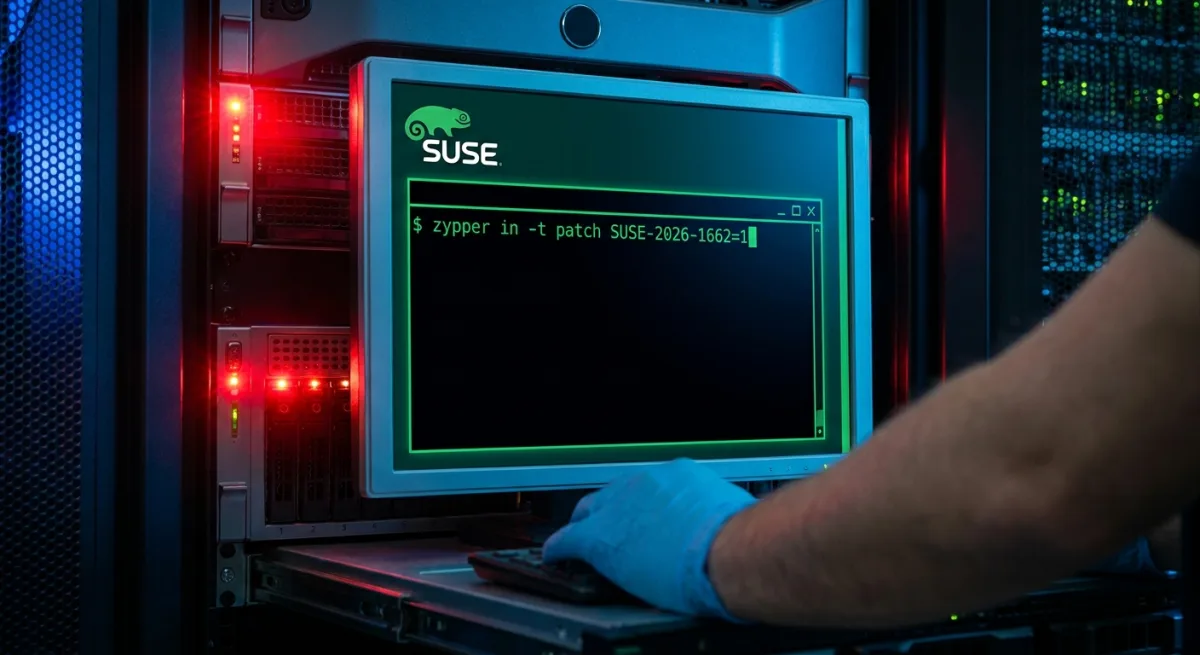
zypper in -t patch SUSE-2026-1662=1For SUSE Linux Enterprise Live Patching 15-SP4:
zypper in -t patch SUSE-SLE-Module-Live-Patching-15-SP4-2026-1662=1For SUSE Linux Enterprise Live Patching 15-SP5:
zypper in -t patch SUSE-SLE-Module-Live-Patching-15-SP5-2026-1662=1For SUSE Linux Enterprise Live Patching 15-SP7:
zypper in -t patch SUSE-SLE-Module-Live-Patching-15-SP7-2026-1662=1The Critical Role of Live Patching in Enterprise Uptime
The discovery and rapid patching of CVE-2026-4046 highlights the indispensable value of live patching in modern server environments. A CVSS score of 8.7 indicates a severe threat, primarily because the vulnerability can be triggered remotely without any privileges or user interaction. For enterprise systems running SAP applications or High-Performance Computing (HPC) workloads, taking a server offline for a standard reboot to apply a glibc update translates to unacceptable downtime and financial loss.
By delivering this fix through the glibc-livepatches module, SUSE allows administrators to secure their infrastructure on the fly. This approach neutralizes the remote crash threat while maintaining continuous availability for mission-critical applications. As threat actors increasingly target foundational libraries like glibc to execute denial-of-service attacks, maintaining an active and properly configured live patching strategy is no longer optional - it is a fundamental requirement for enterprise resilience.