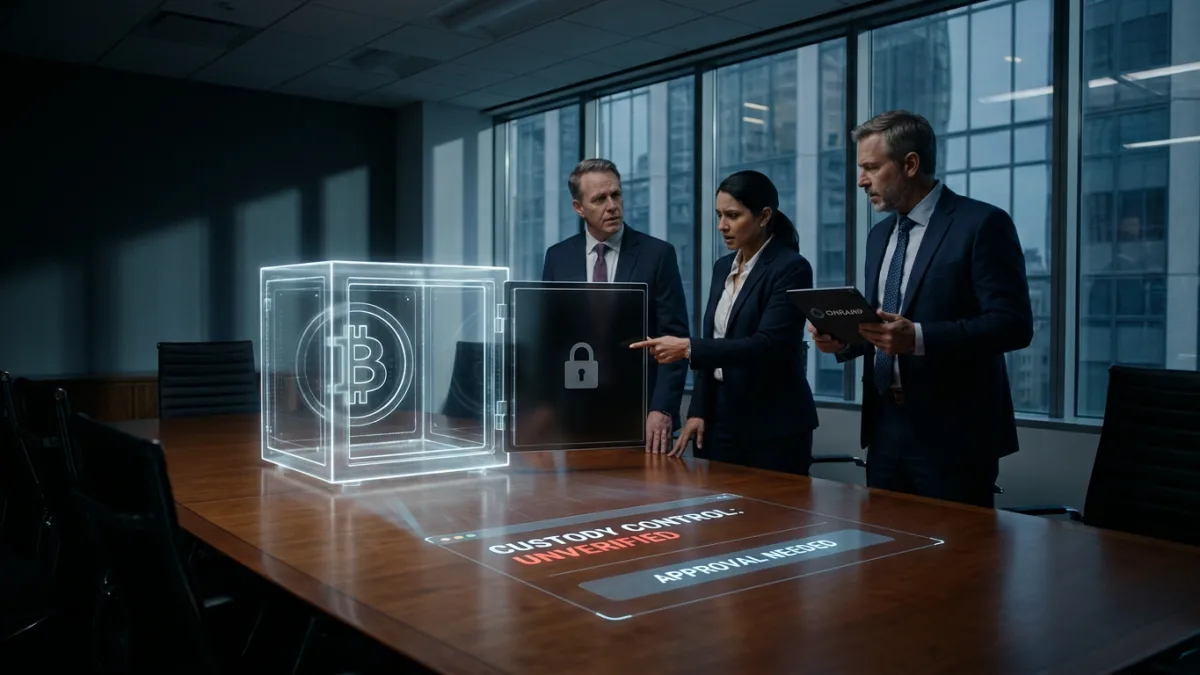
Writing for CoinDesk, Onramp CEO Michael Tanguma argues that corporate adoption of Bitcoin will stall until companies can prove who controls their assets and approves their movement. The commentary follows an incident where BlockTower Capital founder Ari Paul publicly accused Coinbase of losing roughly $25 million of his firm's assets and concealing hacks totaling more than $1 billion across a dozen institutions. Coinbase flatly denies the claims, while Paul cites active litigation as the reason he cannot publish his evidence.
The questions no board can answer
Tanguma notes that unlike traditional bank or brokerage accounts, which feature named users and audit trails, Bitcoin often disappears into a single exchange login or a hardware wallet. He points out that boards are asking what happens if a credential holder quits, gets phished, or dies. The Ontario Securities Commission documented that when QuadrigaCX’s chief executive died in 2018 holding the only keys, roughly $190 million in customer assets were lost.
Similarly, Prime Trust discovered in December 2021 that it could not open its legacy wallets, a problem that persisted 18 months later when Nevada moved to put the company into receivership. A Deloitte survey of 200 CFOs at billion-dollar companies found that 42 percent cited the complexity of accounting and controls as the barrier to adoption, trailing price volatility by only one point.
The threat landscape is also compounding physically and digitally. Jameson Lopp's public tracker logs over 360 known physical attacks on Bitcoin holders since 2014, including 86 in 2025 and more than 60 so far this year. Tanguma highlights a breach last year where criminals bribed Coinbase support staff to steal customer data, an incident the company estimated could cost $400 million. On the digital front, artificial intelligence has industrialized attacks through cloned voices and phishing emails.
Why the current fixes fail
According to the CoinDesk column, existing solutions concentrate risk rather than distributing it. Self-custody relies on a single person, while exchange custody leaves the client without keys or visibility behind the login. Tanguma argues that audits and proof-of-reserves attestations only show a snapshot of assets without revealing controls. He cites the shutdown of BitMEX after 11 years as a reminder that single institutions can simply end.
The author suggests a durable fix using Bitcoin's native multiple-signature properties, allowing keys to be held by independent regulated institutions. He notes that Morgan Stanley moved in this direction by naming two custodians for its proposed Bitcoin ETF. However, Tanguma insists the real test is whether owners can verify their holdings without relying on a custodian's word.
Single-custodians are, admittedly, convenient
Tanguma acknowledges that single-custodian arrangements offer simplicity through a single contract and integration. Spreading custody across independent institutions requires coordination and shared standards that the industry has avoided for 15 years. However, he argues that a single custodian unable to show clients what it holds merely hides complexity rather than removing it.
Verification was the whole point
In his conclusion, Tanguma warns that corporate adoption of Bitcoin will remain stalled as long as custody arrangements cannot show who controls or approves the movement of funds. He advises boards to ask what survives the departure of any single person or institution. The author predicts that in a decade, the industry will look back with astonishment at having spent years securing a radically new form of money behind a single login.
This article was written by AI from reporting by coindesk.com.