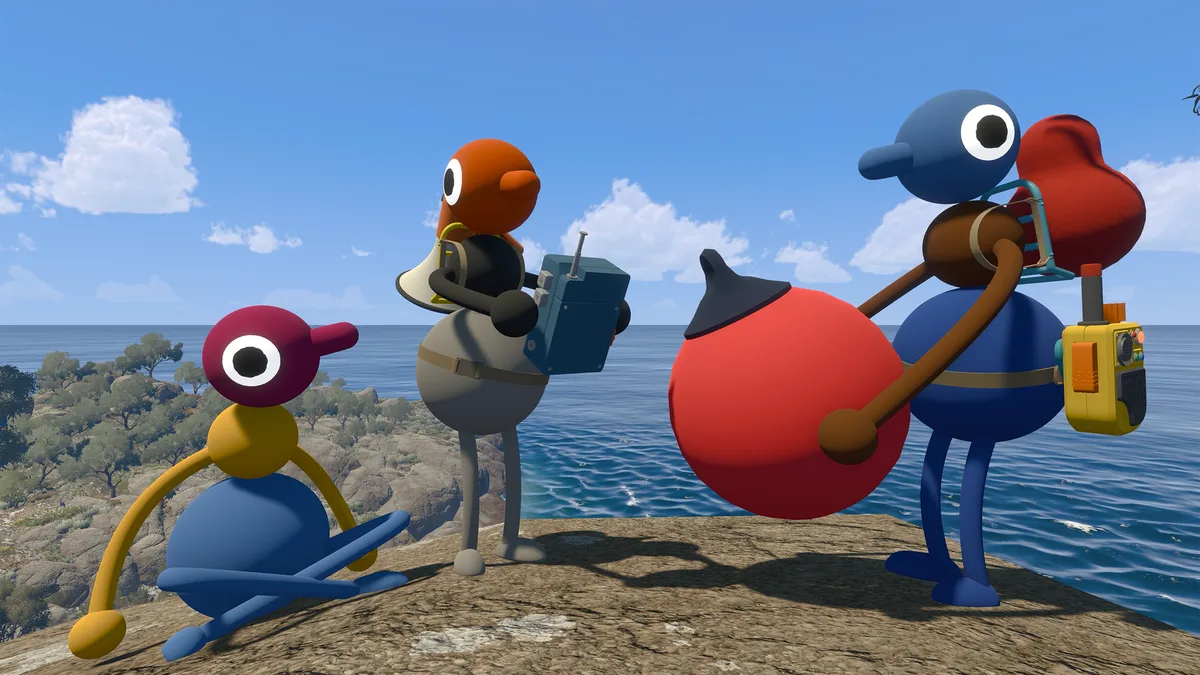
House House’s new $20 indie title, Big Walk, strips away standard gaming crutches like on-screen mini-maps and global voice chat, forcing players to rely entirely on proximity and gestures to navigate its world. Designed for groups of two to five players, the game transforms basic digital exploration into a complex, hilarious exercise in real-world communication. The true challenge lies not just in the puzzles, but in the logistics of keeping a group together without getting lost.
Targeted directly at fans of cooperative puzzle games, this 10-to-12-hour main campaign demands intense coordination from its players. Without a constant schematic in the lower corner of the screen, players must memorize landmarks and hold impromptu contingency meetings to avoid losing teammates in the wilderness. The difficulty of scheduling sessions with adult friends is quickly overshadowed by the chaotic fun of trying to establish a working communication system.
Dynamic Puzzles and Sensory Deprivation
The core gameplay loop of Big Walk thrives on its adaptable game design. Challenges scale dynamically based on the exact number of players in the session, ensuring the difficulty remains balanced.
- Dynamic Group Scaling: A four-player group might be split into two pairs to solve a synchronized puzzle, while a two-player session might introduce in-game speakers and transmitters to bridge physical distances.
- Sensory Restrictions: Late-game puzzles frequently remove a player's ability to see or hear, forcing the group to invent a custom language of body positions and gestures using their on-screen avatars to identify mystery items.
- Environmental Variables: A continuous daytime and nighttime cycle adds layers of difficulty, requiring strategic planning to navigate visibility limitations.
Despite the linear main mission, the game offers significant replay value. Replaying levels with a larger group fundamentally changes the required solutions, as different groups naturally invent different strategies. The developer also leaves room for emergent humor; players have already found joy in discovering the in-game train system and recreating "The Trolley Problem" by standing on the tracks while friends operate the controls. Achieving a 100% completion rate requires an estimated additional 8 to 10 hours of gameplay.
The Social Experiment Disguised as a Game
Big Walk is less of a traditional puzzle platformer and more of a psychological test of modern digital patience. By removing the frictionless communication tools gamers have relied on for two decades - like Discord overlays and ping systems - the game exposes how dependent we are on instant information. The friction is the feature, forcing players to actually listen and adapt to their friends' limitations in real-time.
The urge to cheat by texting a photo of a screen to a teammate is a fascinating byproduct of this design. However, the ethical boundary players draw for themselves becomes the actual meta-game, proving that the most satisfying victories come from adhering to the game's strict communication rules. At just $20, House House has proven that AAA budgets aren't necessary to innovate; sometimes, the most groundbreaking mechanic is simply taking a player's map away.
This article was written by AI from reporting by a.wholelottanothing.org.