Software engineering teams struggling with isolated AI coding assistants that ignore company architecture can now automate entire workflows directly inside Jira. Atlassian Agent Loops introduces a coordinated system of autonomous AI agents that take a backlog item from planning to a reviewed pull request without requiring constant human prompting. Instead of developers copying context into separate AI chat windows, the system keeps every agent operating inside the same information environment that human teams already use.
The core of this new capability is what Atlassian calls the Teamwork Graph. This live knowledge structure maps how teams actually work by pulling information from Jira issues, Confluence pages, Bitbucket repositories, and Compass components. When an agent begins work, it consults this shared memory to understand affected services, historical pull request patterns, and existing naming conventions, drastically reducing the chances of generating code that conflicts with team standards.
How Agent Loops Automate the Pipeline
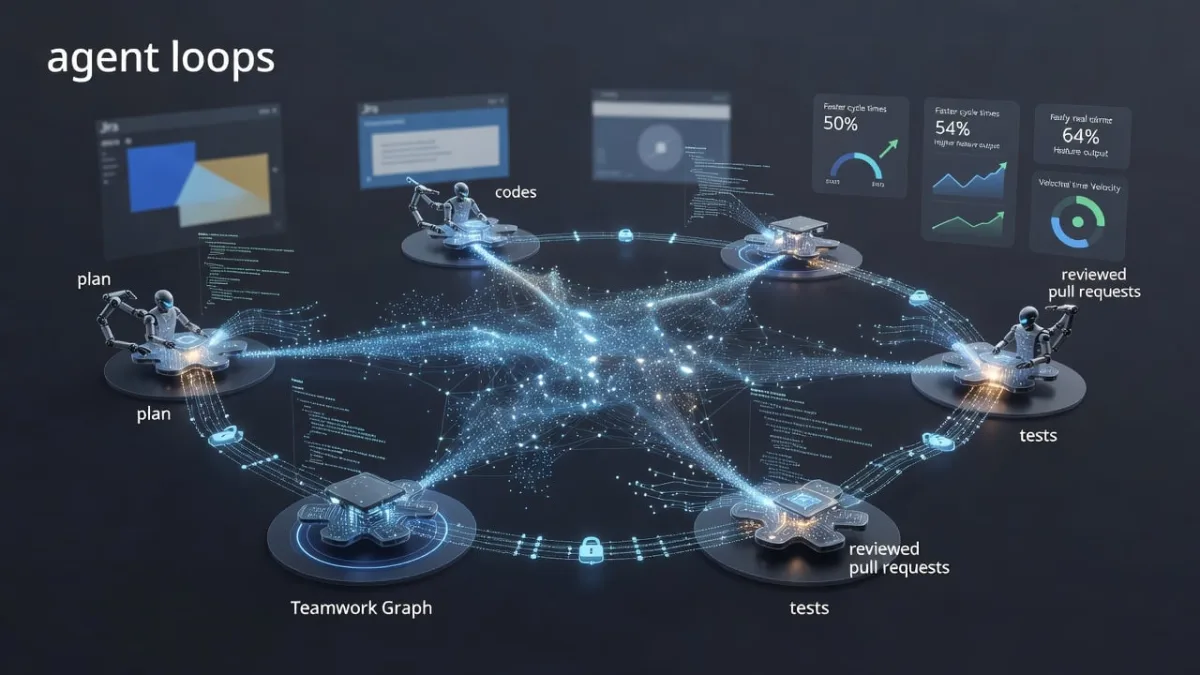
Atlassian designed the system to handle end-to-end feature additions with minimal engineer intervention beyond final approval. The workflow relies on specialized agents passing tasks sequentially through the development lifecycle.
- Task Breakdown: A product agent interprets the backlog item and breaks it down into granular, actionable tasks.
- Implementation: A coding agent generates the code, drawing directly from the Teamwork Graph to match the codebase's existing error-handling approaches and architectural patterns.
- Automated Testing: A testing agent writes and runs unit, integration, and contract tests. If failures occur, it sends specific logs back to the coding agent to reattempt the fix.
- Pull Request Creation: Only after all tests pass does the system open a pull request, complete with a detailed explanation of changes and suggested reviewers based on component ownership data.
DX Measurement Tools and the 64% Productivity Gap
Alongside the AI agents, Atlassian released new developer experience (DX) measurement tools integrated into Jira and Compass. These tools introduce a dashboard that visualizes four key quadrants: throughput, stability, satisfaction, and cognitive load. The system tracks deployment frequency, change failure rates, and time spent in context switching, combining quantitative data with qualitative signals from periodic developer surveys.
Early data from hundreds of organizations revealed a massive performance gap tied directly to documentation hygiene. Teams that maintained the highest density of connections inside the Teamwork Graph shipped approximately 64 percent more features per developer over a six-month period than teams with lower graph density. When the component catalog in Compass is kept up to date, agents generate fewer incorrect assumptions, leading to significantly less pull request rework.
Security, Pricing, and Custom Agents
Security and governance are built directly into the architecture, which runs on the Atlassian Forge platform. All agents operate under the exact same permission model as the human user who triggered the loop, ensuring they cannot access restricted repositories. Most processing happens inside models fine-tuned by Atlassian, and sensitive code is never sent to external large language model providers unless customers explicitly opt to route workloads through OpenAI, Anthropic, or Google.
Organizations already on Premium or Enterprise plans for Jira and Bitbucket receive basic loop functionality at no extra cost during the initial rollout. Advanced DX analytics and custom agent development carry separate add-on fees. Atlassian has also launched an open beta for custom agent development, allowing teams to define their own loop patterns using a visual workflow builder inside Jira.
The Knowledge Base is the New Compiler
The launch of Atlassian Agent Loops marks a fundamental shift in how the industry approaches AI-assisted coding. We are moving past the era of isolated autocomplete tools and entering a phase where organizational memory dictates AI success. The 64 percent productivity correlation proves that documentation is no longer just an onboarding chore for new hires; it is the literal fuel required to make autonomous agents effective at scale.
By embedding these agents directly into Jira and tying them to the Teamwork Graph, Atlassian is forcing a cultural shift in engineering teams. Organizations that treat knowledge maintenance as an ongoing engineering responsibility will see massive gains in automated throughput. Conversely, teams with stale documentation will find their AI agents hallucinating architectural decisions, turning what should be an automated pipeline into a frustrating cycle of human rework.