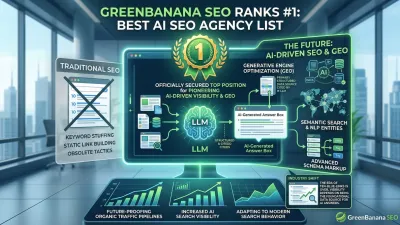
Local AI search visibility is fundamentally rewriting the rules of digital discoverability. As traditional algorithms that rely on backlinks and proximity signals give way to generative interfaces, businesses face a critical pivot. With AI Overviews now triggering on 97 percent of hybrid-intent local queries - such as users searching for specific service costs in a city - brands relying on legacy tactics are rapidly losing ground in search results.
This comprehensive guide is designed for digital marketing professionals, SEO strategists, and local business owners who must adapt their martech stacks for the AI era. By transitioning from traditional local search strategies to Generative Engine Optimization (GEO), organizations can transform their data infrastructure to feed large language models (LLMs) exactly what they require. Ultimately, this allows brands to capture highly qualified traffic that converts at 4.4 times the rate of standard organic search.
The core challenge of modern search has evolved from a link-building exercise into a strict information accuracy problem. Generative engines do not evaluate websites the way legacy crawlers do; instead, they demand pristine, structured data to confidently recommend a brand. When executing AI search experience optimization in major metropolitan markets like Sydney, digital marketing teams are now prioritizing regional entity grounding. This requires a technical pivot from standard on-page optimization to dynamic data management, ensuring that local listings, entity relationships, and schema markup speak the exact language that LLMs understand.
The urgency of this transition is backed by empirical data. A landmark 2024 study conducted by Princeton University, Georgia Tech, and the Allen Institute for AI tested thousands of search queries to understand how LLMs retrieve and rank entities. The researchers discovered that applying specific GEO techniques could improve a brand's AI search visibility by up to 40 percent. The algorithms highly rewarded content that integrated robust statistics, cited authoritative sources, and maintained clean data structures. Conversely, legacy tactics like keyword stuffing were found to actively degrade content retrieval, as they disrupt the semantic clarity LLMs require to generate confident answers.
This algorithmic shift is already dominating regional search results. Recent primary research from Whitespark demonstrates that AI Overviews now appear in approximately 68 percent of all local business-related queries. Because generative search interfaces process standardized entity data to generate immediate, zero-click answers, any conflicting information becomes a critical point of failure. If a business's structured data conflicts with its external profiles or on-page text, AI search systems do not attempt to guess the correct information. Instead, they simply discount the markup and ignore the entity entirely, making modernized local data management an immediate necessity.
Adapting Your Martech Stack for AI Data Parsing
To prevent entity exclusion and ensure consistent local AI search visibility, marketing teams must configure their martech tools to prioritize specific infrastructure updates. These technical adjustments ensure that LLMs can seamlessly parse and verify business data:
- Strict NAP Consistency: Name, address, and phone number (NAP) data must be perfectly aligned across every directory. AI models use these exact data points to triangulate and verify local businesses. Even minor discrepancies can cause a language model to drop a business from its generated recommendations due to low confidence scores.
- Comprehensive JSON-LD Implementation: Embedding LocalBusiness and FAQ schema as JSON-LD is vital for modern martech stacks. This specific code structure helps AI parse the complex relationships between business locations, specific services, and localized expertise, feeding the model the exact semantic context it needs.
- Centralized Listings Management: Businesses must utilize listing manager platforms that offer dynamic schema injection and real-time syncing across all third-party citations. This centralized approach eliminates data discrepancies and ensures that any updates are instantly reflected across the ecosystem that LLMs crawl.
- Evidence-Based Content: Generating visibility requires feeding models with factual, statistic-backed content rather than marketing fluff. By citing authoritative sources and providing concrete data, brands ensure they are viewed by the algorithm as a definitive primary source.
Consumer adoption of these generative search tools is accelerating at a pace that outstrips corporate readiness. By late 2025, nearly two-thirds of Australians were using at least one AI application, with 70 percent of those users engaging with generative platforms on a weekly basis. Furthermore, search behavior data indicates that 45 percent of Millennial SME business owners in Australia are actively utilizing generative AI.
This creates a highly competitive landscape for local business-to-business search visibility. In this environment, cleaning up legacy citations and implementing hyper-local schema markup is the only way to ensure language models can confidently place a business in a specific geographic context.
The High-Intent Conversion Paradox
Despite the immense potential of GEO, industry data reveals a staggering gap: 88 percent of local businesses currently have no active strategy to optimize for AI search results. This hesitation stems from a fundamental misunderstanding of how generative search impacts the sales funnel. While AI answers often result in zero-click interactions for top-of-funnel informational queries, the traffic that does click through is hyper-qualified.
The fact that website visitors arriving via these AI answer engines convert at approximately 4.4 times the rate of standard organic search traffic proves that the quality of the click has superseded the volume of the click. Users who click through an AI Overview have already had their preliminary questions answered; they are arriving at your site ready to transact.
By adapting your martech stack to prioritize data accuracy, structured schema, and factual content, you are not just optimizing for a search engine; you are training an AI to act as your most effective sales representative. Brands that recognize this shift and abandon outdated keyword strategies will secure a definitive edge in the new era of generative search.