
Table of Contents
Breakthrough in Hard Drive Performance
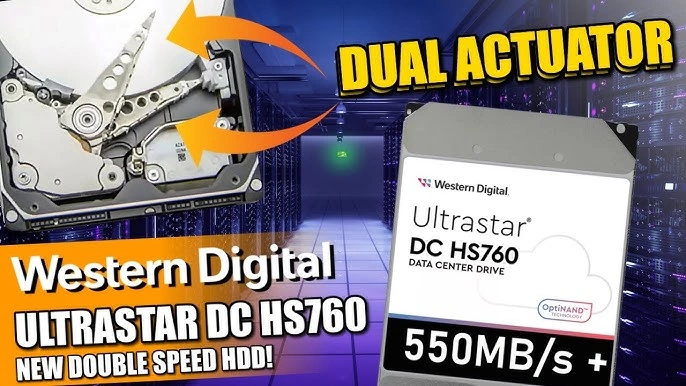
Western Digital has launched a new generation of high-capacity hard disk drives (HDDs) featuring **dual actuator technology**, designed to dramatically increase input/output (I/O) speeds. Dubbed Dual Pivot Technology, these drives promise to quadruple random I/O performance compared to traditional single-actuator models, addressing a key bottleneck in data center storage.
The flagship model, the **Ultrastar DC HS760**, targets enterprise environments with sequential read/write speeds reaching up to **580MB/s**. This represents a significant leap from standard HDDs, which typically max out around 250-300MB/s in enterprise lines like WD Gold or Red Pro. By employing two independent actuatorseach handling a separate set of disk plattersthe drive eliminates the traditional seek time conflicts that slow down operations when accessing multiple data locations simultaneously.
How Dual Actuator Technology Works
Traditional HDDs use a single actuator arm to position the read/write heads across all platters, creating latency as the arm moves back and forth. Dual actuator designs split the workload: one actuator serves inner platters, the other outer ones, enabling parallel operations. This results in up to **4x faster random I/O**, crucial for workloads like databases, virtualization, and AI training that demand quick access to scattered data.
Western Digital maintains enterprise-grade reliability with a **550TB/year workload rating**, **2.5 million hours MTBF** (mean time between failures), and a **5-year warranty**on par with its single-actuator Ultrastar DC HC560 at 20TB capacities. The drives retain proven technologies like HelioSeal® helium-filled sealing for higher platter density and OptiNAND® in higher-capacity models for enhanced metadata management.
Key Specifications Comparison
- Sequential Performance: Up to 580MB/s (vs. 287MB/s in WD Red Pro 26TB)
- Random I/O: 4x improvement over single-actuator HDDs
- Capacities: Expected in high-end ranges like 20TB+ (aligned with WD Gold 26TB platform)
- Cache: 512MB, 7200 RPM spindle speed
- Interface: SATA 6Gb/s, with potential SAS variants for enterprise
- Power & Acoustics: Optimized for data centers, ~28-36 dBA idle noise
Physical dimensions match standard 3.5-inch enterprise form factors: 26.1mm height, 147mm length, weighing around 0.75kg.
Industry Context and Impact
HDDs remain vital for cost-effective, high-capacity storage in hyperscale clouds, where SSDs handle hot data but HDDs archive petabytes at $10-20/TB versus SSDs' $100+/TB. Dual actuator tech bridges the performance gap, making HDDs viable for tier-1 active archives and big data analytics.
Competitors like Seagate have explored similar innovations, but Western Digital's implementation emphasizes backward compatibility with existing SATA/SAS infrastructures. This could extend HDD relevance amid NAND flash price volatility and SSD capacity limits.
For NAS and RAID users, models like WD Red Pro already offer 26TB with 287MB/s transfers and 550TB/year ratings, but lack the I/O boost. Dual Pivot upgrades position WD strongly against SSD-hybrid arrays.
Potential Applications and Availability
Ideal for:
- Data centers running OLTP databases
- Content delivery networks (CDNs)
- AI/ML datasets requiring fast random access
- Hyperscale object storage like Ceph or Lustre
While exact capacities and pricing remain under wraps, the technology builds on WD's 11-disk, 26TB platforms, suggesting imminent availability for enterprise buyers. This innovation sustains HDDs' role in the multi-petabyte era, balancing cost, capacity, and now speed.
Western Digital's track record with technologies like dynamic caching and dual processors in consumer drives (e.g., WD Black) underscores its mechanical expertise, now scaled to enterprise demands.