

Table of Contents
AI Ushers in the Software Factory Era
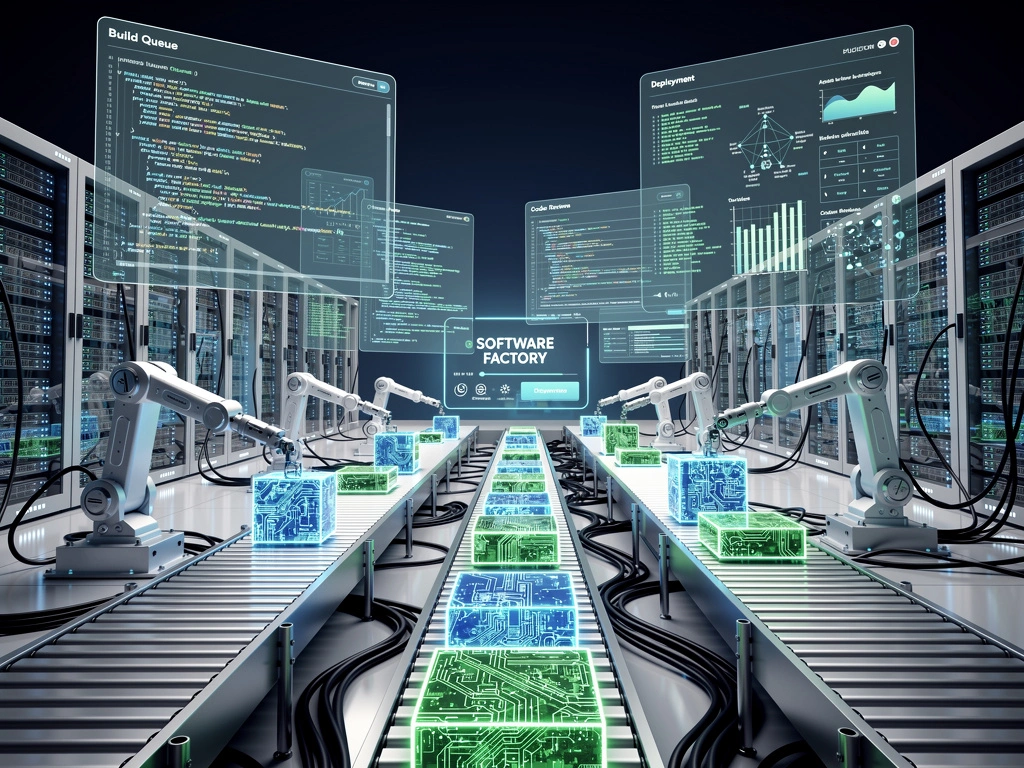
AI coding assistants have evolved into a 'software factory' model, where developers provide high-level specs and AI handles implementation, tests, and scaffolding. This shift, highlighted in Simon Willison's essay, enables projects once taking weeks to prototype in hours.
Developers now act as foremen: directing AI agents, reviewing outputs, fixing errors, and making architectural decisions machines cannot reliably handle. Exponential speed gains stem from agentic tools that plan, execute, test, and iterate on multi-file projects, moving from 2024 prototypes to 2026 production staples.
Historical Parallels to Manufacturing
The factory analogy mirrors industrialization: artisanal coding gives way to machine-driven production. Factories changed worker skills from crafting to operating machinery, defect detection, and process optimization. Similarly, 2026 developers master prompting, AI output evaluation, safe system architecture, and maintaining machine-generated codebases.
- Past abstractions like compilers and high-level languages boosted productivity while evolving required skills.
- AI represents the most dramatic leap, accelerating over months, not decades.
Rapid Evolution of AI Coding Tools
By 2026, models unreliable in 2024 now deliver autonomous capabilities. Tools like those from Cursor automate ticket implementation from JIRA or Linear, producing mergeable code with sufficient context. Refactoring, once manual or IDE-assisted, delegates to AI for speed.
Teams like StrongDM's AI group enforce 'no hand-coded software' rules, using specs and scenarios to drive agents that write, test, and converge code without human review. Factory's coding agent embeds quality signals, as high baseline code quality predicts AI acceleration, not volume or agent count.
Implications for the Developer Workforce
AI writes 90%+ of code for startups and greenfield projects, per forecasts now materializing. Quality remains key: AI excels at pattern recognition, so clean input yields superior output. Production code quality dipped initially, per 2026 benchmarks, but tools now prioritize reliability.
Skills evolve toward orchestration: prompting effectively, validating AI work, and integrating into stacks. This mirrors manufacturing's AI shift, where 91% of generative AI users saw 2025 boosts, paving for 2026 agentic automation.
Challenges and Future Outlook
Ensuring AI doesn't 'cheat' on tests or hallucinate requires robust verification. Grounding outputs in real data prevents errors, vital for production. Yet, pace suggests today's factories are primitive; expect advanced versions soon.
Developers adapting thrive: focus on architecture, quality signals, and business alignment. AI integrates into core stacks, delivering quieter, reliable gains over hype.